
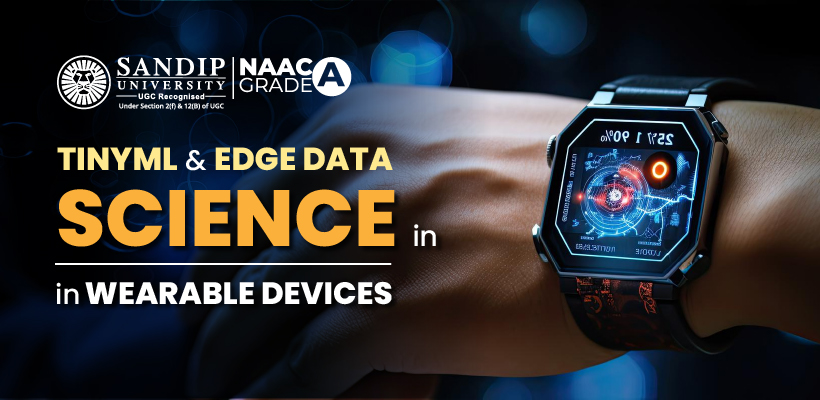
With the rise of the Internet of Things (IoT) and artificial intelligence over the years, data collection and processing has evolved significantly. A few of the key advancements within this realm have been Tiny Machine Learning (TinyML) which allows machine learning models to run on a microcontroller or embedded system. TinyML enables intelligent data processing on devices instead of in the cloud, along with edge data science. Particularly for wearable devices, real-time data analysis, energy efficiency and privacy are taking on great importance in this realm. Many top machine learning colleges in Nashik offer diverse programs in AI, ML, and data science to drive further research and innovation in this field.
For example, wearable devices (smartwatches, fitness trackers and medical monitoring systems) continuously generate a large volume of sensor data. Traditionally, this data was sent to cloud-based servers for analysis. While this might have better accuracy, it is often higher latency with increased bandwidth consumption and privacy concerns. TinyML can solve these problems allowing machine learning models to operate straight on wearable hardware, which is certainly quicker and affordable.
Understanding TinyML
TinyML in general refers to deploying machine learning algorithms on end devices with constraints of little memory and processing power as well as its energy resources. Such devices are microcontrollers, embedded processors and lowpower IoT nodes. TinyML models are small and efficient, making them suitable to run on such devices with limited computational power.
TinyML models are compressed and optimised techniques like model quantisation, pruning, or efficient neural representations unlike classical machine learning algorithms which use highly capable GPUs with large memory. Its optimisations enable for machine learning operations such as classification, anomaly detection, and pattern recognition to be performed on just a few kilobytes of memory in tiny devices.
Role of Edge Data Science
Edge Data Science Edge data science is performing analysing and machine learning computations at the edge of the network, near the point where the data is being created. In wearable electronics, this translates into processing sensor data on the unit instead of sending it to centralise cloud servers.
This approach provides several advantages. First, it helps minimise latency because data doesn’t have to be transported across networks for analysis.
Data science at the edge also improves privacy and security. Wearable devices are generally used to gather sensitive personal health data like heart rate, sleep patterns or physical activity. TinyML mitigates the risk of data exposure in-route by processing this information on-device, and sensitive information never leaves the device.
Applications of TinyML in Wearable Devices
At the same time, TinyML enables entirely new categories of intelligent wearables to monitor health and activity nonstop. Health monitoring is one of the most utilised applications
Activity recognition is another key application. Wearable devices have motion sensors like accelerometers and gyroscopes that create streams of bulk movement data. These algorithms can detect physical activities such as walking, running, cycling, and sleeping based on the data analysis. This function enables accurate physical exercise monitoring and activity recommendations to be offered by wearable technology.
Medical applications of TinyML are also gaining steam with the advent of wearable devices. For instance, wearable electrocardiogram (ECG) monitors can leverage TinyML models to identify abnormal heart rhythms and possible cardiac issues. Just as fall detection systems for seniors can detect sudden movements associated with falling and send emergency alerts.
Advantages of TinyML in Wearables
TinyML has multiple advantages making it a perfect fit for wearable technology. One of the great advantages is low power draw. Because security problems and queries are handled locally, without cloud processing, they need to be sufficiently efficient since the wearable devices run on small batteries.
Enhances data privacy and security and less sensitive information to be sent over the internet as most of the data processing takes place on device. This minimises data breach risks and still ensures that personal health data is protected.
Challenges in TinyML Implementation
To achieve this goal, developers design machine learning models and train them to high compression guidelines to meet the hardware limits of wearable devices while still providing good accuracy.
Wearable devices may have different processors, sensors, and operating systems requiring tailored approaches for instance model deployment.
Future of TinyML in Wearable Technology
Wearable technology has an extremely bright future for TinyML. Hardware design improvements coupled with optimised neural network structures and model optimisation methods allow deploying more complex machine learning features on small devices.
In the next few years wearable devices will become smarter and more autonomous. It will enable constant health tracking, instant disease diagnosis and customised healthcare services. Wearable devices, for instance, may soon be able to identify things like cardiovascular diseases, diabetes, or neural disorders at their earliest stage using real-time analysis of physiological patterns.
It will enable smart healthcare ecosystems where wearables communicate with medical systems and health providers for prevention-based medicines as well as personalised medical needs, leading to TinyML.
Conclusion
Asserting intelligence on small, constrained edge devices is blowing up! TinyML and edge data science run methods on wearables. TinyML is supporting the next generation of smart wearable technologies by lowering latency, improving privacy and making real-time insights possible. A B.E. Artificial Intelligence and Data Science program is the qualification to make your career ambitions in this field come true. While some challenges around hardware limitations and model optimisation persist, recently conducted research is consistently pushing the boundaries on what makes TinyML possible. It will keep advancing wearable healthcare, fitness tracking, and personalised health monitoring in the future.