
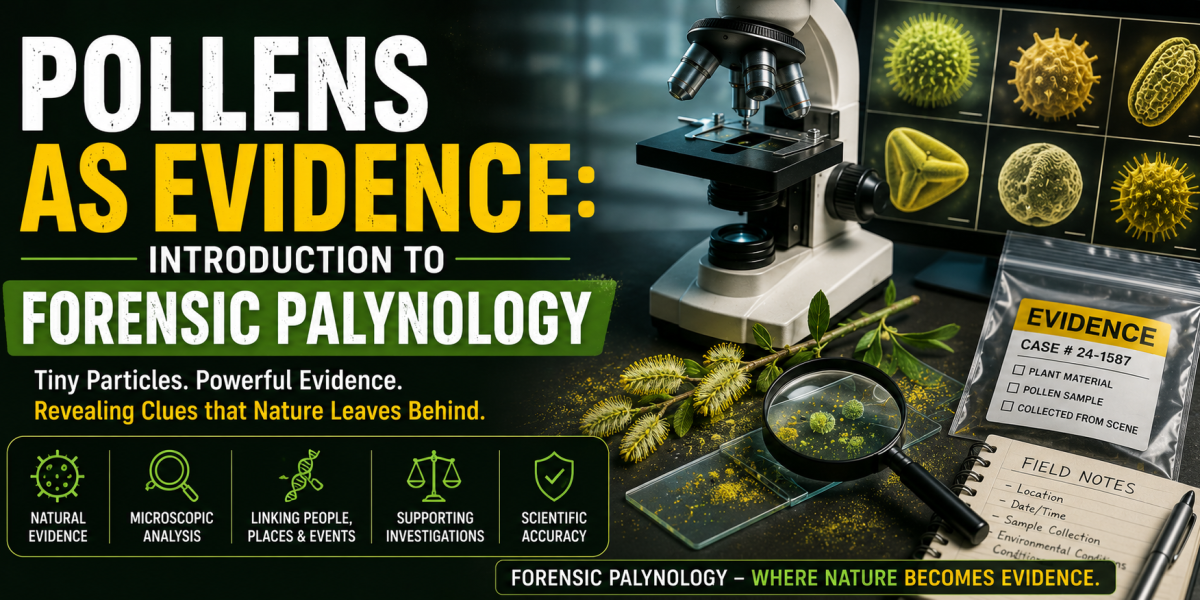
Pollen, despite being ignored except during its active and allergy-causing period, plays an important role in forensics. Pollen helps in determining where the suspect may have been present and in what season that particular incident took place. Moreover, due to their ability to stick to skin, hair, shoes, and clothes, pollen can be used as supporting evidence. Studying pollen is a crucial part of the curriculum in top forensic science colleges in Nashik.
Even the source of a dead body or object as it travelled through its ecosystem. This is a form of forensic palynology, and in addition to murder-mystery clues, it has been used to catch criminals from drug mules to art thieves. Here we are trying to explore the what, how, and where of computer vision in rather more detail along with its tools and a ground case: everything sums up to where the field is going next.
What is Forensic Palynology?
Palynology is the scientific study of pollen grains and spores and other palynomorphs. Forensics is just a part of it, however, for any study to be useful for the legal and criminal side of things. Pollen is produced by flowering plants, while spores are produced by ferns, fungi, and mosses. All are unspeakably tiny, 7 and 200 micrometres, respectively, and invisible to the human eye. One of the important facts about pollen is its coating, the exine, and that this is made up of sporopollenin. Some can survive extreme temperatures, high-level chemicals, or even thousands of years under several kilometres of Earth.
Due to the fact that each plant species creates its own form, size, and surface texture of pollen grains, you end up with your very own natural pollen ‘signature’ in every zone: a pollen print.
History and Evolution of Forensic Palynology
The use of pollen as an investigation tool in practical cases dates back to 1916, when the Swedish scientist Lennart von Post first proposed such an idea. However, the employment of pollen in criminal investigations occurred much later, since the first verified case took place only in 1959 in Austria, when mud on the boots of a suspect contained a unique piece of very old pollen that matched only one location at the riverbank, thus forcing the man to confess to a murder.
At about the same time, in Sweden there was another case when pollen found in the soil of a murdered woman’s clothing did not correspond to any soil samples near the place of the corpse discovery, indicating that the woman was killed somewhere else. In fact, for many years thereafter, the analysis of pollen remained a rare practice known to only a few specialists. Starting from the 1990s, the field became an accepted practice, especially in the UK, Australia, and New Zealand.
Scientific Instruments and Techniques Used
The collection of pollen from a crime scene is an involved procedure. Soil and dust samples are taken by investigators, and clothes, footwear, hair, and vehicle interior surfaces are vacuumed in order to collect any pollen particles on them. Samples collected are then
subjected to chemical treatment in a sterile laboratory environment in order to eliminate all impurities apart from pollen because even the slightest amount of foreign material could spoil the evidence.
Pollen grains are then analysed under a microscope. The most popular type of analysis is light microscopy, allowing researchers to study the structure and surface ornamentation of each particle. More detailed analysis can be done using scanning electron microscopy. Some labs also use DNA sequencing for greater precision. The palynologist then compares samples against control samples from the area to confirm a match.
Importance of Pollen Evidence in Criminal Investigations
It is the silent evidence of forensic palynology, which ties up all the loose ends of a crime. Not only does it establish the link between the suspect and the crime scene, but it also establishes the authenticity of where the body was found. It tells us if the body has been transported to another place or not. Forensic palynology also plays an important role in establishing the origin of the stolen artifacts, contraband drugs, and antiques because pollen present in them indicates their journey.
Moreover, depending on the time when the plants shed pollen, we can deduce the time period in which the crime was committed. The presence of pollen grains gives us an indication of a link, but their absence does not negate it either.
Real-Life Case Study of Forensic Palynology
In 1979, the body of a juvenile female was found in upstate New York, while the remains were found in a corn field. It took several decades for the case to be solved, but eventually it was opened again in 2006. The ash pollen, along with pollen from spruce and birch, was found on the interior of her jacket; however, the presence of Casuarina pollen was also noted, which is not commonly grown in the US except in parts of Florida and California.
Matching this combination against pollen maps pointed investigators toward Southern California as her likely home, reshaping the entire theory of where the girl had come from, even decades later.
Limitations and Challenges of the Field
Despite its potential, forensic palynology remains under-used, especially in the US and India. One challenge is the shortage of trained experts, since identifying pollen needs years of specialised botanical knowledge that few universities teach. Another constant source of concern is the contamination since even the tiniest amount of external pollen will lead to a spurious result. Crime scene samples are almost always tiny (often less than half a gram), so there is no room for error or retries. As the demand in different places is low.
Future Scope and Technological Advancements
Indeed, the future holds much promise, especially concerning newer technologies. The use of DNA identification and next-generation sequencing has enabled faster and more accurate identification of pollen sources compared to traditional microscopy. Automation of imagery
techniques are also underway to reduce the difficult task of manually matching thousands of grains.
In the UK and New Zealand, forensic palynology is widely applied in criminal investigations, an example that could be followed in other countries, including India, where forensic palynology is relatively new. With growing awareness and training, pollen evidence could emerge as one more technique in addition to fingerprints and DNA evidence.
Conclusion
Even though pollen is very small, it is often ignored. However, one pollen grain can contain important information about its place of origin as well as about materials with which it came into contact. Thus, the analysis of pollen grains conducted by forensic scientists holding an M.Sc in Forensic Science can become a useful instrument for solving murders that happened many years ago.
Pollen can also help identify drugs that were smuggled from thousands of miles. Forensic palynology is a field that shows us that tiny clues like pollen can be very important. Big discoveries are made using such a small thing as pollen. Forensic palynology uses pollen to help solve crimes. It is a very helpful science.