
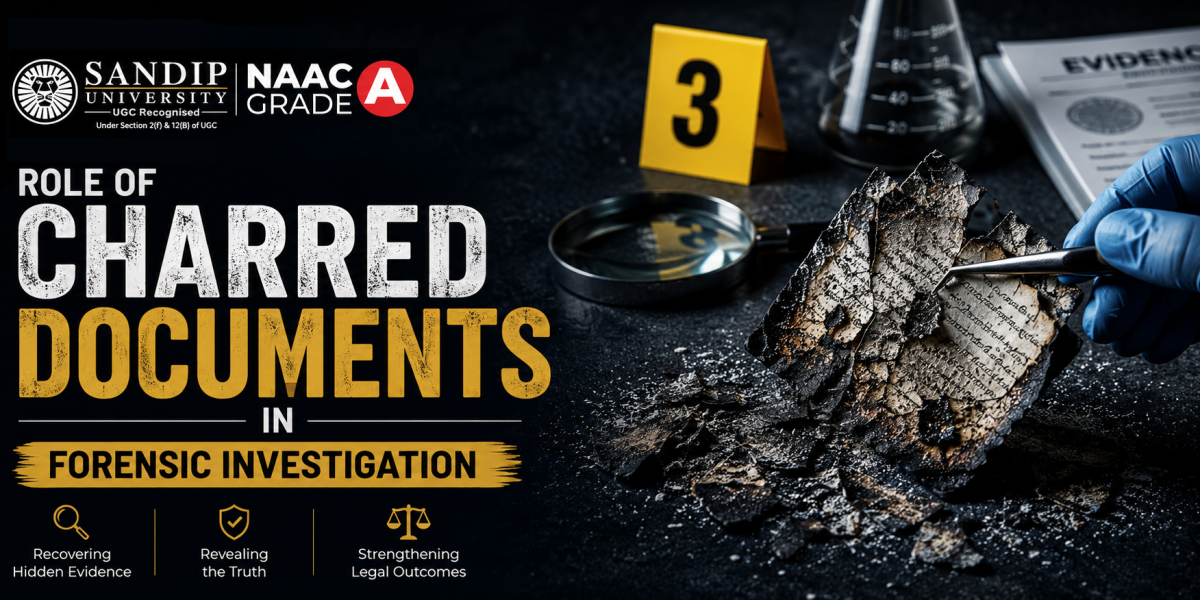
Fire destroys paper. Everyone knows that much. What most people don’t realise is that fire rarely destroys information completely and that gap between “burnt” and “gone forever” is where forensic document examiners do some of their most demanding work. Students learn about examining charred documents when pursuing a forensic science degree from one of the best forensic science colleges in Nashik.
Charred documents show up in investigations more often than people expect. Arson cases where someone tried to burn incriminating records. Insurance fraud where an “accidental” fire conveniently consumed the evidence of financial trouble. Homicide scenes where a will, a suicide note, or a threatening letter has been partially burned to hide intent. Even in cases of document destruction meant to obstruct an investigation, the wrongdoer’s mistake is almost always the same: they assume burning equals erasing. Forensic science has spent decades proving that assumption wrong.
Why Burnt Doesn’t Mean Unreadable
Paper chars rather than vaporises when it’s exposed to heat without full combustion. When paper gets burned the paper itself turns into a brittle thing it can even break easily but the writing on the paper can still be there even if we cannot see it. The reason for this is that the ink used for writing does not burn fast as the paper does. This is because the ink is made of things like carbon or special kinds of dye. The. The ink burns at different speeds and temperatures. This makes it possible to find the writing on the paper again even after the paper has become a black piece.
This is the entire premise behind charred document examination recovering legible content from material that looks, to an untrained eye, like it should be thrown away.
Techniques Used in Charred Document Examination
Infrared photography and imaging is usually the first line of attack. Since carbon-based inks absorb infrared radiation differently than the surrounding charred paper, IR imaging can reveal handwriting or print that’s completely invisible under normal light. This method is safe. Does not cause any damage making it a good first step, before trying anything that might be riskier. Oblique lighting is an inexpensive way that still works well in any lab.
By shining a light across the surface of the char at an angle examiner can see indentations and texture differences made by pen pressure even if the ink is no longer there.
Humidification and flattening deals with the physical problem before the informational one. Charred paper curls, cracks, and crumbles at the slightest touch. Controlled humidity chambers are used to slowly relax the fibres just enough that the sheet can be gently flattened between glass plates without disintegrating a step that has to happen before any imaging can even take place.
Chemical and reagent-assisted recovery is used more cautiously, since it can be destructive. Certain reagents can enhance contrast between inked and non-inked charred regions, but examiners weigh this against the risk of destroying the only surviving physical evidence.
Electrostatic Detection Apparatus (ESDA) comes into play when the goal isn’t the burnt sheet itself but rather indented writing on sheets that were underneath it useful when a full notepad has partially survived and investigators want to know what was written on pages torn off or burned.
Digital image enhancement is now a routine final step. Once IR or oblique-light images are captured, contrast stretching, multispectral overlays, and software-based enhancement can pull out characters that are barely perceptible even under IR alone.
Why This Matters Legally, Not Just Scientifically
Under Indian evidentiary standards, a document doesn’t need to be pristine to be admissible but it does need to be authenticated and its content reliably established. Section 45 of the Indian Evidence Act allows expert opinion on questioned documents, and case law has repeatedly accepted scientifically recovered content from damaged or destroyed documents, provided the methodology is sound and the chain of custody is intact. This is precisely why the recovery process matters as much as the recovery result. A poorly documented examination, however successful technically, can be challenged in court on procedural grounds alone.
This also has real bearing on NCRB recorded arson, fraud, and destruction of evidence cases, where charred material recovered at a scene is frequently the deciding factor between a case that collapses for lack of documentary proof and one that holds up.
Conclusion
None of this is glamorous work. It’s really slow. This happens when you zoom in and use lighting. If you handle it wrong a little too much it can get ruined. If you handle a document much or it gets too hot or wet it can be ruined and you will not be able to read it. This is the reason it’s very important. When professionals holding a B.Sc in Forensic Science are investigating something the document can make a difference. For example, it is different when you say “we think this letter was written” and when you say “we know what this letter said”. It often depends on how someone, in a lab that looks at documents, treats a burned piece of paper. They need to treat the burned paper carefully like they would treat a fingerprint or a drop of blood. Charred documents are not dead evidence. They are evidence that requires more patience to hear.