
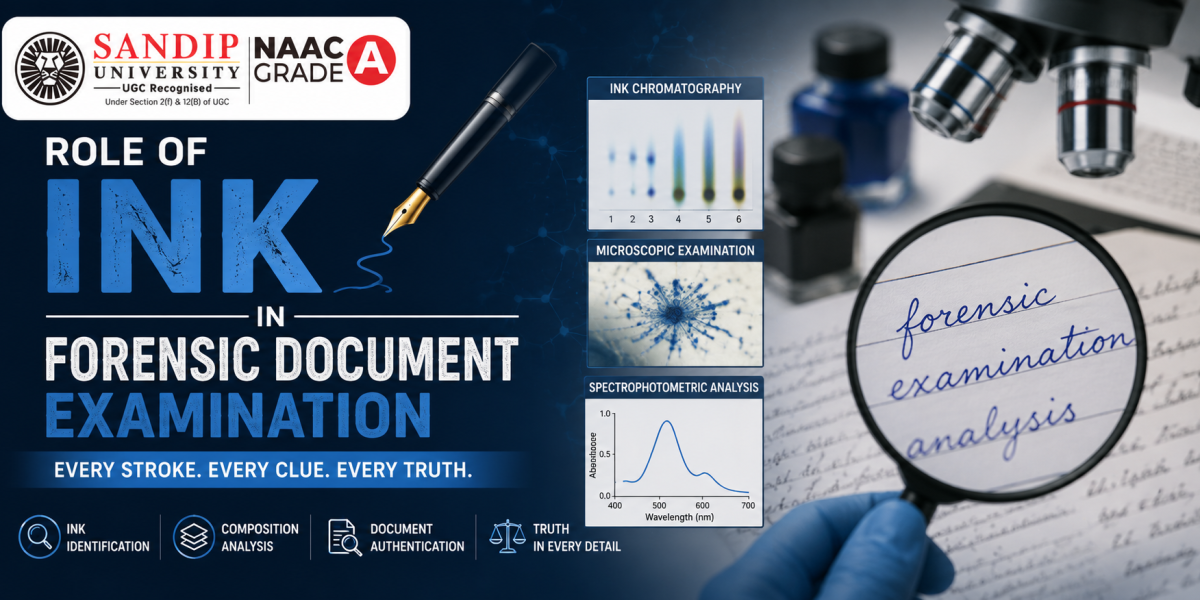
Take two pens that’re on your desk and use them to write the same word. The ink from these two pens probably looks the same to you. It is just black or blue. If you look at the ink in a special lab you will see that it is not the same. The two inks are made with things like different colors and different liquids and they have different helpers to make the ink stick.
Each pen company makes their ink in their own way and they do it in different years. This is what forensic ink examination uses to figure things out. It helps to answer questions in court like did someone really sign a paper when they said they did and was it really them who wrote it. Forensic ink examination is used to settle these questions. It does this by looking at the differences in the ink, from the two pens that you found on your desk. These skills are taught as a part of the curriculum at one of the top forensic colleges in Nashik.
What is Forensic Ink Examination?
Ink examination is a process that starts with something that seems easy which is finding out what type of ink was used. The thing is, types of ink like ballpoint, gel, fountain pen and felt-tip ink all act differently when they are put on paper. Even with ballpoint ink the way it is made can be very different from one brand to another and even from one batch to another. The people who examine ink usually start by using tools that do not damage the ink like a Video Spectral Comparator. This tool uses kinds of light to show differences that you cannot see with your eyes. For example two inks that look like the blue colour in the daylight can look very different under special lights like infrared or ultraviolet light. This can be enough to prove that a document was changed or that two signatures were not written with the ink, like the ink, from a fountain pen or a ballpoint pen.
Thin Layer Chromatography (TLC)
When we need to know more about something, the people who examine things use a method called thin-layer chromatography or TLC. They take a small sample of ink, sometimes it is as small as a pinpoint and they mix it with a liquid. Then they put this liquid on a plate and it moves across the plate. The different parts of the ink move at speeds. This makes a pattern that is like a fingerprint for that specific kind of ink. The companies that make ink change their recipes now and then. So this pattern can help us figure out when a pen was made. This is important when someone says a document was signed a time ago but it was really written recently. The thin-layer chromatography method is very helpful in these cases because it can show us the truth about the ink and the document.
This is the part where ink dating really gets interesting. Ink dating is one of the fascinating parts of the field. I think what makes ink dating so fascinating is the way it helps us learn more about ink dating itself. Certain solvent components in ink evaporate at a predictable rate after the ink is applied to paper. By measuring how much of these volatile components remain, examiners can estimate roughly how long ago the writing was done. It isn’t a perfect science, and conditions like storage, humidity, and paper type can all affect the results, but it has been reliable enough to expose backdated contracts, forged wills, and cheque fraud cases where someone tried to make a document appear older or newer than it really is.
Electrostatic Detection Apparatus (ESDA)
Indented writing adds another layer to this kind of investigation. When you tear a page out of a notepad the pen you used can still leave marks on the pages that’re underneath. These marks are really faint but there is a tool called Electrostatic Detection Apparatus or ESDA that can find them. ESDA can show you the writing that was on the page you threw away. Sometimes it can even show you sentences that were on a page that you ripped up and got rid of. Electrostatic Detection Apparatus is really good at this. It can help you see things that you thought were gone for good.
In the Indian legal context, this kind of evidence carries real weight. Section 45 of the Indian Evidence Act allows expert opinion on questioned documents to be presented in court, and ink analysis has played a decisive role in disputes involving forged wills, altered agreements, and fraudulent financial records under various sections of the IPC. Courts have increasingly relied on this kind of scientific backing precisely because it removes guesswork from what would otherwise be a battle of conflicting claims.
None of this happens quickly, and none of it works on assumption. A person who examines ink for a living has to look closely at every single sample. They have to think that this sample might be the key to solving the case. Because sometimes it really is. A signature can look totally real to you and me. When you compare the ink to a sample that you know is real it can look completely different. A document that seems normal can actually be the one thing that changes everything about a case. A forensic ink examiner holding a B.Sc in Forensic Science has to be very careful with every sample, like the signature or the document because the ink can be the thing that makes or breaks the case.
Every pen really does leave its own story behind. The job of forensic ink examination is simply learning how to read it.