
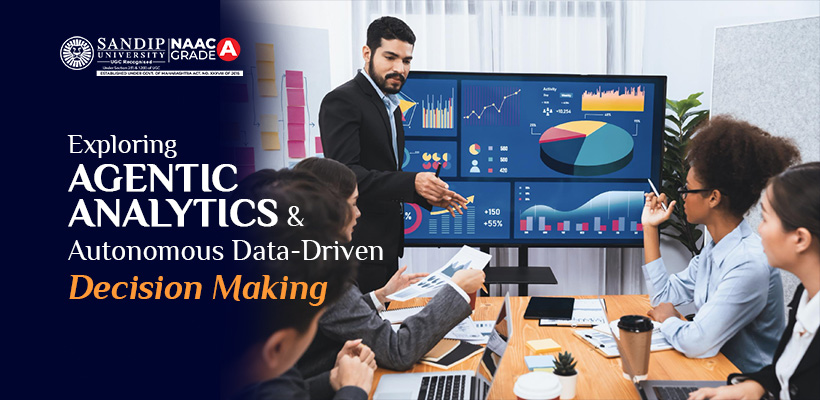
In today’s digital economy, organisations proliferate volumes of data each day, namely through business transactions, consumer interactions, financial systems and connected devices. Traditional analytics instruments help companies derive insights from such information, but these frequently need interpretation by human analysts to make decisions. The process is changing with a new concept for us to adopt, called Agentic Analytics, which adds smart AI agents that can self-analyse the data and make recommendations. Some of the top engineering colleges in Nashik include the study of agentic analytics to drive innovation in data-driven decision making.
Agentic Analytics involves the utilisation of artificial intelligence, machine learning, automation and data science to build systems which can conduct complex analytics tasks without requiring constant human involvement. These agents powered by AI can collect data, analyse patterns, generate reports, recommend decisions and even trigger automated responses. This methodology is the next step in the evolution of data analytics, where systems no longer serve only as basic reporting tools and instead deliver advanced intelligent decision-support systems.
Understanding Agentic Analytics
Agentic Analytics is the application of AI agents which independently execute analytical tasks. Unlike traditional analytics systems, which depend significantly on manual queries and dashboards to derive insight from data in a stepwise process, agentic systems automatically monitor data sources, detect trends or anomalies (which may indicate something worth investigating), and push insights to the user when they need them.
These AI can help in goal setting, big data analysis, and providing guidance based on predictive modelling and historical information.
Key Components of Agentic Analytics
There are several key technological building blocks of agentic analytics systems that allow for autonomous decision-making. They serve as intelligent agents that can accomplish tasks like monitoring data streams, generating insights and communicating findings to stakeholders.
Another Integration and Automation in Workflow Analysed results can result in the activation of agentic systems where actions are carried out automatically. This makes advanced analytics available even for non-technical users.
Automatic Report Generation
Automatic Report Generation One of the most powerful capabilities of agentic analytics is automatic report generation. Traditional reporting has analysts pulling data from multiple sources, prepping the visualisation and then interpreting results. The process can be lengthy, requiring a lot of time and effort from humans.
Reports can be auto generated on an ongoing basis by these systems from real-time data streams, when insights are converted to structured reports. Such reports can be in the form of KPIs, trend analysis, anomaly detection results, and predictive forecasts.
Business Decision Recommendations
Recommendation of Business Decisions Another key feature of agentic analytics is its ability to recommend business decisions. Rather than simply delivering data, AI agents analyse the findings and recommend actionable steps.
When common data patterns indicate potential outcomes, machine learning models analyse historical data. With this information in hand, the system can then recommend decisions that will be likely to drive improved business performance.
In supply chain management, for example, an agentic analytics system could identify potential inventory shortages based on demand forecasting models.
Intelligent Dashboards
Agentic analytics further improves the capabilities of traditional business intelligence tools by building intelligent dashboards. Traditional dashboards present static charts and graphs that users must interpret manually. On the other hand, intelligent dashboards not only create data analysis but also give context-based insights.
Dashboards can also flag anomalies, track developing trends, and explain unusual patterns. For example, a business dashboard would automatically highlight the issue of sudden drop in sales and identify its potential causes for you such as reduced website traffic, lack of supply or seasonal changes in consumer buying behaviour.
Challenges and Considerations
Agentic analytics is promising but also problematic. Trust and transparency is one of the foremost issues surrounded by this. Hence organisations must ensure explainability and interpretability of AI-generated recommendations for their decision-makers.
The data needs to be accurate and well-structured for AI agents to produce information that makes sense. Bad inputs can produce bad recommendations.
Future of Agentic Analytics
Agentic analytics will be a core component of the next generation business intelligence solutions. As artificial intelligence technologies grow, AI agents will be more intelligent and can perform complex analysis.
Eventually organisations might have end-to-end, fully autonomous analytics systems that constantly watch over business operations to detect opportunities or threats and then take corrective actions.
Finance, healthcare, retail, manufacturing as well as smart cities are the industries that will greatly benefit from this technology. This approach based on agentic analytics will help organisations go from reactive decision-making to proactive and predictive management.
Conclusion
In data science and business intelligence, agentic analytics, analysing data, generating reports, suggesting decisions, and presenting smart dashboards by the integration of artificial intelligence, machine learning and automation is empowering autonomous systems. But this technology is going to fundamentally change how organisations engage with data to make analytics faster, smarter, and much more accessible.
As a brave new world unfolds into a further complex future with AI driven solutions taken up by businesses across industries, agentic analytics will play its part in shaping how we program data-driven DECs ahead. Professionals with the right qualifications from one of the best engineering colleges in Maharashtra will be leading the tech revolution in this field in coming decades.