
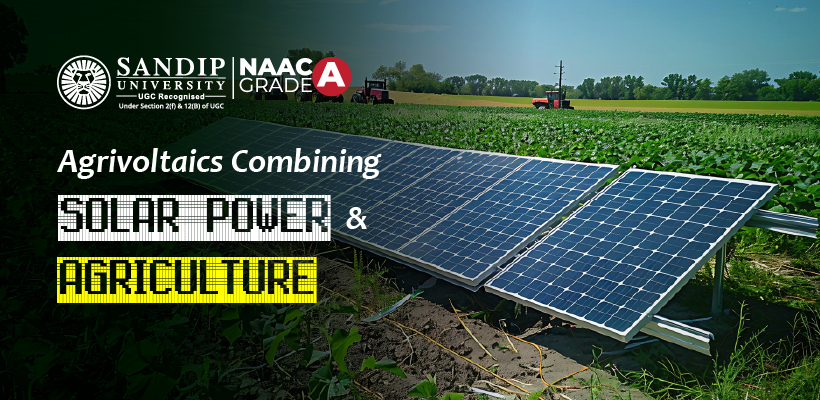
Day by day as the world’s demand for electricity rises rapidly and land used for farming gets reduced. In order to get balance, we required new solutions for food production and clean energy. Agrivoltaics is the upcoming concept which handles these challenges by collaborating between them by farming with generation of electricity on the same land. But, implementing this Agrivoltaics not uses the same land more efficiently but is beneficial for economic and environmental sustainability. Some of the top polytechnic colleges in Maharashtra are conducting research on how to integrate solar power into agriculture to boost agrivoltaics.
- Agrivoltaics uses panels which are placed above or alongside the crops. Which allows the farmers to grow food while generating electricity at same time.
- The solar farms used a large area of land for only generation of electricity. But Agrivoltaics systems are designed to ensure crops get sufficient sunlight, air and water.
- The panels are typically. Spaced so that farming activities like planting, irrigation and harvesting can continue underneath or between them
How Agrivoltaics Works
One of the advantages of agrivoltaics is that it uses land more efficiently. In countries like India, where land for farming is limited and there are people this system helps get the most out of each area. By choosing between farming or solar energy both can exist on the same land. Studies have shown that combining farming and solar energy can increase land productivity by up to 60–70% compared to using land for just one purpose. Another significant benefit is the impact on crops.
While it may seem that solar panels could block sunlight and reduce crop yield the partial shading provided by the panels can actually benefit crops. Crops like vegetables, tomatoes and some fruits do well in moderate shade especially in hot climates. To reduce the heat stress the panels help excessive evaporation leading to soil moisture retention.
The shade from panels reduces the rate of evaporation from the soil, helping retain moisture for a longer period. Additionally, rainwater runoff from the panels can be. Directed toward crops improving water management efficiency. This makes agrivoltaics systems particularly useful in arid and semi-arid regions. From a perspective agrivoltaics provides farmers with an additional source of income.
By generating electricity farmers can. Use the power for their own needs, such as irrigation pumps and storage facilities or sell it to the grid. This diversification of income reduces risk and improves the stability of farmers’ livelihoods. In cases governments and private organisations offer subsidies and incentives to promote solar energy adoption making agrivoltaics more accessible.
Benefits of Agrivoltaics
- By generating energy these systems help to reduce demand for fossil fuels and also decrease greenhouse gas emissions.
- While maintaining agricultural activity Agrivoltaics ensures that the land should remain productive and also prevents issues like soil degradation that can occur with large-scale solar installations.
- Agrivoltaics also supports biodiversity by maintaining a balanced ecosystem, where crops, insects and small animals can coexist.
Challenges in Agrivoltaics Implementation
- The initial installation cost of solar panels and its supporting structures can be high which may discourage small-scale farmers.
- Required proper system design to ensure that both crops and solar panels perform efficiently.
- Some factors like selection of panel height, tilt angle, spacing and crop selection must be carefully planned for better performance.
- Most importantly there may be a lack of awareness and technical knowledge among farmers regarding the implementation and maintenance of systems.
The role of Government policy support and proper research will help to overcome these challenges. Governments can encourage agrivoltaics by providing incentives, training programs and technical assistance. Research institutions can help identify crops and optimal system designs for different climatic conditions.
Why Does Agrivoltaics Have a Strong Potential in India?
- Near about 50-65 % peoples are engaged in agricultural and also contribute 17-20 % to India GDP
- Also, availability of abundant sunlight and a strong agricultural base.
Some of the Government schemes like pumps schemes and rural electrification programs can be integrated with agrivoltaics to increase its benefits. Use of technological advance is also driving the growth of agrivoltaics. Advanced solar panels are becoming more efficient and affordable making it easier to adopt systems. Innovations like solar advanced panels and smart and control monitoring systems allow better control of light distribution and energy output. Adopting these technologies can help to raise both productivity and power generation.
Conclusion
Agrivoltaics, its benefits and innovative solutions, provide answers to some of the most pressing challenges of our time faced by professionals holding a polytechnic diploma in electrical engineering. By combining the productive agricultural land with energy production, it enhances land-use efficiency, supports farmers income, conserves water and promotes environmental sustainability.
Although challenges related to initial cost and implementation can be overcome by continued research, policy support and technological innovation. As the world moves towards a more and safe sustainable future agrivoltaics has the potential to become role models in transforming both the energy and agricultural sectors.