
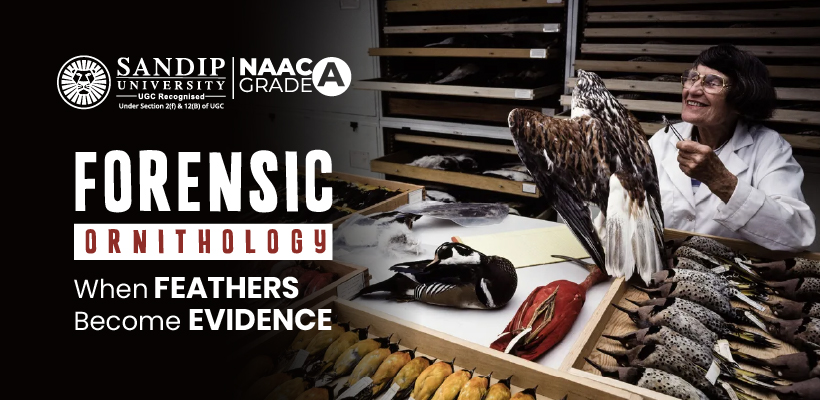
When it comes to forensic science, the most common evidence that we all know are fingerprints, bloodstains, bullet traces, etc. But among them, feathers are often the not-so-obvious clues that will lead you to the answer. This is where the application of forensic ornithology comes. This branch of science uses biological evidence that originates from birds. It supports both criminal investigation and aviation safety. Some of the top forensic science colleges in Nashik offer courses in ornithology applications in forensic science, which is arguably one of the most underrated branches of modern forensic investigations.
What is Forensic Ornithology?
Forensic ornithology is the scientific study of birds that includes their behavioral characteristics, their anatomy, taxonomy, migration, and habitat. This area uses forensic and legal methods to analyse and process potential crimes and/or legal issues involving birds.
As birds are part of most of the ecosystem, forensic ornithology is often used in forensic investigations such as environmental and accident-related cases. The field helps with cases of poaching, illegal wildlife trade, poisoning of protected species, and aviation accidents, where even a few feather fragments from a bird strike can be very important evidence. What looks like a small biological trace can help figure out what species it is, explain an event, and help with both legal investigations and preventative measures. This shows that evidence related to birds is significant in modern forensic science.
Woman Behind Forensic Ornithology
The field of forensic ornithology would not exist without the contributions of Roxie Laybourne, a Smithsonian scientist who is known as the founder of the field. Following the crash of Eastern Airlines Flight 375 into Boston Harbor on October 4, 1960, just six seconds after take-off, feather fragments were found in three out of four engines of the aircraft. Laybourne, who had spent over fifteen years as a taxidermist developing an intimate familiarity with bird anatomy, was consulted. Her conclusion was unexpected: the culprit was a three-ounce European starling. That single case launched a career and a scientific discipline.
Laybourne developed a four-step method: contextual assessment, such as location, season, and circumstance, before physical cleaning and preparing the feather sample. Then it is studied under the microscope, where each characteristic of feather reveals a species-specific architecture and final species identification through museum cross-referencing remains the backbone of feather analysis in forensic ornithology to this day.
The Science Behind the Feather
A single bird carries more than twenty thousand feathers on its body. Each type of feather differs morphologically across species. The rachis, barbs, barbules, nodes, and villi these microscopic structures of feathers are essentially nature’s fingerprints.
Forensic ornithologists meticulously examine the morphological features of a feather found at a crime scene or accident scene. During this examination, various aspects of the feather are observed with a microscope. For example, the length of the barbs and barbules will be noted, as well as the shape and pattern of the nodes and how pigments are placed within the feather, as to whether there are any villi present. The feather from a bird has lots of things that can tell us what kind of bird it is. If we write down what we see and compare it to feathers we know about, such findings often allow identification of the bird at the lowest possible taxonomic level.
Recent research has even demonstrated that as few as two feather barbs barely visible to the naked eye can yield sufficient mitochondrial DNA for species identification.
When Feathers Aren’t Enough: DNA Barcoding
Not every case offers an intact feather. In aircraft accidents, fires, or advanced decomposition, biological evidence may be too damaged for traditional microscopic comparison.
In cases like this where molecular techniques are necessary, DNA barcoding is a common way for scientists to determine the identity of an organism by using animal mitochondrial DNA, particularly via the commonly used CO1 gene, which is now frequently used to differentiate between species.
There has been a famous aviation accident in Oklahoma in which only some feathers and minimal DNA were recovered from the wreckage of an aircraft. With laboratory results identifying the bird’s species, it was possible to establish that the bird was an American white pelican, a large migratory type of bird that is typically in this area for the annual migration.
Identifying the bird will not only help with the investigation of this particular accident but can assist in preventing future accidents by providing information about which bird species are typically involved in bird strikes so that airports can manage the habitat appropriately as well as use more accurate data to assess risk from birds during flight operations.
Beyond Feathers: New Scientific Tools
Forensic ornithology has tools that extend even further. The study of stable isotope analysis (SIA) helps scientists learn about birds’ diet, region of origin, and migration; these types of scientific evidence show where birds have travelled from and what types of food they have consumed.
Radar ornithology detects, monitors, and quantifies movements of birds using electromagnetic energy waves, day and night, throughout different seasons over hundreds of kilometers distance, this information aids in predicting migratory routes in proximity to airports and contributing to the Department of Defence’s Bird Avoidance Model and the aerospace industry by allowing for improved bird-safe aircraft designs.
Combining ATR-FTIR spectroscopy with chemometrics (i.e., principal components analysis [PCA] and linear discriminant analysis [LDA]) demonstrates promise for differentiating species from feather samples with 100% accuracy: A rapid, non-destructive technique that includes wildlife forensic casework.
Why Does the Field Matter More Than Ever?
In recent years, the fields of forensic ornithology, which studies the connections between birds and humans, have become increasingly prominent as a result of the expanding intersection of humans and birds with growing cities, increased air traffic, growth in wildlife trade, and increasing instances of environmental crime.
The feathers that are gathered from wildlife trafficking cases can aid in determining if the animal in question has a classification of being threatened or endangered by law. In the incident of an aircraft strike with a bird that resulted in damage, even a tiny fragment of feather could be used to assist in the determination of the causes of the occurrence and may be used to prevent the reoccurrences of such. Because obtaining significant evidence from a single feather or genotype fragment provides critical information, this type of evidence may be utilised to better the safety of both human populations and avian populations and also provide justice for avian species that have fallen victim to illegal activities.
Conclusion
Forensic ornithology shows how biological proof can help broaden forensic interpretations about places that have been overlooked in most conventional investigations. Various techniques, such as feather morphology, microscopic examination, DNA analysis, and long-term developments in technology of analysis, can present meaningful information about bird remains and can be helpful in a variety of investigations, from wildlife crime to airplane crashes. The implementation of new methods of investigation known to professionals holding a B.Sc in Forensic Science will continue to support the growing importance of forensic ornithology, not only in the identification of species but also in creating a stronger connection between forensic science, conservation, and public safety.
Apply now to one of the top forensic science colleges in Nashik and start your career in forensic investigation.