
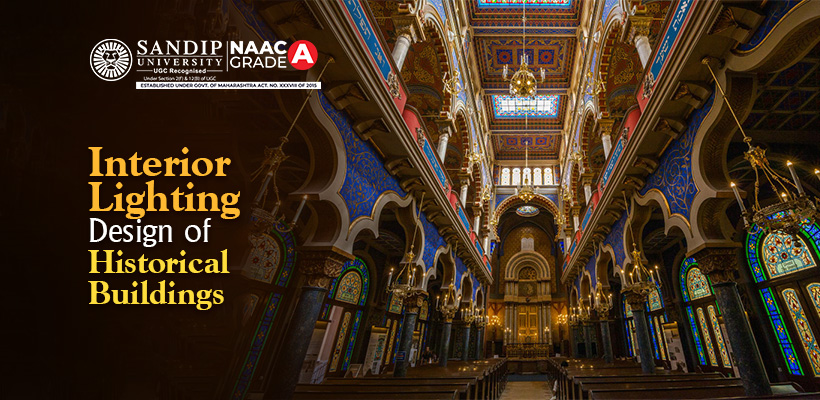
Interior lighting design of a Historical Building is much more challenging than any other type of lighting design. The interior lighting design follows specific guidelines but it can be varied depending upon the designer’s choice. For enhancing the perception of Historical Buildings and better appreciation of its heritage value through the art and science of lighting design based on study, research and analysis of relevant and available literatures, codes and guidelines, existing case studies and experimentations. Lighting is a very important topic covered in the interior design course curriculum at top design colleges in Nashik.
Historical Buildings therein possess collections of various old artefacts which have high heritage value. Historical Buildings are a vital component of urban civilisation and it helps us to experience the glory of our previous days. Historical Buildings are also increasingly accepted as important venues linking a new generation with an older one. So, maintenance of the internal and external architectural lighting characters is important for preventive preservation and significant for achieving this goal.
Proper Restoration and Preservation
Proper restoration and preservation of those antique materials are essential. Good lighting solution considering energy efficiency point of view as well as preservation from the bad effects of artificial light sources upon old artefacts through non-destructive procedures.
Nowadays most of the Historic Buildings are lit with lamps, adopting facilities of Mercury Vapor Discharge principle. This liberates Ultra Violet (UV) Rays which have some deleterious effect upon surroundings. Even LED lights also liberate UV rays to some extent. These UV rays have been classified according to their wave lengths. Antique high value materials in these buildings need to be protected from these corrosive / aging agents. Before application proper analysis for UV content of lamps is essential. In such buildings one of the attractions for researchers are old documents, e.g., Paintings, Books, Periodical, Deeds, Currencies, Negotiable Instruments, etc. Preservation of the same is very crucial as well as problematic.
Thus, for protection of antique items, a safe distance is evaluated between archives and light sources to control fading effects. A new approach i.e. natural device has been also employed for absorption of UV from the ambient light. Atmospheric conditions as well as microorganism both are also responsible for destroying archival materials due to poor conditions of Lamp and luminaires and lower value of illuminance level. There is a major problem to protect old paper and textiles like paintings, sculptures, photographs, periodicals, costumes, and curio pieces etc. which are brittle in nature and yellowish and faded day by day due to environmental effects.
Unsatisfactory Illuminance Levels
Uniform light distribution is very much important for a good and efficient Lighting Designing. In this area daylight entered from a glass window. So, the illuminance level is very high near the window and the illuminance level of other areas is low.
Improper Visualisation Due to Poor Lighting Arrangement
Ambient and accent lighting concepts are very much essential for this purpose. Actually, ambient lighting illuminates the whole area but it cannot focus sufficient light at specific objects. Lighting design is very much essential to describe a room and also feel its environment.
So, according to the survey it may identify the above-mentioned problems. But now the scholar tried to find out the reason behind these problems. To find out the cause, physical measurements are to be taken for some typical area of above-mentioned Historical Buildings or sites.
Conflicts Between Natural Light and Artificial Lightning
Initially most galleries were designed by utilising maximum usage of daylight, but due to urbanisation adequate daylight is not available in the entire building. For this reason, use of artificial lamps was very much essential, which are more technically upgraded at present. From earlier experiences it has been noted that fading of paintings is one of the major drawbacks of highpower artificial light sources. Thus, before applications of light source thorough studies have been made.
To protect the archival materials from artificial light sources a good lighting designing is evaluated where illuminance level, safe distance and natural device (conifer tree) arrangement are done as per standard guidelines and adopted methodology. An electrical system or design is not acceptable if the system is not energy efficient and cost effective. So, a good lighting system is designed with the help of “DIALux evo” software with calculation on energy efficiency and cost estimation in comparison with existing designs. It is a new way to restore archives like paintings, old artefacts for a long period of time.
Conclusion
Majority of the Historical Buildings are not properly illuminated and artefacts are not conserved too. So, it may be concluded that we are not concerned about our old pride in terms of preventive preservation. So, it is necessary to find out ways to save our old cultural heritage. It is already observed that all artificial light sources are composed of UV radiations. Pursuing a B.Des in Space and Interior Design can help you further solidify your knowledge about interior lighting design. The most energy efficient light source LED which is extensively in use is also not free from UV. That is why in chapter-6, trees have been employed for absorption of UV from the ambient light. This is a new approach. Nowhere, this methodology has been adopted. This can be addressed as novelty and originality of the study.