
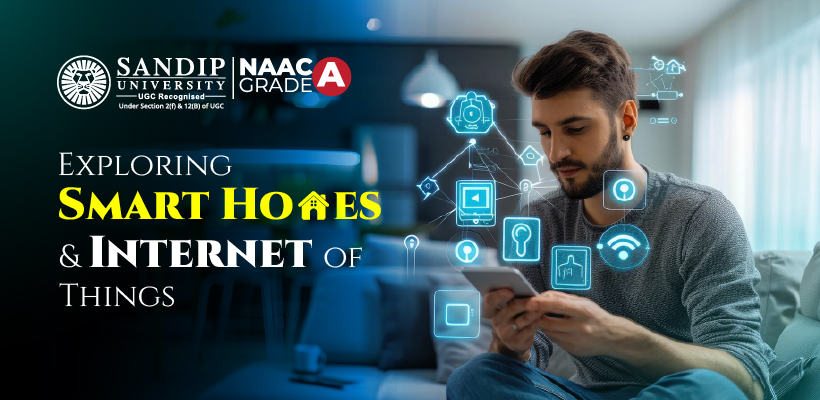
If you are wondering how a normal home is transformed into a smart home, it is very essential to understand the Internet of Things (IoT) and how it operates within the ecosystem. At its base, IoT is a network or connection of physical devices, vehicles, home appliances, and other items which are embedded with sensors, software, and other technologies for connecting and exchanging data with other devices and systems over the Internet. Some of the best interior design colleges in Nashik are integrating the study of IoT in interior design programs to train students in this field.
Diving deep into IoT: The Backbone of Smart Home Innovation
- IoT is a Foundation: Converting a normal home into a smart home is totally dependent on the Internet of Things (IoT), which uses sensors, actuators, and other devices for automation and optimisation of home functionality
- Key parts of IoT Systems: A basic IoT system actually consists of sensors for detecting changes, actuators for responding to inputs, connectivity (Wi-Fi/Bluetooth), data processing, and user interfaces.
- Enhanced Living Experience: IoT devices improve comfort with the use of smart thermostats, efficiency with the use of lighting systems, security with the use of smart locks, surveillance, encryption, and touch less or contactless accessing things in your home like Fridge, speaker through voice commands
- Security Advancements: IoT allows real-time monitoring, automated alerts are generated, encrypted data exchange is possible, and access control for safety of home.
- Future Trends: May be in future, your thinking will shape something as per your requirement automatically
Working of IoT in Smart Homes
- IoT uses sensors to collect environmental data, Actuators perform/take actions based on this data, such as adjusting temperature or locking/opening doors, switching on or off the light system.
- The devices used in the IoT ecosystem are interconnected via Wi-Fi, Bluetooth, or other wireless technologies, which allows them to communicate and exchange or share data in between.
- All the data which is collected by sensors is processed to make decisions. All the actions taken by the devices are taken based on the processing of the data which is collected from the ecosystem. This can occur on the device itself or on a cloud-based server.
- Applications or voice commands are used by home users to interact with the smart home system which allows them to control and automate devices.
- An entity which is coined as a central server or hub who coordinates the system, processes the data and sends commands to ensure the seamless operation of the smart home.
In short, if we interconnect these components, sensors and actuators, connectivity, data processing, user interfaces, and central servers, which results in creation of IoT smart homes that are not responsive to the resident’s needs and preferences, they are also adaptable to changes in the environment, enhancing both convenience and security.
How IoT Devices Transforms a Normal Home into Smart Home
Smart Thermostats: Comfort Meets Efficiency
In today’s era everyone focuses on achieving high efficiency and observing the truth that “Comfort is the new niche”.
Today we are left out with the days of adjusting temperature manually. With the advancement in technology and evolution of IoT, in smart homes or offices or malls, smart thermostats are becoming crucial for achieving a balance between comfort and energy efficiency. These devices are adapted to your preferences and adjust the climate within your home that suits your needs perfectly. They also can adapt to external weather conditions, to make sure your living space is always welcoming and as per your requirement
Lighting: Glow with Intelligence
Those days are over when we switch on or off the lights as per our needs and save electricity. With the evolution and advancement in the use of IoT in smart homes has brought about a transformation in how we receive and control lighting. Just Imagine a home where the intensity and colour of lights are adjusted based on the natural light entering the room or the lights are adjusted as per environment or the mood for a movie night, all that is possible through smart lighting systems. Smart light systems promote energy saving and also help to enhance the appearance and elegance of our homes, and all the functionalities are as simple to control as using a voice command or just on a tap or click on a smartphone.
Security Systems: Protectors in Your Absence or Presence
Everyone is concerned about the safety of their home. The Internet of Things in the home has revolutionised the limits of our approach and capabilities to home security. The use of smart locks, surveillance cameras, and motion detectors, our homes have never been safer. The ability to monitor your home remotely, receiving instant alerts with every suspicious activity, and even control access to your home from anywhere in the world has been a major game-changer. The reliability and intelligence of these systems are geared by high end technology, with sensors and actuators playing a magical role in improving their effectiveness.
Touch Free System: Suggests Clean, Contactless Activation
Nowadays with the evolution and increasing use of AI, IoT is integrated with Artificial intelligence which focuses on gesture-controlled, contactless interaction. This Technology uses sensors, motorised mechanisms, and AI voice commands to open doors hands-free. Primarily featured in premium models like Samsung’s Bespoke AI and LG Signature, this feature is activated by touch sensors, motion detection, or voice commands (e.g., “Hi Bixby”), ideal for when hands are full.
Conclusion
Looking at the future scope, smart homes will be more intelligent and responsive and reactive than they are these days. With the fastest growing use of AI and machine learning in IoT devices, in the future homes will be able to learn from your daily routines, your behaviour, your thinking power, your response to each thing happening in the home and preferences and also your comfort. Instead of waiting for instructions and your decisions, they will start deciding things on their own, like lighting, temperature, or security, maybe before you even realise you need it. Professionals holding a B.Des in Space and Interior Design will be in high demand to help design homes that integrate IoT into the residents’ everyday lives.