
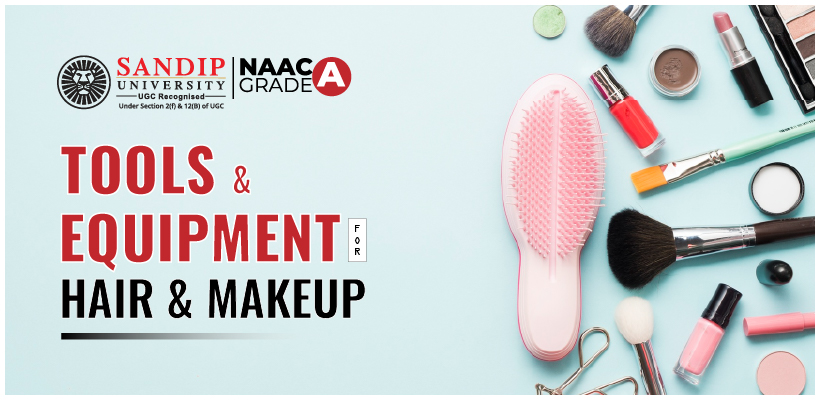
Tools and outfit are terms that are frequently used interchangeably without knowing the factual difference between tools and outfit, but in fact, they’ve different delineations. Some of the top beauty cosmetology colleges in Nashik train students in the accurate use of tools and equipment for hair and makeup grooming. Tools and outfit are not only two words that are frequently used in day-to-day life, but also two implements that are frequently used every day as well. Still, how does one make a distinction between these two particulars? Let us find out.
What’s a Tool?
Tools are appertained to as outfit, instruments or implements. They can perform a variety of functions similar as cutting and mincing, moving, shaping, fastening, guiding, making chemical changes, fastening, information and data manipulation, etc. There can be specific tools designated for specific purposes.
What’s Equipment?
Outfit is the necessary point which you can use for the particular purpose. It represents all feathers of ministry, functional bias or accessories or a set of tools that are designated for a specific task is known as outfit.
Difference Between Tools and Equipment
Tools and outfit are two words that are frequently used contemporaneously, substantially due to the parallels of their meanings. Because of this factor, they can be used interchangeably in numerous cases but not always.
A tool can be any point that’s used to achieve a thing. Outfit generally denotes a set of tools that are used to achieve a specific ideal. A tool can be non-mechanical as well. Still, when one says outfit, there’s a certain mechanical aspect to it that cannot be ignored. The operation of tools among mortal beings runs back millions of times. Still, the use of outfit is further of a recent development. Tools are frequently seen to be used by creatures as well. Outfit is only used by mortal beings. Tools are generally multipurpose. Outfit is designed for a specific task.
Hair Tools and Equipment
Hairstylists use tools and outfits to change the appearance of their guests. Through professional training and high- quality tools, they use their creativity to wash, set, cut and style hair as well as apply dress and business treatments. The right tools and outfit can make all the difference in a stylist’s capability to generally satisfy guests.
Skirmishes and Combs:
The hairstylist should have combs and skirmishes in colourful sizes, and this should include soft and hard- bristled skirmishes and combs with different tooth density. A stylist should also have detangling combs, which work stylish for wet hair. There are also specialty combs for creating certain aesthetics similar to hair- teasing combs which produce hairstyles with volume. Bristle strength and hardness contribute to different styling options in both skirmishes and combs.
Scissors and Shears:
Are a important for a stylist, and a hairstylist should have at least two different dyads of shears or scissors. One brace should be a regular brace used for slice; the second should be a lower brace for bangs. Trimmers are also necessary for handling near cuts and the grooming of globules and mustaches. Some scissors have teeth; these are ideal for hair slice because they produce a layered cut rather than a blunt one.
Legs and Clips:
They are handy while cutting, baptising and treating hair styles. A stylist will use legs and clips to separate the hair for dyeing or may use legs to hold curlers in place. Clips and legs come in different sizes, shapes and types to suit a variety of different purposes in a stylist’s salon.
Blow Dryer:
It is the teetotaller is an essential tool for hairstylists, as numerous hairstyles are achieved through blow drying, though others bear a wet set. For wet- set hairstyles, a professional hood teetotaller is used along with soft breakers and legs or clamps.
Curling Irons:
Entwining irons are also employed by hairstylists as a means of setting coiled hair, and hairstylists may keep several different sizes of entwining irons on hand ranging from 1/ 4- inch barrel to 2- inch barrel.
Hair Irons:
A hair iron is a tool used to change the structure of the hair with the help of heat. There are three general kinds of entwining tongs, also known as entwining irons, used to make the hair curled; straighteners, also known as flat irons, used to unbend the hair; and crimpers, used to produce small creases in the hair.
Hair Comber:
Hair comber is a small comber for styling and entwining hair, and with a blow- teetotaller. The damage that expansive heat operation can beget to hair is well known still and so a number of volition, heat free hair breakers have been manufactured for the request.
Makeup Tools and Equipment
Robe Encounter It is shaped like a paintbrush but is slightly thick with establishment bristles and is generally made of synthetic filaments. It’s used for robes under the eyes, as well as cream eye shadow.
Brow Encounter:
This encounter can be used to define and fill in brows, as well as for gel eyeliner operation. This encounter is generally fairly affordable.
Blending Brush:
Generally, the rounder and bigger the tip, the softer and further blended the operation will be, this is a great encounter for newcomers and also a great encounter for blending out shadow, hence the name “ blending encounter ”.
Crinkle Encounter:
Another interpretation of the crinkle encounter or blending encounter, this bone is angled, rather than round. This type of encounter is a bit more precise and placement can be easier if you’re doubtful about your crinkle colour.
Pencil Encounter:
This encounter is pivotal for creating a soft and Smokey shadow look and wearing liner and eye shadow on the bottom of your switches. It creates an important softer and flatter look than a pencil. This encounter is small and is shaped like a pencil tip.
Flat Eye Shadow Brush:
This encounter is essential for a great eye makeup operation and for creating a smooth base for any eye shadow application. It is used for dense, firm bristles and a bit of a thicker brush
Lash & Brow Spooley Brush:
This handy little spooley brush is great for taming brows and depluming mascara after application. These are fairly cheap. They generally also come on the other end of brow pencil.
Flat Eyeliner Brush:
It is used to apply eyeliner that is flawless and lasts all day
Lip Brush:
is used to apply smooth and balanced lip colors with techniques.
Foundation Brush:
A foundation brush is great for achieving a flawless, airbrushed finish. There are lots of different versions of this brush and a lot of it depends on what type of foundation you are using. Not all foundations work well with a brush, so it really depends on your foundation type here
Stippling Brush:
This type of brush creates a flawless, airbrushed base with high definition results. It can be used to apply foundation, blush, bronzer, powder, and highlighters. It also is very effective for applying liquid and cream products. There are duo-fiber bristles at the top of the brush, which make for a light, gentle application that looks very natural. These brush ends have a very light and feathery feel.
Beauty Blender/Sponge:
The beauty blender Sponge is an absolute essential for applying and blending base makeup. This teardrop shaped sponge absorbs water rather than product, so your foundation, concealer, BB cream etc. will last even longer. Using a bouncing technique, the top of the sponge hugs the contours of the face and covers blemishes whilst the bottom flawlessly blends makeup over larger areas. Perfecting for achieving that natural, streak-free finish, beauty blender has been dubbed a modern-day phenomenon, and we totally agree.
Conclusion
These are some of the tools used in hairstyling and makeup. Pursuing a B.Sc in Cosmetic Science can help you further enhance your knowledge of how to use such tools in a professional setting. This program can greatly enhance your chances of a bright future in the cosmetic industry.