
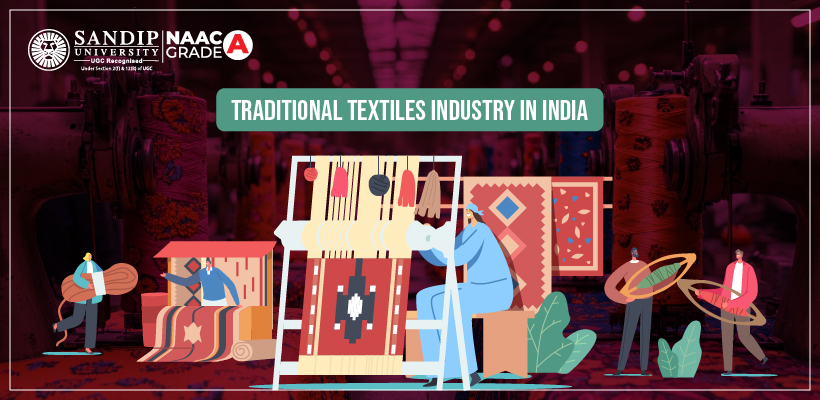
The traditional Indian textile industry is one of the largest in the world, with a huge raw material and textile manufacturing base. The country has produced celebrated textiles such as Dhaka muslin, which was woven so fine and light that it could pass through a finger ring. In terms of Indian GDP, this sector has been quite beneficial in the economic life of the country. Today, some of the top fashion design colleges in Maharashtra offer cutting-edge programs in this field that blend traditional textiles and modern industry methods to create fantastic fashion pieces. Let us further explore the traditional textile industry in India:
Textile Industry in India: A Brief Profile
The textile industry is one of the leading sectors in the Indian economy as it contributes nearly 14% to the total industrial production1. It is claimed to be the biggest revenue earner in terms of foreign exchange among all other industrial sectors in India.
The textile industry is the second largest employer, after agriculture, with a total workforce of around 35 million. India is next only to China among the world’s largest producers of textiles and garments. The industry is easily the largest foreign exchange earner on a percentage basis of the ratio of import inputs to export out outputs, as the import content is insignificant compared with those of other major export products.
Textile Clusters
A business cluster is a geographic concentration of interconnected businesses, suppliers, and associated institutions in a particular field. Clusters are considered to increase the productivity with which companies can compete, nationally and globally ‘. The term industrial cluster, also known as a business cluster, competitive cluster or Porterian cluster, was introduced and popularised by Michael Porter in The Competitive Advantage of Nations ‘, (1990). He claimed that clusters have the potential to affect competition in three ways:
- By increasing the productivity of the companies in the cluster
- By driving innovation in the field
- By stimulating new businesses in the field
Traditional Indian Textile Clusters
- Chanderi – Madhya Pradesh,
- Chamba Rumal – Himanchal Pradesh,
- Phulkari – Punjab,
- Banarasi Brocade – Uttar Pradesh,
- Block Printing – Rajasthan,
- Madhubani – Bihar
History of Textile Industry in India
The archaeological surveys and studies have found that the people of Harappan culture knew the weaving and the spinning of cotton four thousand years ago. Indication to weaving and spinning materials are also found in the Vedic Literature.
There was textile trade in India since ancient times. A block printed and resist-dyed fabric, whose origin is from Gujarat, is found in tombs of Fostat, Egypt. This proves that Indian export of cotton textiles to Egypt or the Nile Civilisation in medieval times was prevalent to a large extent. Large quantity of north Indian silk was traded through the silk route in China to the western The Indian silk was often exchanged with the western countries for their spices in the barter system. During the late 17th and 18th century, there were large exports of the Indian cotton to the western countries to meet the needs of the European industries during industrial
revolution.
Consequently, there was the development of nationalist movements like the famous Swadeshi movement. There was also export of Indian silk, Muslin cloth of Bengal, Bihar and Orissa to other countries by the East Indian Company.
India is the second largest producer of fibre in the world and the major fibre produced is cotton. Other fibres produced in India include silk, jute, wool, and man-made fibre. Approximately 60% of the Indian textile Industry is cotton-based.
The cotton sector is the second most developed sector in the Indian Textile industries. It provides employment to a large number of people but its production and employment is seasonal depending upon the seasonal nature of the production. The Handloom Sector is well developed and is mainly dependent on the SHGs for their funds. Its market share is 13% of the total cloth produced in India.
The woollen sector in India is the 7th largest producer of wool in the world. India also produces 1.8% of the world’s total wool.
The jute sector comprising of the jute or the golden fibre in India is mainly produced in the Eastern states of our country like Assam and West Bengal. India is third largest producer of jute in the world.
The sericulture and silk sector in India is the second largest producer of silk in the world. India produces 18% of the world’s total silk. Mulberry, Eri, Tussar, and Munga are the main types of silk produced in our country and are a labour-intensive sector.
Issues Faced by Traditional Textile Community
Handwoven products are much in demand today. For a buyer seeking value for money, identifying a genuine handloom product is a challenge. This is where ‘Handloom Mark’ can help establish genuine handloom products and ensure appropriate income/returns for products made by socio-economically backward weavers. There is a need to preserve the traditional craft as well as to integrate it in contemporary context.
Branding, production, supply chain related issues, efficiency in managing the entire supply chain is required, including for design, fabric procurement and logistical skills, in transport, quality control and property rights protection, export financing and clearing of trade formalities.
Conclusion
It can therefore be concluded that by focusing on capacity building of traditional textiles, the socio-economic development of skilled craft persons, their number and skills development as well as transference can be facilitated. Pursuing a futuristic program like B.Des. in Fashion and Lifestyle Design could help you foray into the fashion industry with employable skills and knowledge. Opting for the right degree program will result in creating employability for present and future generations, and a system which caters to a holistic well-being of the traditional textile community and its eco-system.