
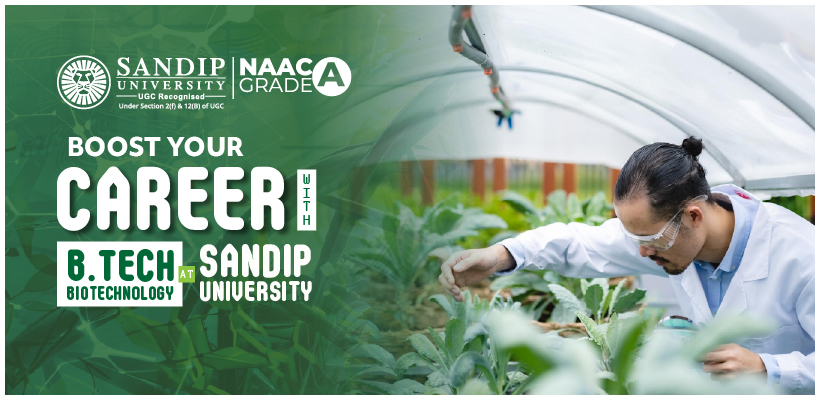
Biotechnology is a rapidly evolving field with the potential to grow further. Consequently, it is an ideal alternative for students with a background in physics, chemistry, mathematics, or biology. In a Biotechnology program, students learn how to use technology to create products that benefit people.
Upon completion of this program, students will be able to acquire skills in bio-product development, software development, computational tools, machine learning, and artificial intelligence, enabling them to pursue careers in big data. Students gain a combination of theoretical knowledge and practical experience through laboratory sessions, specialised courses, internships, data analysis projects, and industry training. Biotechnology specialists are in high demand in various fields, including pharmaceuticals, bioprocess industries, vaccine production, agriculture, bioinformatics, healthcare analytics, and environmental science.
B.Tech in Biotechnology at Sandip University
B.Tech in Biotechnology from Sandip University offers a compelling blend of skills and knowledge, along with the chance to work alongside a diverse group of individuals. The program’s core focuses on biotechnology’s foundations, alongside artificial intelligence, machine learning, bioinformatics, and data science. This prepares students for dynamic sectors like precision medicine, gene editing, and healthcare analytics. Graduates will be well-positioned for careers in genomics, data analysis, and advanced biotechnology, benefiting from the university’s modern facilities, research prospects, and job placement support from prominent biotech and analytics firms.
Career Opportunities After B.Tech in Biotechnology
Our goal at Sandip University is to ensure that all our students receive the best possible education and stay abreast of the latest developments in biotechnology. Graduating with a B.Tech in Biotechnology from Sandip University can lead to a wide array of career options. Graduates contribute to the creation of drugs and vaccines, but their work also involves understanding and managing the intricate regulatory landscape. Furthermore, students can collaborate with professionals in genomics, healthcare analytics, and biotechnology firms that focus on data analysis and interpretation.
Preparation for National-Level Exams
A significant portion of agricultural biotechnology research is conducted within the Indian Council of Agricultural Research (ICAR), including molecular breeding and crop genomics. Additionally, Biotechnology students may be able to advance their careers with NIV and ICMR, which offers opportunities to conduct clinical trials, identify novel biomarkers, and develop data-driven disease models. Sandip University trains professionals who specialise in genomics and translational biotechnology who work for government and research organisations such as the CSIR, ICMR, DRDO, and ICAR. Moreover, Sandip University also prepares students for national-level examinations such as GATE, DRDO, ICAR, CSIR NET, and UGC NET, through which students can obtain master’s or doctoral degrees in Biotechnology, Life Sciences, Bioinformatics, or Computational Biology.
Conclusion
Pursuing a B.Tech in Biotechnology from one of the top engineering colleges in Nashik like Sandip University in 2026 represents an investment in a field that blends biological expertise with data science and artificial intelligence. The ability to handle genomics, transcriptomics, and proteomics data has broadened career horizons, enabling graduates to excel in both biotech and data-driven industries. With a robust skill set and the support of a well-structured academic program, biotechnology graduates are well-equipped to build impactful, dynamic, and future-ready careers in this ever-evolving discipline.