
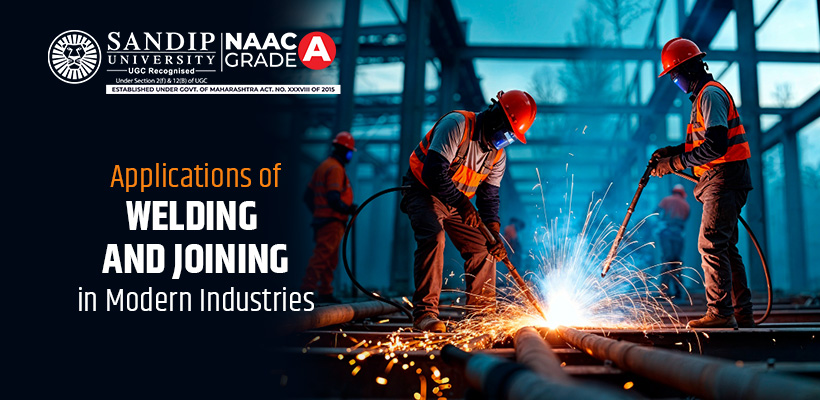
Welding and joining technology are very important to the development of modern infrastructure and industries. The capability of joining the materials permanently or semi-permanently resulted in the lightweight and strong joint, which finds applications in the aerospace and infrastructure industries. Some of the top engineering colleges in Maharashtra are training students in high-tech labs to gain a practical understanding of welding and joining. In current times, the materials and their processing techniques are evolving continuously, which leads to the development of welding technology from a conventional method to a more science-oriented research topic.
Significance of Welding and Joining
The parts that cannot be joined together mechanically are assembled by welding and joining. During these processes, structural integrity, leak-free connection, and material continuity are guaranteed. Modern ways of joining also provide the opportunity of using dissimilar materials, which is also becoming important in performance optimisation industries that also look at optimisation of costs.
Use in the Key Industries
Automotive Industry
Welding is also very significant in automotive industries to make frames, chassis and body of the vehicles. Such techniques of welding as resistance spot welding, MIG welding and laser welding are widely used in mass production. The high joining level allows the usage of light materials like aluminum and the high strength steels, and this will increase the security and fuel efficiency. The friction welding is gaining popularity in battery cabinets of electric cars.
Aerospace Industry
Precision and reliability of the welding in aerospace should be very high. The TIG welding, electron beam welding, and friction stir welding technology are dedicated to welding the most crucial airplane components including fuselage, fuel tanks, and engine components. The processes have offered low defects and high weight to strength ratios demanded in aircraft operation and safety.
Construction and Infrastructure
The welding process is very important in structure, bridge, pipeline and railways. Structural steel structures are joined with arc welding so that they become hardy and can bear a load. Pipeline welding requires high-quality joints mostly in the oil and gas industries so that it does not leak and resist changes in the environment.
Energy Sector
Welding plays a significant role in the energy sector, such as thermal energy systems, nuclear energy systems, and renewable energy systems. The welding on the nuclear power plants would be used in making the pressure vessels and the piping systems, which ought to resist extreme temperatures and pressures. An element of renewable energy, welding can be used in the tower of wind turbines and in the framework of solar panels. The marine environment is so tough that even the offshore oil rigs are made with robust welded joints.
Shipbuilding Industry
Another important field of welding is shipbuilding to assemble metal structures (steel) in huge sizes. Constructions of ships are currently done using automated welding machines to improve efficiency and consistency. Welding provides the joints with watertightness and structural integrity, which is significant in the safety of the marine industry.
Electronics and Micro-joining
The electronics industry uses micro joining techniques such as soldering, brasing, and ultrasonic welding in assembling small components. These methods are required to design circuit boards, sensors and semiconductor products in which precision and reliability are paramount.
Medical Devices
The medical industry also uses the welding and joining technologies to manufacture surgical equipment, implants, and diagnostic equipment. Laser welding is also common in biocompatible welding since it is a precise welding method that can be applied to materials such as titanium and stainless steel.
The Development of Welding Technologies
Upgraded welding process is being embraced in the modern industries including:
Friction Stir Welding (FSW): is perfect in the welding of aluminum and dissimilar metal and does not melt.
Laser Beam Welding (LBW): This is the most accurate and least distorting welding.
Electron Beam Welding (EBW): The technique is appropriate when it comes to high-performance with deep penetration.
Hybrid Welding Processes: The use of several methods in order to improve the efficiency and the quality of joints. The welding process has also been enhanced with automation and robotics to enhance consistency, human error, and high-volume welding.
Difficulties and Future Projections
Despite its extensive usage, welding presents problems such as residual stresses, distortion, and defect development. The technology is already being experimented to develop smarter welding operations by artificial intelligence, real-time operations and optimisation by simulation.
The future of welding lies in:
- Introduction to Industry 4.0 technologies
- Creation of environmentally friendly and energy-saving procedures
- Growth in the application of additive manufacturing and hybrid joining methods
- Diffusion Advanced material combination (composites and nanomaterials)
Conclusion
Welding and joining technologies cannot be neglected in modern industries. A B.E. Mechanical Engineering degree can cement your understanding of welding and joining, and their applications in modern industries. They are used in key sectors that enable innovation and improvements in technology. As the newly emerging industries continue to grow, there will be an even greater need to install more dependable, high-quality, and efficient means of joining, and therefore, welding is an essential part of the modern manufacturing and engineering industry.