
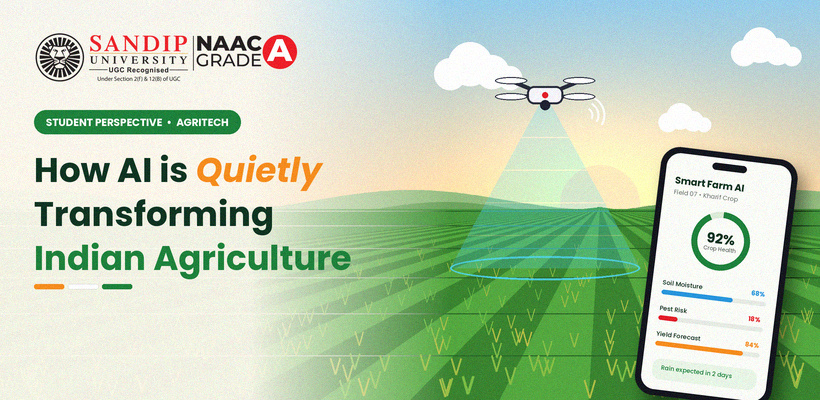
Agriculture supports nearly half of India’s workforce, yet most of its 140 million-plus farms are small and depend heavily on weather, markets. And local knowledge. Artificial intelligence engineers from some of the top computer science colleges in Nashik are now helping smallholders make improved decisions, from what to sow to when to sell. Here is where it’s making a difference.
-
Smarter Sowing and Weather Advisories
Timing is everything in rain-fed farming. A sowing advisory pilot in Andhra Pradesh, built by Microsoft with ICRISAT, sent farmers text messages telling them the best time to plant, based on weather data, rainfall patterns. And soil conditions. Farmers who followed the advice reported notably improved yields than those who didn’t. Similar hyperlocal forecasting and advisory tools are now offered by startups and agencies across the country.
-
Early Detection of Pests and Diseases
Pest outbreaks can wipe out a season’s income. AI-powered apps let farmers photograph a diseased leaf and receive a diagnosis and treatment suggestion within seconds. Organisations like Wadhwani AI have worked on pest-management tools, especially for cotton, that help farmers spot infestations early and spray only when necessary. That cuts costs, limits chemical overuse. And protects soil health.
-
Satellite Imagery and Crop Monitoring
Companies such as CropIn, SatSure. And Fasal combines satellite imagery, sensors. And machine learning to track crop health, estimate yields. And flags emphasise in near real time. Banks and insurers use these insights to check risk and pace up claims, which matters for farmers who have a hard time to access formal credit and crop insurance.
-
Precision Irrigation
Water scarcity is one of India’s biggest agricultural challenges. Soil-moisture sensors paired with AI models tell farmers when and how much to irrigate. In crops like grapes, sugarcane. And vegetables, this can reduce water use significantly while maintaining or improving yield.
-
Drones and Automation
Drones are increasingly used for spraying pesticides and fertilisers and for field surveys. Government schemes such as Namo Drone Didi try to put drones in the hands of women’s self-assist groups, creating both a service business and a rural skill pathway. Drone spraying reduces labor, exposure to chemicals. And time per acre.
-
Market Intelligence and Fair Pricing
Farmers often sell without knowing the going price. AI models that check mandi prices, demand trends. And weather-driven supply shifts can say when and where to sell. Platforms built on these insights also assist with grading and quality assessment, which improves bargaining power.
-
Conversational AI in Local Languages
Perhaps the most promising go is voice and chat assistants in Indian languages. The government’s Kisan e-Mitra chatbot answers questions on schemes. And initiatives like Digital Green’s Farmer.Chat provide advice through messaging and voice. This matters because many farmers prefer speaking to typing. And English-only tools get them out.
Conclusion
The government’s Digital Agriculture Mission and AgriStack initiative aim to make a digital foundation: farmer registries, digital crop surveys and linked land records. With this data layer in put, AI services developed by professionals holding a B.Tech in Artificial Intelligence and Machine Learning can be tailored to individual farmers, from personalised advisories to faster scheme delivery and credit access.