
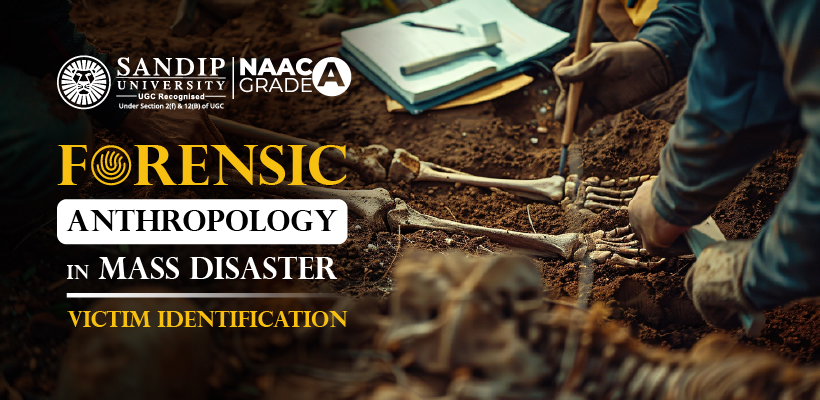
Multiple lives can be affected, as well as the damages and failures can be created to property and structure due to natural (earthquake, flood, etc.) or man-made (plane crash, fire, etc.) disasters. Mass Disasters generally leave thousands of people affected and most of the deceased decomposed, mutilated and/or burnt beyond recognition. Therefore, the identification of those who died during mass disasters may present scientific challenges and emotional challenges for those left behind. Some of the top forensic science colleges in Maharashtra include the study of mass disasters in the curriculum to help students train in this branch of forensic science.
A tool for determining victim’s structural recovery, and the recovery/identification of the deceased in mass disasters is forensic anthropology. Forensic anthropologists frequently collaborate with forensic pathologists, odontology analysts, DNA analysts, and law enforcement officers, to help provide closure for family members.
Types of Mass Disasters
Mass disasters have been divided into following categories:
- Environmental disasters
- Transportation accidents
- Industrial accidents
- Fire events
- Terrorism acts
All disaster victim identification (DVI) operations that occur worldwide where victims are recovered/identified, follows the same procedures as established by INTERPOL for recovering, documenting and identifying victim’s remains.
1. Skeletal Analysis After Mass Casualties
In many of the mass casualty incidents, the soft tissue may be contaminated/compromised due to various reasons; such as:
- Exposure to extreme temperatures
- Decomposition
- Animal scavenging on the bodies
- Fragmentation of bodies from explosions
In these situations, the skeletal remains will be used as the primary means of identifying someone.
Skeletal Analysis helps in:
Determining if the remains are human (or) non-human before analysis
- Sorting through mixed remains
- Reassembling fragmented bones
- Calculating the Minimum Number of possible Individuals (MNI)
- Determining trauma (injury related to time of death, explosion, & burning patterns)
Forensic anthropologists apply osteological (skeletal) principles when developing biological identities for persons based upon skeletal remains. Even a small bone fragment, when thoroughly evaluated, can provide important information regarding a person’s biological identity.
2. Identifying Age, Sex and Height
A primary goal of forensic anthropology includes the development of the biological profile of an identified body.
- Determining the individual’s sex:
The determination of individual’s sex is based primarily on three factors:
- Structure of the pelvis (the best predictor)
- Skull characteristics
- Long bone measurements
Due to the fact that the pelvis is sexually differentiated (sexual dimorphism) for the purpose of childbirth, it is the best body part to use for sex determination.
- Determining the individual’s age
Depending on the state of the remains being examined, the age finding methods have differences based on if the remains are from a child or a grownup.
- Age of Children
- Based on dental eruption and epiphyseal closure at the end of long bones.
- Age of Adults
- Structure of the pubic symphysis from the pelvis.
- Structural changes to the auricular surface of the pelvis.
- Cranial suture closure.
Although methods of determining the age of individuals provide only an estimate of their age, the range is frequently reduced sufficiently enough that it aids in narrowing down a group’s identification using others.
- Determining height of individual
The stature of an individual is determined by examining:
- Long bones
- Having established regression equations based on populations and/or gender
The above methods help to link the skeletal evidence to the missing person’s information and provide the stature.
3. DNA Examination from Skeletal Remains
When visual or morphological recognition is not feasible, DNA examination becomes crucial.
In instances of advanced decomposition or burn cases:
- Bone marrow may still retain DNA
- Femur and teeth are considered as ideal sources
- In the absence of nuclear DNA, Mitochondrial DNA can be used
Forensic anthropologists help in:
- Choosing suitable bone samples
- Ensuring contamination is avoided
- Collaborating with forensic biology labs
DNA findings are contrasted with:
- Family reference samples
- Personal items
- Ante-mortem medical documentation
The skeletal analysis and DNA testing together significantly enhances the accuracy of identifications.
-
Protocols of Disaster Victim Identification (DVI)
International standards call for structured methods of identifying victims in mass disasters. INTERPOL DVI consists of four distinct phases for recovering victims.
Phase I: The Scene Phase
- Recover the bodies in a systematic manner
- Properly label and document both the location of recovery and the recovered remains
- Ensure preservation of the chain of custody
Phase II: The Postmortem (PM) Phase
- Conduct autopsies
- Conduct skeletal and anthropological examinations
- Collect DNA samples from the remains
- Conduct dental examinations on the remains
Phase III: The Ante-Mortem Phase
- Collecting data on the missing
- Collecting data on the medical records of the missing
- Collecting data on the dental records of the missing
- Collection of DNA from the relatives of the missing
Phase IV: The reconciliation (matching) Phase
- Compare the AM data with the PM data
- Finalise the confirmation of the identification using a multidisciplinary team
Forensic anthropologists’ primary role is during the post-mortem and reconciliation phases of the identification of victims of mass disasters.
-
Difficulties in Identifying Victims of Mass Disasters
Environments affected by mass disasters have many challenges. These include body mix-up from disaster debris, a severely high number of bodies exposed to heat, degradation of the environment in those areas, lack of ante-mortem documents on the missing and lack of social support.
In spite of all of these challenges, victim identification can still be done accurately through the use of established procedures and scientific methodology.
-
Significance (Legal & Humanitarian)
Each time a victim is identified, there is a humanitarian action as well as a scientific occurrence. This humanitarian duty allows for:
- Certification of death by law
- Processing of inheritance and insurance
- Aid to law enforcement
- Provide closure for family members
The work of forensic anthropologists identifies the lost and restores dignity to them.
Conclusion
By conducting biological profiling, performing DNA analysis, using global DVI standards, and examining skeletal remains, forensic anthropologists holding a B.Sc in Forensic Science can help to identify victims from mass catastrophes. Forensic anthropology is an application of science as well as of understanding humanity. Due to the increasing number of international disasters, anthropologists are constantly working to improve their ability to locate deceased individuals by utilising a combination of anthropology, forensic biology and modern molecular techniques (technology). In the end, forensic anthropology changes silent skeletal remains into recognisable individuals—restoring names to the unnamed and providing closure to mourning families.
Explore B.Sc in Forensic Science at Sandip University