
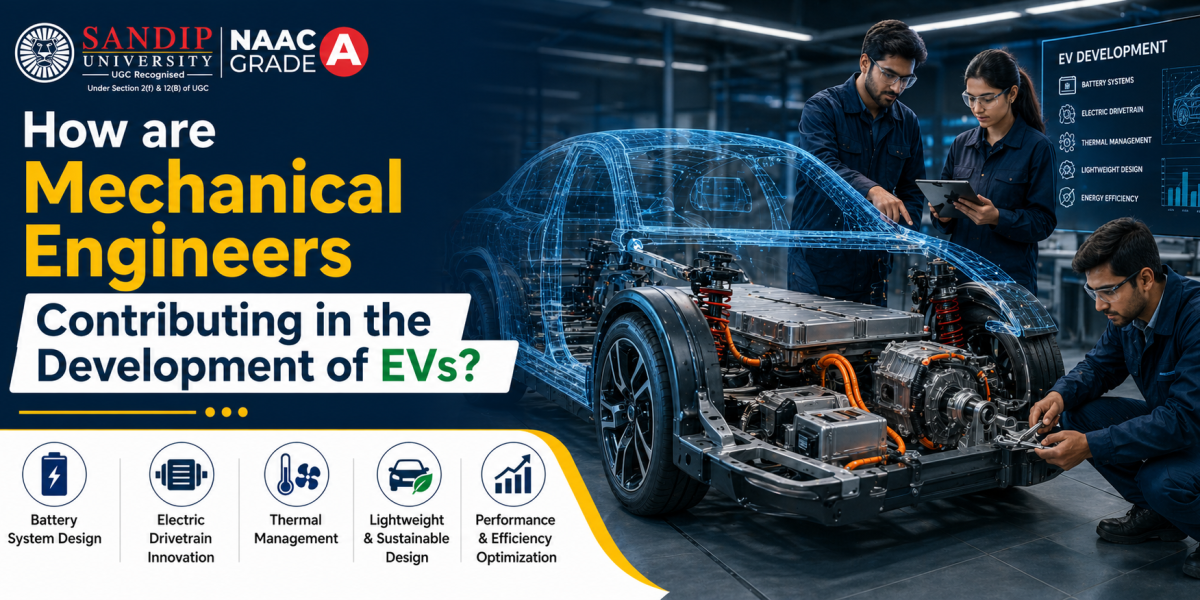
The sector of electric vehicle (EV) is among the most revolutionary areas of contemporary transportation. With the world struggling to make sure it is environmentally sustainable, energy efficient and its carbon footprint is low, the trend of changing the traditional internal combustion engine vehicles into electric ones is gaining momentum. Though the EV market can be generally associated with the innovative technology and innovations, the efficiency, reliability, and safety of these vehicles are significantly contributed by mechanical engineers. Their contributions are integral to the development of electric vehicles in a multitude of areas. Some of the top engineering colleges in Nashik are training future mechanical engineers to take the lead in developing electric vehicles for a more sustainable future. Here is how it is done:
1. Battery Design and Optimisation
The battery of any electric vehicle is one of the most important components of electric vehicles. The mechanical engineers take part in designing and optimising battery packs which involves a deep knowledge of thermodynamics, material science as well as fluid dynamics. EVs rely on long capacity, long-lived batteries that can store energy over long distances and are safe and efficient throughout their charging cycles. Mechanical engineers would volunteer by working on:
Battery Enclosures: The design of the structure that houses battery cells and is robust enough and able to offer protection against physical forces, temperature variations and environmental conditions.
Thermal Management Systems: Given the fact that during the use of a battery, it produces heat, it is important to manage its temperature to guarantee its extended life and prevent overheating. Mechanical engineers prepare cooling systems, be it liquid or air cooling, to maintain the best temperature levels in the batteries.
Mechanical Durability: The mechanical properties of the battery packs are tested and optimised by engineers to ensure that they resist vibrations, shocks, and other mechanical stresses that can be experienced during vehicle operation.
2. Electric Motor and Power Transmission Design
Mechanical engineers are the key players in designing such electric motors in a manner that will enable them to be the most efficient, powerful, and long-lasting electric motors. The range, acceleration and the driving experience of an EV is directly influenced by the performance of the motor. Key contributions include:
- Motor Design and Manufacturing
- Gearbox design and production
3. Structural Design and Weight Reduction
In order to enhance range and general performance, it is of high priority to reduce weight of an electric vehicle. The mechanical engineers are interested in lightweight materials and new design techniques to make EVs more energy-efficient. Their work includes:
Chassis and Frame Design: Engineers strive to create lightweight but strong frames with the help of such materials as aluminium, carbon fibre and composite materials. This assists in lighter weight of the vehicle without compromising the structural integrity and safety.
Aerodynamics: Mechanical engineers work alongside aerodynamicists to design the outside of EVs so that it reduces air resistance and increases fuel efficiency. When an EV is well-designed and with an aerodynamically optimised design, it can have a better range and higher performance, particularly at higher speeds.
Suspension Systems: These design and optimise suspension systems that provide smooth handling and ensure that the vehicle can handle the weight of the battery pack and the driving forces.
4. Thermal System and HVAC Design
Through thermal management, electric vehicles specifically need efficient thermal management due to the use of batteries and electric motors that produce heat. Mechanical engineers will be engaged in the design of systems that will regulate the temperature of key parts. In this area, their contributions are:
Heat Management of Motors and Batteries: As electric motors and batteries get hot, mechanical engineers develop systems to cool them effectively, so that components do not overheat and become damaged, which is why it is common in almost all electric motors and batteries.
Cabin Heating and Cooling (HVAC): Mechanical engineers also engage in the design of the heating, ventilation and air conditioning (HVAC) systems of EV cabins. Compared to the traditional vehicles, which rely on the waste heat of the engine to heat the cabin, electric vehicles require more energy-efficient methods. Engineers concentrate in electric heat pumps and other energy efficient systems that consume little power to cool or warm the inside.
5. Safety and Crashworthiness
When designing vehicles, safety is always a concern and mechanical engineers can make a substantial contribution towards making EVs as safe as, or even safer than, their counterparts with internal combustion engines. Part of their work in the area of EV safety includes:
Crash Safety Design: Engineers strive to achieve crash safety simulation and vehicle body design in order to verify that the vehicle is able to absorb the impact and protect the passengers in the case of a car crash.
Battery Safety System: An important issue with EVs is the possibility of fires or explosions at the battery due to a crash or a short circuit. To achieve the safety of the vehicle and its occupants, mechanical engineers come up with advanced safety measures, including fire resistant casings, battery isolation circuits, and advanced monitoring systems.
6. Integration with Automation and Smart Systems
Most of the electric cars in the modern world are now loaded with autonomous driving features and intelligent applications such as infotainment systems, automatic parking systems and improved safety systems. Mechanical engineers have a part to play in the development of these systems by:
Vehicle Control Systems: Mechanical engineers collaborate with electrical and software engineers to design and integrate mechanical parts of the vehicle with complex control systems to help with autonomous driving capabilities, such as adaptive cruise control, collision avoidance, and lane-keeping assistance.
Energy-Efficient Smart Features: Engineers also cooperate to design energy-efficient systems, such as regenerative braking where kinetic energy of braking is converted back into electric energy to recharge the battery, and thus help increase the range of the vehicle.
Conclusions
The invention of electric cars cannot be done without mechanical engineers. Their proficiency is spread across a broad spectrum of skills- designing effective power trains, thermal management systems, as well as ensuring the safety and reliability of EVs. As the demand for electric vehicles continues to rise, engineers holding a B.Tech in Mechanical Engineering will continue to work towards innovating to make the EV more efficient, affordable and accessible to consumers worldwide. In their quest to ensure that their excellence is achieved at all times, mechanical engineers are not only shaping the future of transportation, but are also playing a major role towards ensuring that the environmental impact of the automotive industry is minimised.