
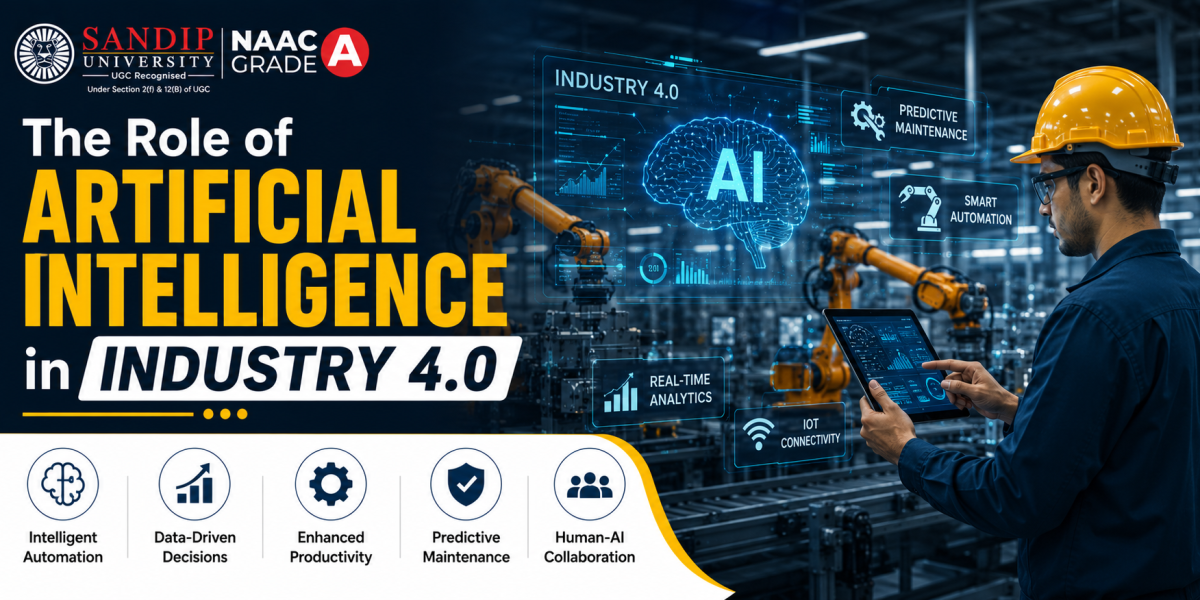
Industry 4.0 is the fourth industrial revolution and the impact of Artificial Intelligence in this revolution is significant. It combines cutting-edge digital technologies with conventional production techniques to produce more intelligent and effective systems. The 4th Industrial Revolution focuses on intelligent automation and connected systems, whereas the earlier industrial revolutions centred on mechanisation, electrification and computerisation. It fuses technologies such as cloud computing, robots, big data analysis, artificial intelligence and the Internet of Things. These technologies combine to form a very intelligent and effective industrial environment requiring minimal human involvement. In today’s technology, some of the best engineering colleges in Nashik artificial intelligence plays an important role because it enables the machine to learn, analyse information, think and make decisions flexibly.
How Will Artificial Intelligence Integrate into Different Industries?
Artificial Intelligence forms the basis of intelligence in Industry 4.0. It aids robots and machines to imitate human mental processes like pattern recognition, problem solving, learning from past experiences, and making sound decisions. With the previous industrial process machines were only able to do certain things. But, with the incorporation of AI, they’ve become intelligent machines that can learn and grow continuously. Industries are now flexible, efficient and productive due to the development of machines to become intelligent machines. The integration of artificial intelligence (AI) can enable organisations to achieve greater innovation and efficiency. Automation is one of the significant contributions of Artificial Intelligence to Industry 4.0. Time-consuming and repetitive activities can be efficiently and accurately handled by AI-powered systems. Furthermore, the automation enabled by AI technology greatly enhances the efficiency and reduces expenses in industrial settings. Predictive Maintenance is another main application of Artificial Intelligence in Industry 4.0. For traditional industry, if the machine suddenly fails, it will lead to production delay, and finally result in loss in production and increase the cost of maintenance.
What is Predictive Maintenance?
Predictive Maintenance (PredM) can extend machine life, minimise repair costs and ensure that manufacturing operations are not interrupted. Artificial Intelligence is also being used widely for Quality control systems. It is important to maintain high quality of the product in the manufacturing. The computer vision systems that utilise AI can accurately analyse a product and identify defects. The systems are used to examine images and videos taken from production lines, detecting even the smallest defects that the human eye can’t see. This guarantees the quality products that can be made available to the market. Artificial Intelligence is vital for real-time data analysis and decision-making, in addition to automation and quality control.
Today industries produce huge data from machines, sensors and production systems at every second. This information is very complicated and cumbersome to manually analyse. AI can do this efficiently and in a timely manner, converting it to valuable insights. These findings will benefit managers and decision makers in making informed decisions. AI can, for example, assist in the optimisation of supply chain management, in the refinement of production schedules, and in the improvement of the use of resources. This results in improved planning and profitability of industries.
Important Applications of Artificial Intelligence
Another important application of Artificial Intelligence in Industry 4.0 is developing smart factories. Smart factories are an environment where machines, systems and devices are networked via the IoT and communicate in real time. AI is the core intelligence which controls and manages these interwoven devices. It simplifies the manufacturing process, optimises production resources, and quickly resolves issues. Smart factories are very flexible and automated, with the operation changing dynamically with the variations in demand and conditions. Such flexibility was not possible in the old manufacturing systems. Artificial Intelligence is also changing various sectors, including automobile manufacturing, healthcare, logistics, retail, and energy.
Artificial Intelligence is playing a role in areas such as self-driving cars, smart assembly lines and vehicle diagnostics within the automobile sector. These are some of the areas in which AI is revolutionising industries in different sectors to become smarter, faster and more efficient.
Challenges of Implementing Artificial Intelligence
Though Artificial Intelligence has many benefits, there are also challenges in integrating Artificial Intelligence in Industry 4.0. The large investment for implementing Artificial Intelligence is one of the challenges. This may prove challenging for smaller industries which may not be able to make this investment. Additionally, issues with cyber security are also a problem in this regard. Lastly, there are also concerns regarding employment as many jobs will become automated. A polytechnic diploma in engineering is a futuristic program that focuses on solving the challenges posed by artificial intelligence.
Conclusion
AI is a strong and transformative force in Industry 4.0. It transforms the industrial environment as a more intelligent, efficient and highly automated system. Whether it’s through automation, predictive maintenance, quality control, or real-time decision-making, AI is taking the lead in innovation across all industries. It contributes to reducing expenses, improving productivity and quality of products in industries. While there are some implementation hurdles to overcome, the benefits of AI are far outweighed by the drawbacks. With the advancement of technology, Artificial Intelligence will play an even more significant role in the future developments of Industry 4.0 and will become even more refined. In conclusion, AI is not just a tool for improvement but a force that will shape the future of industrial transformation.
Looking for a career in AI and smart manufacturing? Discover engineering programs at Sandip University today.