
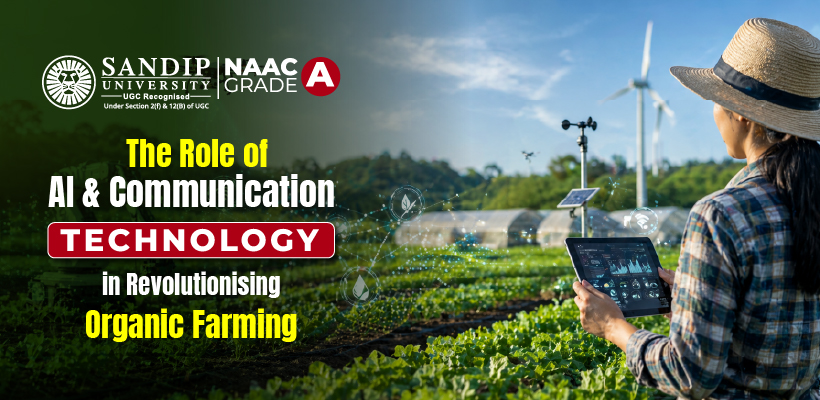
Recent advancements in hardware technology, artificial intelligence (AI) and data science are leading to the big changes in the agricultural sector. Traditional organic farming uses natural methods and delivers benefits to the environment as well as the healthy food in reach with natural vitamins and other supplements to humans as well as pet animals. Students graduating from some of the top AI colleges in Nashik are leading the way in developing these modern tools and technology that will help farmers to get more yield, less waste, and grow better crop quality.
How is AI Transforming Organic Farming?
The AI is highly accurate and significant in organic farming because it will deliver the correct information and replies based on data. In today’s era managing soil fertility and getting rid of pests without poisons are two major objectives that are often solved with the help of organic farming. Machine learning algorithms and predictive analytics are two types of AI tools that help farmers make smart choices for better interaction with the environment for best yield.
If you take an example of agriculture drone or unmanned aerial vehicles (UAVs) are revolutionising the organic farming by enabling precise, efficient, and data-driven management system. The key applications include automatic spraying of organic pesticides and soil activators and organic fertilisers, crop quality monitoring via multispectral and wireless sensors, 3D mapping, and aerial seeding, reducing labour, efficient water usage, and reduced input costs. These tools enhance productivity by optimising crop health management and providing actionable, real-time data for farmers.
IoT based Smart Irrigation System
As we know the scarcity of ground water and over utilisation of water resources with ecological farming requires careful water control, and new smart irrigation technology is changing how farmers use water for irrigation. These systems utilise Internet of Things devices and AI programs to monitor soil moisture levels and weather forecasts.
Smart organic farming uses precise and accurate data to ensure that crops will get the exact amount of water they need, which reduces water wastage and uses it very efficiently. This is especially beneficial in drought-prone areas where water conservation is essential and challenging. Farmers may grow healthy. Organic crops while following ecologically friendly procedures and adopting natural processes which are designed by nature.
Robots in Organic Farming
To achieve high productivity with best quality, Robots is another technological advancement that is making waves in organic agriculture. Researchers are developing stages for autonomous robots to perform labour-intensive routine tasks such as planting, weeding, and harvesting the different types of robots used in organic farming.
Organic growers find weed controlling to be a very time-consuming task due to the prohibition of synthetic herbicides. AI-equipped robots can locate such weeds and eliminate them without hurting crops, saving time and removing the weed for manual labour. These robots not only increase output but also enable farmers to concentrate on other elements of organic farm management.
Blockchain Technology for Transparency
Trust and total Transparency is essential to gaining customers and their satisfaction ‘ to make trust by the customer in organic farming, Block chain technology provides a safest, accurate and unchangeable ledger for tracking the path of organic fruit and vegetables from farm to the end user. Customers can view comprehensive details on the origins, cultivation methods, and organic status of their produce by scanning the QR code on it which has details of all parameters. This degree of transparency and openness helps organic producers stand out in the market and increases consumer confidence.
AI-Powered Market Analysis
All these Organic producers must have a thorough understanding of consumer demand and preferences also market trends. To produce useful and demanded farming products, AI-driven trends and technologies examine data from a variety and different sources, such as retail sales, social media and meteorological trends. Farmers may frame and set competitive prices, forecast demand for certain crops, and adjust planting dates with the aid of these technologies. These Organic producers can minimise waste and increase earnings while upholding their sustainability commitment by coordinating their production with market demands and also contribute towards the reduction of pollution and global warming.
Artificial Intelligence for Sustainable Crop Management
Today the AI is modernising crop management for organic farmers. Life-threatening weather, infections, pests and other crops are just a few of the possible hazards that predictive analytics can predict. Equipped with this understanding, farmers can use organic measures to protect their crops in a proactive manner. To organically increase soil fertility, AI-based systems can also recommend companion planting techniques and crop rotations. These environmentally friendly methods are perfect for organic farming since they guarantee sustained output without the need for artificial inputs
Energy Efficiency in Organic Farming
Availability of non-conventional energy resources like solar and wind energy, Organic farmers are lowering their carbon footprints thanks to technology for undependability on traditional energy resources. AI-driven climate and weather control systems, energy-efficient greenhouses, and solar-powered equipment are all becoming more and more effective. AI for instance, can control and maximise crop growing conditions and reduce energy usage in greenhouses by controlling the parameters like temperature, humidity, and lighting intensity. These developments not only reduce expenses and pollution but also complement organic farming’s environmentally aware philosophy,
Enhanced overall Efficiency: Farmers can focus on making strategic decisions since automation as well as precision tools saves time, money and efforts.
Improved Resource Management: Smart organic farming systems encourage sustainability by using less energy equipment, water, and other resources.
Improved Crop Quality: Data collection and Data-driven technology insights ensure the cultivation and irrigation of crops under ideal conditions and environment, resulting in production of healthier, testy and better-quality food.
Consumer Trust and Goodwill: By increasing the transparency and use of Blockchain technologies promotes confidence and trust in organic certification and distribution.
Conclusion
AI and Latest technology are changing the scenario of organic farming by solving irrigation and organic fertiliser requirement problems that have been around for a long time and creating new ways to be sustainable for Indian farmers. Professionals holding a B.Tech in Artificial Intelligence and Machine Learning program are developing technologies, like smart and efficient irrigation systems and Blockchain technology, to help organic farmers grow more efficiently and sustainably in a better world, while still maintaining the customer standards and demands for high-quality and healthy food. Use of these technologies along with organic farming methods will be crucial in creating a better and more productive future as the farming industry changes. By utilising these new technologies, organic farmers can remain innovative and contribute to a better non polluted world.