
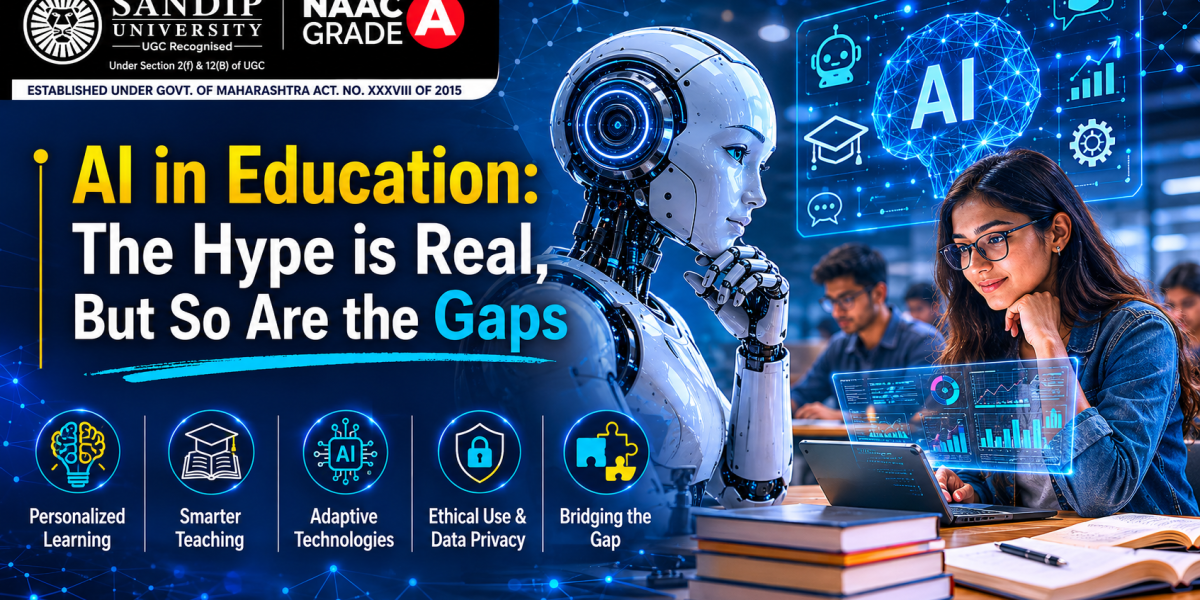
I want to start with a story that still bothers me a little.
Two years back, I was visiting a relative in Nagpur — she teaches Class 9 and 10 Maths in a semi-private school. Decent school, not elite, not struggling either. I was telling her about some AI tutoring tool I’d read about, something that supposedly adapts to each student’s level and gives personalised feedback. Her response was very simple: “Our students share one phone between three siblings at home. How will AI help them?” Faculty from some of the top AI colleges in Nashik are focusing on this question and are trying to find adequate solutions.
I didn’t have a good answer then. I still half-don’t. But I also think the conversation around AI in education has gotten stuck between two very loud groups — the people who think AI will fix everything, and the people who think it’s all nonsense distraction from real problems. The truth is somewhere messier, more interesting, and more frustrating than either camp admits.
AI in Indian Classrooms: Reality vs Expectations
Let’s be honest about what AI in education looks like right now, at least in the Indian context.
At the top end — premium coaching institutes, international schools, well-funded edtech platforms — there is genuine, working AI. Adaptive practice engines that identify weak spots in a student’s understanding and serve more of those specific question types. AI-generated doubt resolution that answers at 11 PM when no teacher is available. Automated essay feedback that at least catches structural problems even if it can’t judge real insight. These tools exist, work reasonably well, and students are using them.
Then there is everything else. Government schools, budget private schools, rural areas — the conversation is almost entirely theoretical. Infrastructure isn’t there, teacher training isn’t there, devices aren’t there. And honestly, in many of these schools, the more pressing problem is not “how do we personalise learning with AI” but “how do we get children to attend regularly” or “how do we make sure the teacher shows up.”
I say this not to be cynical but because I think pretending this divide doesn’t exist leads to policy decisions that serve the already-served.
Where AI is Actually Helping Students
Okay, given all that, here is where I genuinely think AI is making a difference or has real potential.
Doubt resolution at scale: This is probably the biggest one. A Class 12 student preparing for JEE in a small town — she might have one good teacher for Physics, maybe none for Chemistry. An AI that can answer “why does this specific step in this derivation work” at midnight, patiently, repeatedly, without irritation — that is genuinely valuable. Platforms like PhysicsWallah and others have been building this out, and the usage numbers are real.
Language learning and reading support: AI tools for improving English — pronunciation feedback, grammar correction, reading comprehension — are showing strong results particularly for first-generation English learners. The feedback loop that a human tutor would provide is replicated reasonably well, and at essentially zero marginal cost per student.
Teacher workload reduction: This one gets less attention than it deserves. Teachers in India are drowning — lesson plans, administrative work, progress reports, parent communication. AI tools that draft lesson summaries, generate practice worksheets, or flag students who are consistently getting things wrong in assessments — that frees up actual human time for actual human teaching. This seems obvious but implementation is still patchy.
Assessment beyond rote. Traditional Indian exams reward memorisation brutally. Some newer assessment tools powered by AI are trying to test conceptual understanding, not just recall — dynamic question generation, case-based problems that can’t be mugged up. Whether these actually get adopted at scale in a system built around board exams is another question, but the tools themselves are getting more sophisticated.
The Problems That Don’t Go Away with Better Technology
Here’s my actual worry about the AI-in-education conversation. We keep talking about technology as if the problem is technological.
The deeper problems are not. A student who is malnourished, working part-time to support family, living in a house with no quiet space, taught by a teacher who is exhausted and underpaid — AI cannot fix any of that. A personalised learning algorithm is useless if the child is not emotionally or physically in a state to learn.
There’s also a real question about what AI optimises for. Most AI tools in education are optimised for exam scores, because that is what is measurable. Learning, curiosity, critical thinking, the ability to sit with uncertainty — these are much harder to measure and therefore mostly absent from what AI in education is actually reinforcing.
I have seen this up close — students who have become genuinely good at getting AI tools to help them get correct answers, but have no idea why the answer is correct. That is not a technology failure exactly. It’s a design and incentive failure. But it’s real.
What I Actually Think Will Happen
The honest version: AI will meaningfully improve outcomes for students who already have decent access and infrastructure. For everyone else, the gap might actually widen before it narrows — because the students with qualifications from some of the best computer science colleges in Maharashtra will benefit from AI faster and more fully than students without.
The schools and systems that figure out how to use AI to amplify great teaching — not replace mediocre teaching — will produce something genuinely powerful. That combination of a caring, skilled teacher and an AI that handles repetitive feedback and doubt resolution and differentiation? That’s the version of this I’m excited about.
But we need to stop pretending the technology alone is the intervention. It never was.
From someone who spends too much time thinking about edtech and too little time agreeing with the optimists.