
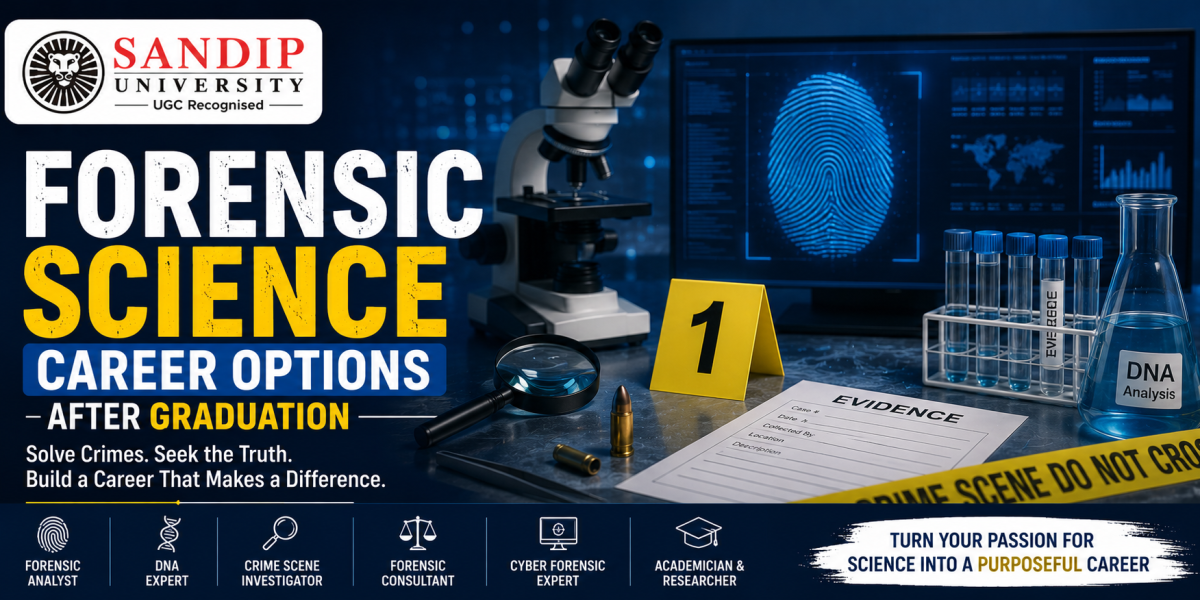
Forensic science is the branch of science which is used for the purpose of the law. The forensic sciences are used around the world to solve civil disputes, to enforce criminal laws and government regulations and to protect public health. Forensic science draws upon a variety of scientific disciplines including biology, physics and chemistry.
Forensic scientists use various different scientific techniques to examine and interpret evidence in connection with civil and criminal proceedings. Some of the top forensic science colleges in Nashik train students to learn how to interpret and examine evidence in high-tech labs.
In criminal law, forensics help to prove the guilt or innocence of the defendant. In civil cases, forensics helps to resolve a broad spectrum of legal issues through the identification, analysis and evaluation of physical evidence. Forensic science draws contributions from almost all scientific branches like physics, chemistry, biology, forensic engineering, electronics, and computer science, etc., for recognising, identifying, and evaluating any physical evidence that is brought to any forensic scientist for examination.
In the modern judicial system, it has become an essential part because it utilises a vast spectrum of available science to acquire crime relevant, factual, and legal information. Forensic science spreads over Document examination, DNA analysis, Electronic or Digital Media examination, Toxicology, Ballistics, etc.
Major Branches of Forensic Science
The major branches of forensic science include:
- Forensic Biology and DNA Analysis
- Forensic Chemistry
- Forensic Toxicology
- Fingerprint Examination
- Ballistics and Firearm Examination
- Questioned Document Examination
- Cyber and Digital Forensics
- Forensic Psychology
- Forensic Anthropology
- Forensic Odontology
- Crime Scene Investigation
- Audio-Video Forensics
How to Become a Forensic Scientist?
1. High School Education: Choose science stream with Physics, Chemistry, Biology, or Mathematics subjects at 10+2 level. Understanding of science subjects is very important for forensic education.
2. Choose any of the following streams for Bachelor’s degree:
- B.Sc. Forensic Science
- B.Sc. Chemistry
- B.Sc. Biology
- B.Sc. Physics
- Biotechnology
- Microbiology
- Biochemistry
- Computer Science (for Digital Forensics)
3. A Master’s degree helps students specialise in a particular area such as:
- Forensic Biology
- Forensic Toxicology
- Digital Forensics
- Forensic Chemistry
- Ballistics
- DNA Analysis
- Cyber Forensics
- Questioned Documents
4. Ph.D those who are interested in research and academic careers, a doctorate in forensic science or a related discipline can be pursued.
5. Diploma and Certifications are also focused on niche forensic areas such as digital forensics and various other relevant fields.
Various diploma courses and certification programmes are available in:
- Cyber Forensics
- Mobile Forensics
- Ethical Hacking
- Digital Evidence Analysis
- Crime Scene Management
- Fingerprint Examination
- Forensic Photography
Essential Skills Required for Forensic Science Careers
In addition to educational credentials, the successful forensic scientist should have the following:
- Strong analytical and observation skills
- Scientific reasoning
- Attention to detail
- Problem-solving ability
- Report-writing skills
- Knowledge of criminal law and courtroom procedures
- Computer proficiency
- Integrity and ethical conduct
Recruitment Pathways for Government Jobs
Entry into public forensic roles follows a regulated selection system. Through these pathways, government jobs for forensic science graduates enter stable and professionally governed careers.
- Union Public Service Commission (UPSC)
- State Public Service Commission
- SSC CGL
- SSC CHSL
- IB ACIO II
- UGC NET
- FACT (Forensic Aptitude and Caliber Test)
- Scientific Officer examinations
- DRDO Recruitment
- CSIR Recruitment
- State Forensic Science Laboratory Recruitment
- Police Recruitment Boards
- National Investigation Agency Recruitment
Government Career Opportunities
Public sector forensic employment covers various departments and agencies that offer strong career pathways under government jobs for forensic science.
- Civil servants (IPS, IRS etc.)
- Central Bureau of Investigation- CBI
- CID (Criminal Investigation Department)
- NIA (National Investigation Agency)
- IB (Intelligence Bureau)
- RAW (Research and Analysis Wing)
- NTRO (National Technical Research Organisation)
- NCB (Narcotics Control Bureau)
- NCRB (National Crime Records Bureau)
- BPR&D (Bureau of Police Research and Development)
- DRDO (Defence Research and Development Organisation)
- CFSL (Central Forensic Science Laboratories)
- Income Tax Department
- Teaching
- ED (Enforcement Directorate)
- SFSL (State Forensic Science Laboratories)
- Police Departments
- CERT-In (Indian Computer Emergency Response Team)
- DIA (Defence Intelligence Agency)
- NCCC (National Cyber Coordination Centre)
Popular Job Roles After Graduation
Forensic graduates may work as:
- Scientific Officer
- Forensic Scientist
- Crime Scene Investigator
- DNA Analyst
- Fingerprint Expert
- Toxicologist
- Ballistics Expert
- Cyber Forensic Analyst
- Digital Evidence Examiner
- Questioned Document Expert
- Forensic Chemist
- Research Scientist
- Assistant Professor
- Intelligence Officer
- Investigation Officer
With experience, professionals can advance to senior scientific officer positions, laboratory directors, research coordinators or forensic consultants.
Conclusion
Forensic science is an exciting field that connects science with the legal world, offering rewarding careers for people who are interested in investigation and justice. Forensic scientists can offer much to crime-solving and the legal system if they have the right qualifications and the right attitude. Forensic science careers can offer good salaries and job opportunities for those with the relevant qualifications.
One of the professions that is growing very fast is that of forensic science. Forensic science involves the application of science together with justice. With the development of technologies making crimes more sophisticated, there is a need for more highly trained forensic scientists holding M.Sc Forensic Science degree.
In addition to providing job security and high pay scale, a career in forensic science provides the unique chance to contribute to society through solving cases, identifying victims, fighting fraud and improving the judicial system. It allows graduates to have an interesting career path through constant learning, practical work and specialising in new areas like cyber forensics, artificial intelligence, digital forensics and forensic genomics. Explore B.Sc Forensic Science at Sandip University.