
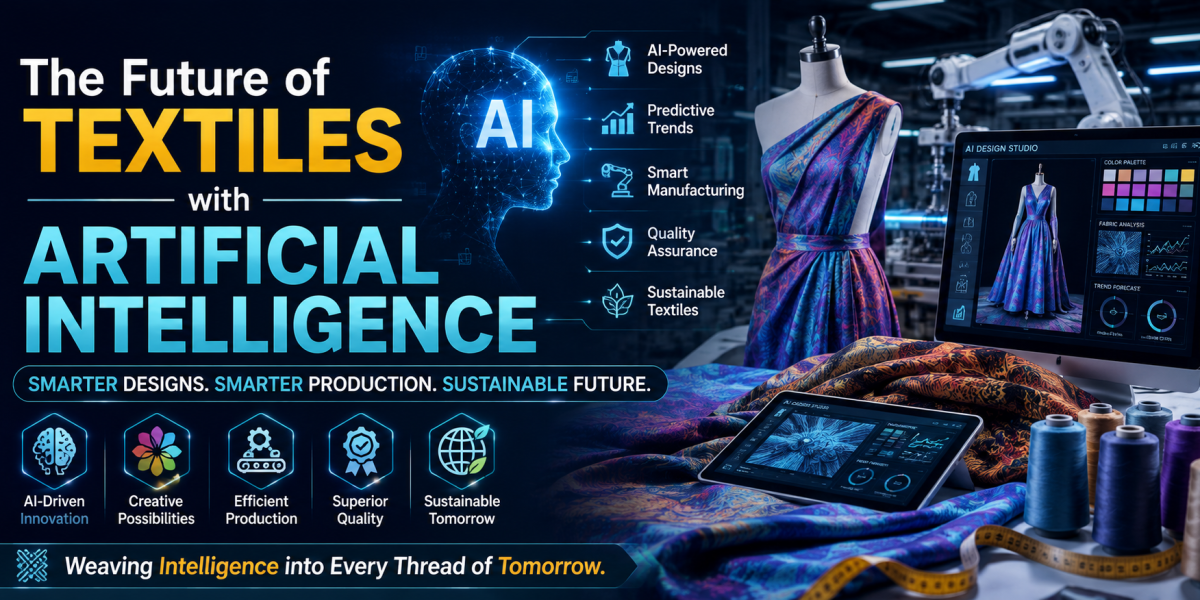
The textile industry knows no end and has gone through multiple changes throughout the centuries. First came the primitive forms of weaving, then the inventors took it to mechanisation, and now we are witnessing the dawn of an entirely new era. The age of Artificial Intelligence (AI). No longer is it something to be wondered about in Sci-Fi movies – AI is now a reality that finds its way into our lives daily.
The future of the textiles industry will not be “AI versus humans,” but rather “humans, in cooperation with AI, making the textiles industry great.” The ever-growing industry has entered a period of change, due to soaring production costs, environmental impact, shifting fashion trends, and increasing demands of the clients – and Artificial Intelligence promises to become the driving force of this evolution.
An AI design assistant will be able to scan thousands of design offers, color charts, fashion trends, and much more to help the designer from some of the top design colleges in Nashik come up with a winning combination. Such a combination will be inspired by the latest market demands as well as the specific preferences of a certain consumer base.
For instance, a designer dress collection for summer needs to feature the most popular colors and fabric structures. An AI assistant will be able to determine what colors and material structures will be in demand in different parts of the world. It would also suggest unique combinations that could become iconic.
At the same time, even a minor issue in production can lead to poor-quality rolls of fabric and tremendous losses for the manufacturer. With the help of AI, these losses can be minimised by implementing the concept of predictive maintenance. In other words, smart sensors will be able to assess the condition of various machines and predict when they may need servicing.
It goes without saying that such an approach will lead to higher production quality and fewer complaints from customers.
E-commerce sites use AI recommendation systems to make buying decisions based on the customers’ preferences, behavior, and even body measurements. In the future, one will be able to simply send a request to an e-commerce site using one’s smartphone and indicate one’s body measurements. The AI system will then recommend clothes and other textile products that would fit perfectly. It will also be able to suggest unique designs for specific clients or even entire collections.
Such an approach to selling and designing clothes significantly reduces the number of unwanted products or sizes, thus reducing waste and, consequently, costs. Overall, personalised approaches to textile customers enabled by AI will lead to higher customer satisfaction, as well as cost savings for both customers and manufacturers.
AI and Sustainability
They can also reduce the amount of chemicals needed for processing fabrics, as well as help recycle and reuse materials whenever possible. Moreover, an AI-driven textile manufacturing facility will be able to estimate the market demand and only produce the necessary products, thus eliminating the need to create goods that will eventually become waste.
Perhaps one of the ways AI can help the textile industry become more eco-friendly is through smart textile recycling. By using computer vision, one will be able to separate various types of waste materials, such as cotton, polyamide, wool, and so on. As a result, the process of recycling will become much faster and more efficient, thus paving the way for a circular economy.
Smart Textiles of the Future
AI-driven textiles will not only transform clothes and other textile goods but also create an entirely new category of products: smart textiles.
In many ways, smart textiles will behave similarly to “smart” devices we use in our daily lives. They will also include various sensors that will enable them to react to external stimuli, such as pressure or temperature. In the future, smart textiles will find their way into healthcare, military, sports, and many other industries.
AI in the Textile Supply Chain
At the same time, there are many steps involved in bringing a product to a store shelf. Textile manufacturers and sellers constantly struggle to keep a steady supply of goods while also minimising costs.
The good news is that with the help of AI, manufacturers and sellers will be able to optimise the supply chain and make it much more cost-effective. First of all, it will be much easier to estimate the demand for various products.
The Future of Textiles Professionals
Many fear that the rise of AI will lead to mass unemployment, but history tells us that new technologies rarely eliminate the need for people in a certain field – rather, they displace them. The same will happen to the textiles industry.
In other words, future textile designers will have to rely on AI design assistants to create new products. Similarly, future textile manufacturing managers will have to acquire new skills to be able to manage AI-driven textile production. Future quality inspection officers will have to learn new skills to work with AI-driven cameras that will be able to spot even the tiniest of defects. Future sustainability officers will have to use big data to keep the production processes eco-friendly and optimise resource consumption. Finally, future smart clothing designers will have to be able to work with a variety of sensors and turn them into working prototypes.
It is worth noting that many educational institutions are already updating their textile curriculums to include education in computer sciences, AI basics, digital manufacturing, automation, etc. As a result, future textile professionals holding a B.Sc in Fashion and Apparel Design will be much better prepared for the challenges and opportunities ahead.
Conclusion
The road to the implementation of AI in the textile industry is not without its challenges. One of them is the high cost of implementing such systems. Small and medium-sized manufacturers may not have the financial capabilities to afford such expensive equipment. Another challenge is a potential cybersecurity threat. AI systems will have vast amounts of very sensitive data, which may make them a target for hackers. Another potential obstacle on the path to fully AI-driven textile manufacturing is the need for retraining.