
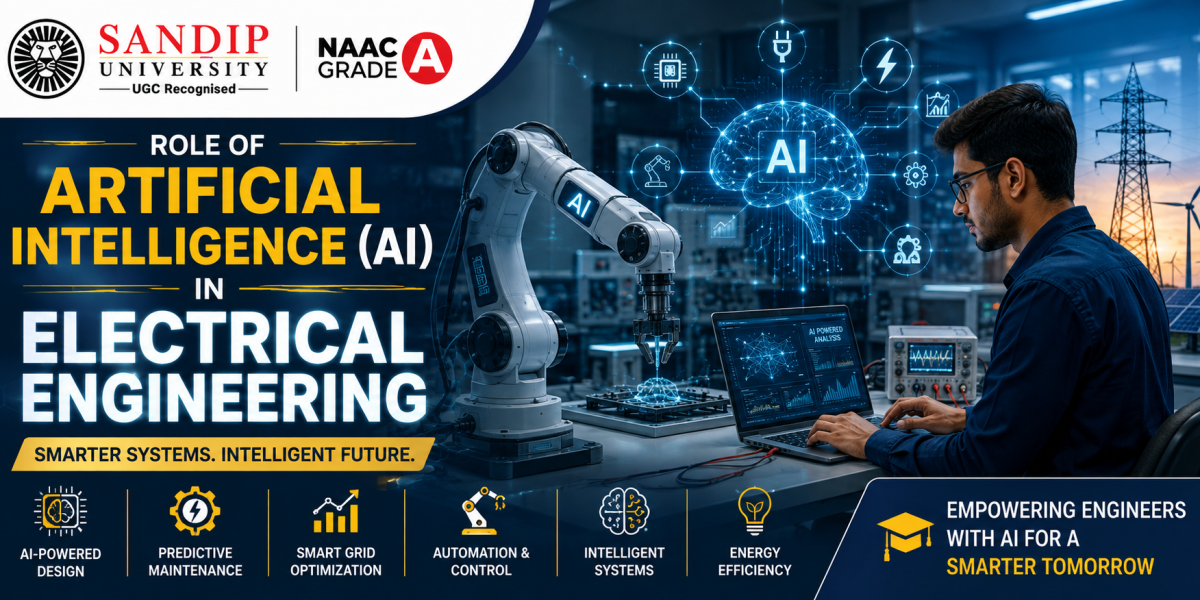
Today, Artificial Intelligence (AI) led a new wave of transformation. We only hear about Artificial Intelligence (AI) in tech conferences or computer science labs but today, it’s become a practical tool which is used in day to day human life and also in modern engineering. In electrical engineering it changes the way to design any electrical system, solving problems and improving productivity also improves the quality and revolution in industrial automation. For professionals holding a Diploma in Electrical Engineering it may include Smart power grids, improvisation in electric vehicles, or helping the researcher to discover the new materials or discover any system. AI is defining how engineers look at the problems, improving productivity and proving the reliable and sustainable solution.
Whenever Technological revolutions are there then Electrical engineering (EE) has always been a driving force behind it—from innovation like electric motor to the smart power grids and uninterrupted communication system.
Electrical engineering is progressing beyond conventional circuit design and power systems into intelligent, data-driven systems capable of self-optimisation, prediction, and autonomous decision-making. Nowadays Artificial Intelligence (AI) provides better and exciting opportunities in the engineering sector.
Let’s explore some of the most important ways Artificial Intelligence (AI) is shaping the future of electrical engineering.
-
Smarter and More Reliable Power Systems
Modern societies depend on electricity, and any interruption can affect households, industries, and healthcare. By using traditional power grids we are struggling with efficiency, detection of fault, also traditional power grids, while effective, often struggle with efficiency, fault detection, and fusion of renewable energy sources. AI offers a solution by enabling smart grids that analyse very large amounts of real-time data. One of the biggest impacts of Artificial Intelligence (AI) can be seen in modern power systems. If smart grids are used instead of traditional grids, then it analyses large amounts of real time data.
With the help of Artificial Intelligence (AI) power systems provide some data or assumptions for electricity demand, manage renewable energy sources like solar and wind, and respond quickly to changes in the network. Another major advantage is fault detection. Instead of waiting for equipment failure such as transformer or transmission lines, AI systems can sense the fault and provide the signal before creating any major impact or serious breakdown so it reduces outages and saves money and time.
AI also improves load forecasting by analysing historical consumption patterns, weather conditions, and seasonal trends such as summer, winter and rainy. With the help of AI, it provides precisely accurate predictions to help generating and distributing electricity companies for generation and distribution very effectively.
-
Making Electric Vehicles Smarter
EV is not the futuristic concept now it’s a mainstream of engineering. The issues with the battery efficiency, charging infrastructure, grid management are the main challenges. And to address this type of issue AI plays a vital role. Nowadays electric vehicles (EVs) are very common, to improve the performance and reliability AI is the best example.
Some modern techniques are used to check and monitor battery health, optimise charging and discharging cycles, and extend battery life with the help of Modern Battery Management Systems (BMS). This improves the total efficiency but also increases safety. Due to continuous operation of the battery the temperature changes, by using AI developed intelligent thermal management systems that help the batteries from overheating and improves the overall performance.
Another application is smart charging. For charging thousands of electric vehicles, during peak demand of electricity there is pressure on power grids to fulfil the customer demand without any interruption. EV become more reliable, efficient and sustainable by integrating with AI
-
Transforming Industrial Automation
The manufacturing section works on parameters like efficiency, quality & cost reduction. Predictive maintenance and intelligent process optimisation is enabled with the help of AI. In the manufacturing sector automation is a priority and nowadays there is a need for automation by using AI to increase productivity, quality and to reduce the operational cost. Predictive maintenance is one of the most important factors in Industry.
The electrical equipment such as motors, turbines, etc. Continuously collect the data with the help of sensors and with the help of AI, it analyses the collected data and provides predictions regarding the possible failure for that particular electrical equipment. With the help of this maintenance can be scheduled before unexpected breakdown occurs on the equipment and minimise the downtime for the industry.
-
Challenges and Opportunities
While AI offers have enormous potential, its integration into electrical engineering is not without challenges:
- Data Security: Smart grids and industrial systems work on large amounts of data, to prevent the attacks from cyber attackers, need good cyber security to data.
- Skill Gap: Engineers need to procure AI expertise to fully use its benefits. Continuous professional training and updated curriculum required.
- Cost of Implementation: To deploy the AI, initially it’s expensive but if we think about the long-term goal that is definitely beneficial.
In spite of these challenges, the opportunities are greater. AI is not replacing engineers; it is straightening them with tools to innovate faster and smarter.
Conclusion
For making smart power systems, more efficient industries, more reliable and sustainable technologies artificial intelligence is more important. Advanced research and from smart grids & electric vehicles to automation in the industry, AI providing innovation across the engineering field. As AI grows, electrical engineers who use these tools will help build a smarter, cleaner, and better-connected world for all the engineers holding qualifications from some of the best polytechnic colleges in Nashik.