
Skills that can shape the next generation of pharmacists from a pharmacy degree to a future-ready career
A Bachelor of Pharmacy (B.Pharm) is not just an academic course that will lead to a career in pharmacy; rather, it offers a foundation in medicines, drug formulation, pharmaceutical analysis, pharmacology and patient care and healthcare science. But with the changing dynamics in the pharmaceutical industry, a degree from one of the best pharmacy colleges in Maharashtra may not be sufficient to sustain a career growth.
The key factor for B. Pharm students is not just “What job can I get after graduation?” but “What skills can I acquire to build a career in the next 5 or 10 years?” The answer is in the fusion of pharmaceutical expertise and hands-on abilities, digital literacy and lifelong learning.
The Pharmacy career landscapes are evolving
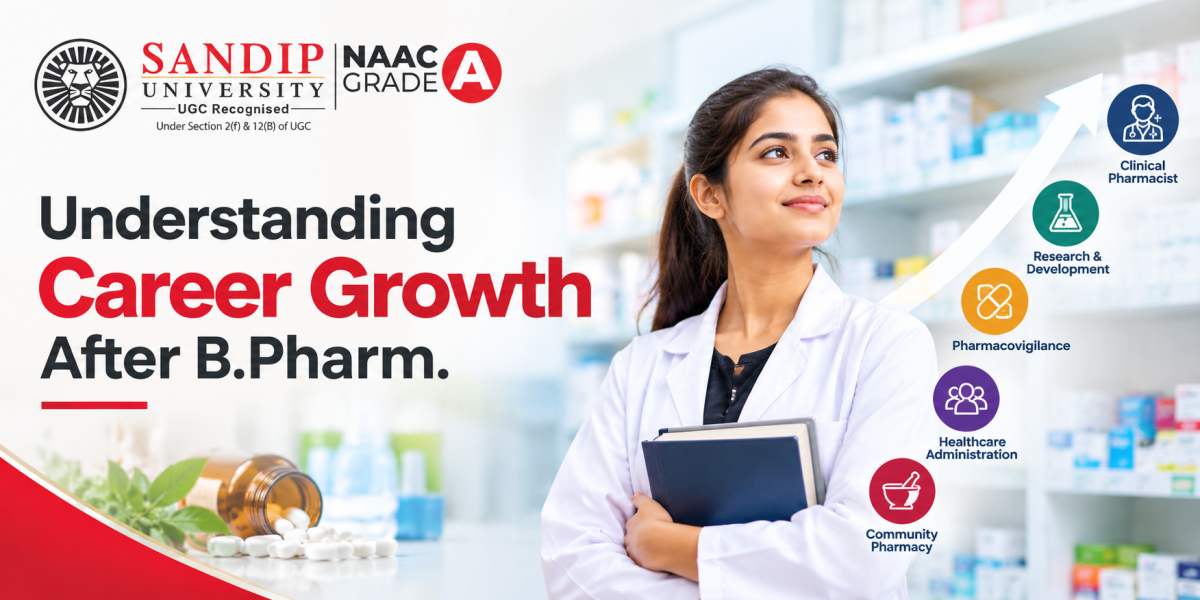
The pharmaceutical industry is growing not just as a manufacturer and a dispenser, but as a service provider as well. Pharmacy graduates will find new opportunities in digital health and data-driven healthcare, research, clinical studies, regulatory affairs and pharmacovigilance, as well as in biotechnology. The pharmaceutical industry in India is progressing toward innovation and advanced manufacturing practices, presenting opportunities for graduates with expertise in the field.
Avoid creating a strong foundation from a weak scientific/technical base
For highly satisfactory professional development and starting point different areas of pharmacy need strong scientific backgrounds, which are provided by subjects like Pharmaceutics, Pharmaceutical Chemistry, Pharmacology, Pharmacognosy and Pharmaceutical Analysis.
Pharmaceutical analysis is needed for quality control, formulation development depends on pharmaceutics, drug discovery depends on medicinal chemistry so as the natural products are discovered through pharmacognosy and drug action and safety depend upon pharmacology. The student should relate the concepts learned in class with the pharmaceutical practice.
Practical skills are crucial to success
Employers appreciate students who have the ability to use knowledge in real-life contexts. Students gain an understanding of professional contexts through laboratory practice, documentation, analysis of results, standard operating procedures and basic quality practices. Classroom learning can help prepare students for industry by means of internships, industrial visits, research projects and workshops.
Digital Skills are now an essential requirement
Pharmaceutical and healthcare activities are increasingly dependent upon technology. Handling information has changed with the advent of digital databases, electronic documentation, and data analysis and technology-assisted research. B.Pharm students don’t have to be programmers. But knowledge of digital literacy, data interpretation, literature searching and knowledge of digital tools can be a wedge.
Artificial Intelligence (AI) can help in the areas of research, information management and analysis, but should be used in conjunction with, not in place of, professional knowledge. The knowledge of its applications and limitations will become more and more important.
Communication skills are a professional skill
The pharmacist has to be able to communicate effectively as well. Skills in communication are useful in laboratories, hospitals, pharmaceutical companies, research organisations and in regulatory environments. Clarity is essential for professional emails, reports, presentations, patient communication and teamwork. Seminars, poster presentations, discussions and research activities can strengthen these abilities. Complicated language is not necessary to be a good communicator; it is necessary to make information understandable to the intended audience.
Prepare a Career Portfolio in college
Students can create a portfolio of academic performance, projects, internships, research presentations, workshops, technical skills and professional activities. A portfolio is an aid in CV preparation and interviews. It is important for the students to concentrate on meaningful learning, not certificates.
The Future Pharmacist Will Continue to learn
Pharmacy is closely related to science, healthcare, regulation and technology. These regions are still evolving and lifelong learning is a key component of continuing education.
Sandip University’s B.Pharm program stresses lifelong learning, the use of modern tools, communication, problem solving and professional responsibility. These skills can aid students in adjusting to change in the workplace. Career development is an ongoing process of learning, using learning, getting experience, and acquiring skills.
Conclusion
A successful pharmacy career isn’t started when you accept your first job. It starts when students know the profession, acquire skills and learn about what can be done better. The confidence is gained from experience. Adaptability is enhanced through digital and professional skills. Opportunities are created through communication and knowledge is kept relevant through ongoing learning.
For a pharmacist to be successful in the future, they must have an understanding of medicines and be willing to embrace new technologies and healthcare demands. Learning thoroughly, working consistently, remaining curious and continuing to learn is the best investment for a student in the pharmacy field. Good preparation can enable students to enter the world of work confidently and flexibly.
Explore B.Pharm Admissions at Sandip University