
At the time I started teaching, a career in pharmacy was fairly straightforward – manufacturing, quality control or a pharmacy counter. Today, this is not the case anymore. Pharmacy is now merged with biotechnology, Data science, Clinical research, Digital healthcare. Pharmacy students’ “Where can I get a job?” question has evolved to “How can I prepare for a field that is constantly changing?”
Research is the Base of the Progress in Pharmaceuticals
All medicines on the shelves of a pharmacy started as questions. All medicines found on the shelf of a pharmacy originally started as questions. Research is used to find new medicines, to improve existing treatments, to create new methods of delivering medicines, to improve the safety and quality of medicines and to help to solve issues in formulation and manufacture. It also contributes to lowering the cost of healthcare and enhances the patient experience.
Research is not just gathering information. It involves determining a true problem, gathering valid data and establishing a viable solution. Once learnt, this is a skill which is useful in all pharmaceutical roles.
Opportunities for B.Pharm and M.Pharm Students
For B.Pharm Students at the Pharmacy College start developing their research orientation in the classroom and laboratory. The development of scientific thinking is built in the academic projects and formulation and analytical studies, as well as pharmaceutical chemistry, pharmacology, pharmaceutics, pharmacognosy and quality assurance courses. There are literature-based projects and internships which provide relevant exposure. The most important is asking a question: why did a formulation fail to work, why did a method vary and why does one excipient perform better than another?
Specialisation Opportunities for M.Pharm Students:
- Advanced formulations and novel drug delivery: development of new drug formulations which deliver the drug at the correct rate and location in the body.
- Quality by Design: to build quality into a product by scientific understanding instead of after the product is made.
- Analytical method development: Development of reliable analytical methods for measuring the purity and strength of drugs.
- Pharmacovigilance, clinical research and regulatory science: keeping an eye on safety, running trials, complying with regulations.
- Nanotechnology and pharmaceutical biotechnology: medicine using biologically derived medicines and working with tiny carrier systems.
- AI in drug discovery: the use of computer models and data to forecast drug behaviour, prior to experimental testing.
Moving to a New Career Path in the Pharmaceutical Industry and Other Emerging Fields
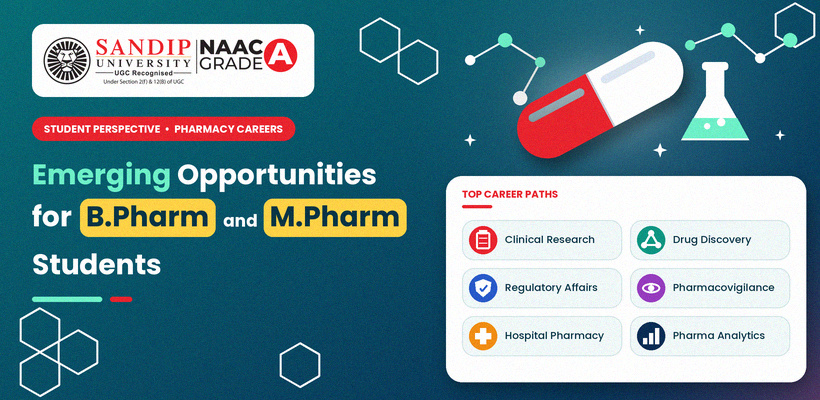
The pharmaceutical industry is expanding and is increasingly technology driven, providing opportunities in various functions: research and development, production, quality control and assurance, regulatory affairs, clinical research, pharmacovigilance, formulation and analytical development, medical and scientific writing and pharmaceutical management. Both are characterised by their own disposition. Students have a preference for bench work, documentation, data or communication. I would suggest students investigate these areas early and not take it for granted that one is for all students. There are opportunities to be sure, but it is for those who are ready for it.
Artificial Intelligence and Data Analytics in Pharma
AI and data analytics are being used to accelerate the process for drug discovery and to make sense of huge volumes of data – and graduates who are at ease with such data will be able to benefit.
Pharmacists and scientists from some of the top pharma colleges in Nashik will be increasingly at the centre of therapy decisions, and drug therapy will be personalised medicine and pharmacogenomic. Therapeutics and categories such as biologics and biosimilars are emerging and require new analytical and regulatory skills.
These decrease side effects and increase targeting, in the case of nanomedicine and advanced drug delivery. Insights from real world use of digital health and real world evidence support clinical trial data. Automation and green manufacturing: efficiency and sustainability are becoming a part of the quality and compliance thinking.
Skills Beyond the Classroom
Marks are important but not all that is required. Research methodology, literature searching, data interpretation, critical thinking and scientific writing are sought after by the employers and research supervisors. The ability to communicate and present, to work in teams and to be digitally literate are all equally important, as well as simple data analysis. Students should also be aware of issues of research ethics (including honesty in reporting the data and avoiding plagiarism) and be aware of the concept of intellectual property, including patents. All these skills are interrelated through industry exposure.
Building Links Between Academics and the Industry
Learning in the classroom is more meaningful if connected with actual pharmaceutical issues. Students are given an insight into how a formulation goes from laboratory scale to production through internships, industrial visits, industry-based projects, guest lectures and training programmes where they learn that quality and regulatory requirements are key factors for all decisions. Through collaborative and problem-based research, universities and industry can work together to find the solution to real-world problems, and ultimately, the transfer of technology. Students involved in such interactions have a much greater awareness of the sector than students who learn from books.
Planning Ahead for the Future
B.Pharm students should:
- Enhance skills in key areas of learning
- Be actively involved in projects and gain some lab skills
- Regularly read scientific literature
- Pursue internships
- Gain basic knowledge of digital and data skills
M.Pharm students should:
- Choose problems for research rather than easy problems
- Exemplify research methodology and scientific-writing skills
- Understand publication ethics
- Seek industry interaction
- Discuss interdisciplinary research areas like biotechnology, engineering and data science
Other graduates will consider careers outside of the traditional roles, such as pharmaceutical start-up, healthcare technology, contract research, analytical services, formulation innovation, digital-health solutions and scientific consultancy. Being an entrepreneur is rewarding, but it’s challenging and unpredictable. Demands high knowledge, patience, guidance and a realistic perception of regulatory and financial issues.
Conclusion
Students with solid fundamentals and the curiosity, research and awareness of the industry have ample opportunities in today’s world of pharmacy. The skills of questions, honest consideration of evidence, and an attitude of continual learning will continue to be useful, even in a changing landscape of technology. B.Pharm and M.Pharm students from some of the best pharma colleges in Maharashtra should develop a solid foundation, find out where to use what you’ve learned and remain connected to the progress of pharmaceutical science.