
Why is Natural Product Research Important?
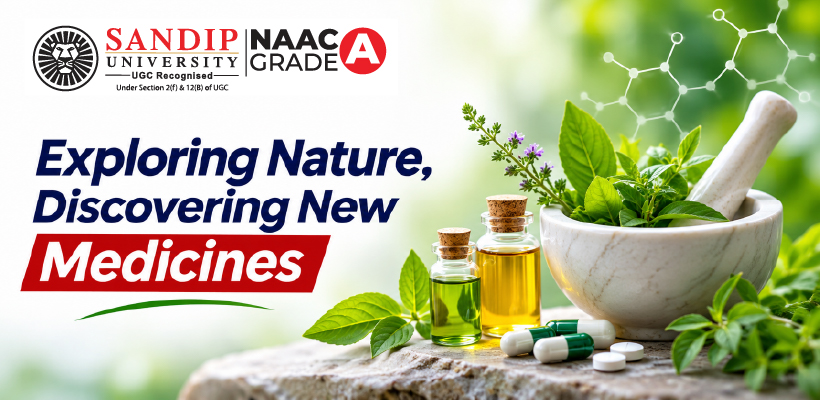
Natural product research is the scientific study of substances obtained from natural sources which includes plants, animals, microorganisms and minerals. In the current healthcare landscape, natural product research is gaining considerable scientific and commercial significance, driven by increasing consumer interest in plant-based medicines, herbal formulations, nutraceuticals, cosmeceuticals, and holistic wellness products. Some of the top pharmacy colleges in Nashik like Sandip Foundation are conducting research in this field to boost innovation.
The global herbal medicine market is estimated to have reached USD 107.7 billion in 2025, reflecting the expanding demand for herbal healthcare products. Natural product research therefore plays a vital role in validating traditional knowledge through systematic investigation of chemical constituents, biological activities, quality, safety, and therapeutic potential. By integrating traditional knowledge with modern analytical techniques researchers can identify promising bioactive molecules, develop standardised formulations, and explore innovative healthcare products that meet scientific, regulatory, and market requirements.
Contribution of Natural Products to Healthcare and Important Discoveries
Natural products have played a significant role in healthcare for centuries, forming the foundation of traditional systems such as Ayurveda, Siddha, and traditional Chinese medicine. Medicinal plants, including turmeric, neem, tulsi, ashwagandha, ginger, and aloe vera, continue to be investigated for their bioactive constituents, therapeutic properties, quality, and safety. Natural products have also contributed to modern drug discovery, as demonstrated by penicillin from fungi for bacterial infections, morphine from Papaver somniferum for pain relief, artemisinin from Artemisia annua and quinine from Cinchona for malaria, reserpine from Rauvolfia serpentina for hypertension, vincristine and vinblastine from Catharanthus roseus and paclitaxel from Taxus brevifolia for cancer treatment, and cyclosporine from fungi to prevent organ transplant rejection. These examples highlight the importance of integrating traditional knowledge with scientific research to discover, develop, and evaluate natural products for healthcare applications.
Department of Pharmacognosy in Natural Product Research at SIPS
The Department of Pharmacognosy provides a scientific foundation for investigating medicinal plants and natural products. Research in this field includes botanical identification, microscopic examination, physicochemical evaluation, phytochemical investigation, extraction and isolation of bioactive constituents, assessment of biological activities, formulation development and its standardisation and optimisation and any other related research. These studies help establish the identity and quality of natural materials and support the systematic investigation of substances with potential pharmaceutical and healthcare applications.
Natural Product Research Activities at SIPS
At Sandip Institute of Pharmaceutical Sciences (SIPS), natural product research can be explored through a systematic sequence of scientific investigations, from the selection of natural materials to the development of promising research-based products. Depending on the research project, activities may include medicinal plant identification, collection and processing of plant materials, extraction of constituents, preliminary phytochemical screening, isolation of selected compounds, formulation development, standardisation, optimisation, and biological screening. These activities help students understand how natural materials can be investigated using established pharmaceutical research methods. They also provide opportunities to develop practical skills, analytical thinking, and an appreciation of scientific research.
Formulation Development
Formulation development involves incorporating selected extracts or constituents into suitable dosage forms or products, such as tablets, pills, syrups, capsules, creams, gels, ointments, or other appropriate preparations. The formulation is designed according to its intended use, the properties of its ingredients, and relevant quality requirements. Researchers evaluate parameters such as appearance, pH, consistency, stability, dissolution, disintegration studies and other formulation-specific characteristics. Optimisation helps identify suitable processing conditions and ingredient proportions to improve product quality and reproducibility. These steps are essential for converting an initial research concept into a more developed formulation that can undergo further evaluation.
Importance of Standardisation, Optimisation and Biological Screening
Standardisation helps establish appropriate quality parameters and improve consistency between batches. Optimisation involves refining experimental conditions or formulation variables to achieve desired outcomes. Biological screening is used to investigate selected activities, such as antimicrobial, anti-inflammatory, diuretic, antidiabetic or other relevant effects, using appropriate methods. The findings provide preliminary scientific evidence to guide further research.
Natural Product Research to Innovation, Avishkar, Patents and Startup
Natural product research offers opportunities for innovation in herbal healthcare products, cosmeceuticals, nutraceuticals, personal care products, and other relevant areas. Students can learn to identify research problems, develop hypotheses, design experiments, evaluate findings, and refine promising ideas. Research outcomes may provide a foundation for prototype development, market feasibility studies, intellectual property assessment, and potential Startup proposals. However, commercial development requires additional attention to safety, quality assurance, regulatory compliance, manufacturing feasibility, and market requirements. By encouraging scientific thinking and entrepreneurship, natural product research can help students explore how research ideas may progress towards practical applications.
Exploring Natural Product Research Opportunities for Students at SIPS
Students interested in medicinal plants and herbal medicines, pharmaceutical sciences, and innovation can explore the research opportunities offered by the Department of Pharmacognosy at SIPS. Participation in suitable research activities can help them develop practical laboratory skills, scientific curiosity, problem-solving abilities, and an understanding of research methodology. Students may also gain exposure to the stages involved in investigating natural materials, from preliminary studies to formulation development and product-oriented research. Such experiences can support academic projects, higher studies, research careers, and entrepreneurial aspirations.
Natural Product Research, Innovation and Entrepreneurship at SIPS
As one of the top pharmacy colleges in Maharashtra, Sandip Institute of Pharmaceutical Sciences (SIPS) encourages students to explore natural product research through innovative projects, product development, and entrepreneurial initiatives. The institution receives at least two Startup-grants annually, files around ten patents each year, reflecting ongoing efforts to promote innovation and intellectual property generation. Furthermore, approximately 50% of students undertake projects based on natural products, focusing on medicinal plants, herbal formulations, bioactive constituents, standardisation, and potential healthcare applications. These initiatives provide students with opportunities to develop research skills, creativity, and translate traditional knowledge into innovative pharmaceutical products and entrepreneurial ventures.