
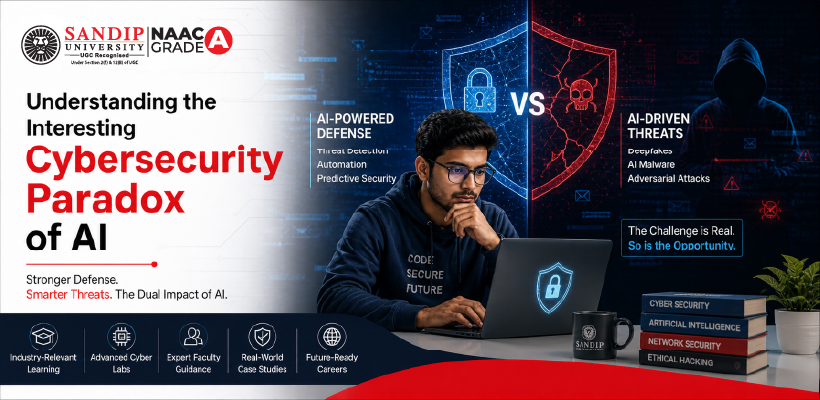
Artificial intelligence is no longer a plot point in the future- it is scanning your network traffic, automatically creating phishing emails, and is likely to write code with your developers. AI has proven to be a double-edged sword in the fight against cybersecurity. On the one hand, it will be able to defeat human attackers by outwitting them. On the other hand, it provides those very attackers with a lever to breach machine-speed defences. The inquisitive and a touch disturbing fact? The neural network that identifies a zero-day exploit can also be used to produce one. Some of the top artificial intelligence colleges in Nashik offer cutting-edge programs to train future engineers in this field.
New Superpower in the Defender
The positive things are best to begin with. Conventional security measures are based upon a signature -preexisting behaviour of badness. It is similar to seeking a given model of cars when the breaker has just come up with a flying horse. AI plays in the game. Unsupervised machine learning models can acquire an understanding of what normal looks like from billions of events and raise flags on irregularities in real time. 10 GB of encrypted data being downloaded very quickly by a user at 3 a.m.? AI notifications without having a pre-written rule.
Companies such as Darktrace and Vectra map baselines of behaviour across entire networks using AI. By the time the reaction to an intrusion by an IoT thermostat begins, scanning internally for a hacker, the AI will notice the deviation in a matter of seconds, not days. In addition, AI provides automated incident responses. The system can isolate an infected endpoint, block an evil IP and spin up a forensic snapshot before an attacker has even acquired privileges, rather than waking a sleepy SOC analyst in the middle of the night. It is a speed that people cannot do. But this is where the cheering is halted.
The Mute Revolution of the Attacker
It turns out cybercriminals have the same technology. Persistently trained generative AI-like think ChatGPT, but malicious thought-driven is a quiet revolution that has already begun. Phishing e-mails, which used to be full of grammatical errors and a suspect haste to sound urgent, have now been flawlessly written, personalised and context-sensitive. When attackers feed a LinkedIn profile and a press release issued by a company into a large language model, an email that perfectly mimics a request to send an urgent wire transfer comes out the other end, addressed to the CFO. No typos. No “kindly.” Weaponised fluency, de pure.
The next would be the border of polymorphic malware—names cognised by the traditional antivirus. However, malware powered by AI can recode itself each time it is duplicated, affecting its hash and framework without altering its malicious purpose. Suppose you had a virus that evolves faster than your definitions allow. Researchers have already revealed the production of generative adversarial networks (GANs) capable of generating evasive malware to trick commercial antivirus engines. The arms struggle has escalated to an exponential level.
Password cracking is aided by an AI, too. Trained on passwords (many billions strong, leaked online), neural networks can predict new, complex passwords (a password like IlovePizza99) not only at a speed faster than rule-of-thumb crackers but also with fewer errors. Why? Since AI learns patterns of human behaviour, it learns how we capitalise, how many symbols we introduce, and which numbers we choose.
The Deepfake Wildcard
Nevertheless, there is no AI and cybersecurity talk without deepfakes. A few seconds of someone speaking will now suffice to create a voice clone. The power of AI voice-generating attackers has already been utilised by posing as a CEO and duping an executive branch manager into sending him $243,000. Video deepfakes have become a reality — suppose you have a Zoom live meeting, and your colleague is a fake person who appears to be real-time, but is actually an AI avatar under the control of a threat actor. The verification of identity, the authentication process based on biometrics, and even the possibility of courtroom video testimonies are all at risk.
So, Do We Panic?
No. But we do rethink. The opposition is no longer an outlawing of AI- that is not possible. On the contrary, AI vs. AI techniques have to be taken up by the defenders. Similarly, we should be able to use machine learning to identify malware; now, we should be able to check phishing and deepfakes created by AI. Watermarking synthetic content, cryptographic attestation of media provenance (C2PA standard), and adversarial training, a procedure to expose defensive AI to offensive AI during training, are becoming requirements.
In addition, the human factor is also important. AI can identify suspicious emails; however, it cannot replicate the culture of trust and authentic verification. Even perfectly written requests will be viewed as a double-check through another channel to create the strongest organisations, prompting employees to embrace unexpected requests. And in the case of critical systems, a zero-trust architecture can even make sure that an AI-compromised credential can no longer go on a stroll laterally.
The Curious Takeaway
It is the dawn of a period in which the attacker and the defender are more of the same species: software that learns, evolves, and creates. Our struggle to combat cybersecurity is no longer a human-to-human battle or an automated tool battle; it is as much a model-to-model and dataset-to-dataset battle. The good news? The scale and quality of the data favour defensive AI. The bad news? AI offensive merely has to be corrected once.
Conclusion
Finally, AI is not going to kill cybersecurity jobs; it will elevate them. Instead of looking at logs and using software to analyse data, analysts will train, tune, and outengineer AI opponents. Professionals holding a B.Tech in Artificial Intelligence and Machine Learning are better-equipped to stay ahead of the competition in the job market. It is not a question of whether AI will be used to commit attacks; it is already occurring. The actual issue is if the people can, and how fast, the same firepower can be repurposed, trust put back together in an AI-saturated world. The context, intent, or the silent gut sense that rescued the situation is forgotten, as is all its brilliance. That part? Still human. For now.
Start your journey in AI and cybersecurity—apply now at Sandip University.