
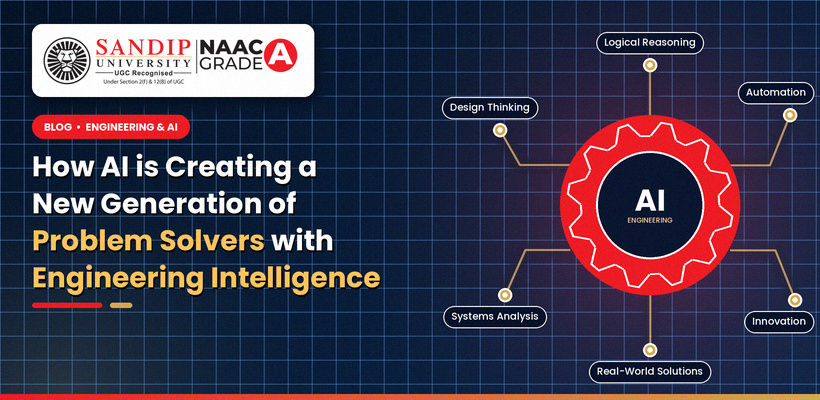
The technology of the era has been the way of every generation of engineers. The attention was once given to machines, electronics and automation. Later in the years, software became an important part of engineering, as did the internet. Nowadays, AI and Machine Learning are a part of that journey.
The unique feature of AI is that it enables a system to learn from information. Rather than programming a computer for every possible scenario, machine learning can assist the computer to identify patterns in data and to predict what happens as a result of the pattern.
This is a new mindset for math students from some of the top computer engineering colleges in Nashik. The challenge is no longer just to do well! It is understanding, as well as knowing, if a system can learn to get better, to make the process more efficient.
1. A Different Way of Looking at Problems
For example, look at manufacturing. A production line machine can operate normally for months, then suddenly suffer from some fault. Typically, maintenance is carried out on an event-based basis or at periodic times.
Sensors and machine learning can track information over time, such as temperature, vibration info and operating speed. When a specific pattern is observed before a machine fails, an AI system could detect this pattern early and alert the parties concerned.
Innovation is only relevant if the technology isn’t tied up in the process. The true advantage is what problem it is solving: reduce downtime, avoid unexpected breakdowns. Here’s a glimpse of how AI is making its way into engineering. Used because of real-world issues that can be addressed in a different way using data.
2. Machine Learning Is More Than an Algorithm
When students start learning AIML, they may come across various terms including classification, regression, neural networks, and deep learning. While these concepts are essential, knowing an algorithm is just part of a learning curve; there are many other steps to take.The more pertinent question is where and why it should be used.
Suppose that someone wants to create a system used to detect faulty products based on pictures. The project involves much more than selecting a machine learning model. Images have to be picked up and formatted. The model requires appropriate examples with which to learn. The results must be checked, and mistakes explained.
The difficulty is not with the model; sometimes it is. There might simply not be sufficient data available. It’s helpful to be able to identify these as important to master when being a good problem solver.
3. The Right Problem Comes First
AI has a huge number of applications, and it should be used for anything. One of the most typical pitfalls is to start off having a technology and search for a problem that could benefit from it. Things tend to go better the other way round with engineering.
The first item of interest for a useful project is the actual problem, which can be followed up by questions: Who suffers from it and/or whose problems does it cause? What causes it? What do you know about the situation? Are there ways for technology to help the situation?
It is only when you grasp these questions that it will make any sense to you when you consider if Artificial Intelligence is suitable to use. It’s a thinking style that is helpful to students. It drives them to seek knowledge concerning problems, not just products.
4. Data Has Changed the Engineer’s Toolkit
Engineering systems generate tremendous information amounts on a daily basis in the modern world. A car can make records of performance. It is possible for the factory to track machines at all times. A smart building can monitor energy usage. Even the simplest mobile app can provide data on the use of the app. When understood correctly, this can help to inform.
Working with data from this view is then becoming an important area of engineering education for AIML students. They acquire knowledge of sorting or categorising information, recognising useful patterns and understanding whether the results are truthful.
Meanwhile, pupils should develop an understanding of the need to be sensitive to errors and bias in data. The poor quality of information fed to a model can also yield a poor result. Language knowledge is essential as well as algorithm knowledge in real-world AI applications.
5. Projects Teach What Textbooks Cannot
An examination question is quite different to a project involving AI. During an examination, the problem is set. The student will frequently, in a project, need to state the problem, locate information, select a process and determine if the outcome is meaningful.
Things don’t always go as desired the first time. A model may be incorrect in forecasting. Data from a data set can be modified. Unexpected (even unfeasible) results can be produced by a program. An idea that seemed to be a good one going in may not work at all.
These experiences are worthwhile. Projects help students to explore a problem rather than seek an answer. This can be even more meaningful through hackathons, a series of hands-on exercises, research projects, and collaborative efforts. Learning how to get a wrong design right is as important as getting a right design right for an engineering student.
6. AI Is Bringing Engineering Closer to Other Fields
AI is also helping to create a greater connection between engineering and other fields.AI is used in the healthcare industry, agriculture, finance, education, transportation, and manufacturing industry. Consequently, a technical professional might be required to have some knowledge about the discipline where the technology is being utilised.
If a student is creating an AI approach for agriculture, he or she should have a basic understanding of agriculture. In the context of a healthcare application, this involves someone having a grasp of the problem from a healthcare point of view.
That’s why it’s sometimes essential to have a solution provider.If students show an interest in technology and a specific domain, they can provide an overall perspective on the problems they are dealing with.
7. AI Still Needs People to Make Good Decisions
While Artificial Intelligence can handle data rapidly, it can’t supplant the role of human judgment. It is normal for an AI tool to see a pattern and make a prediction, but it is up to people to decide what to do with these. This is especially crucial where personal information, healthcare, finance or key decisions are present.
Fears of privacy, equity, security and reliability can no longer be disregarded.AI usage should thus be embedded in the learning experience for students to have a sense of responsibility for their use. It’s important to grasp the limitations of an AI system as much as it is to understand its capabilities.
A good engineer is not just asking “Is it technically feasible?” The engineer also takes into account how suitable and useful it is.
8. Learning AIML in an Engineering Environment
Artificial Intelligence is being brought increasingly into the fold of engineering; pupils should not be restricted to using technology in books and lectures and should be allowed to use and resource their knowledge.
In order to give students exposure to new fields like Artificial Intelligence and Machine Learning, Sandip University, Nashik, has designed a curriculum in these departments. Students will be able to work on projects, learn about new concepts that can be developed with the help of technology and develop the ability to analyse and understand the real-world applications of AI.
A learning atmosphere that revolves around AIML can also provide students with the chance to venture into various other fields, such as machine learning, data analysis, intelligent software, automation, and more cutting-edge applications. These experiences can prepare students to have a broader understanding of what they’ve studied and what will be expected of them in a workplace.
9. The Engineer of the Next Generation
The use of technology will evolve, but the main goal of engineering remains the same: to devise alternative and improved methods of problem solving.
Artificial Intelligence provides another toolkit to engineers. Machine Learning makes learning from data possible. With its capabilities, Generative AI is enhancing interactions with information and generation of new content. However, none of these technologies—these alone, without guidance—can determine which troubles to solve.
That’s a job for people yet. The next generation of engineers will have to learn an engineering skill; they will have to learn to be curious, be able to make a judgment and be prepared to try out new things. They will have to comprehend technology, but not forget the humans and issues back.
Conclusion
AI and engineering are both deployed to make machines smarter, but they can also help to make solutions smarter. Professionals from some of the best computer science colleges in Maharashtra know this fact. This is the true essence of Engineering Intelligence: to use technology wisely to solve problems of significance.