
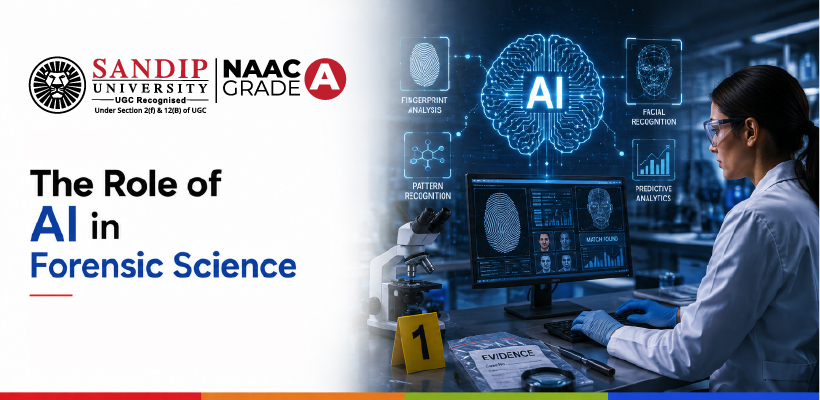
For more than one hundred years, forensic science has depended on the careful work of humans – comparing fingerprints under a magnifying glass, matching striations on bullets, and analysing DNA fragments in clean labs. Now, artificial intelligence has entered the picture and is changing the way forensic experts from some of the top forensic science colleges in Nashik work and making the whole process faster, more effective, and less prone to mistakes. AI is already making an impact in crime scene analysis as well as in court.
Speeding the Analysis of Evidence
Many benefits are already offered by AI in the field of forensic science. One of these benefits includes the speed of processing evidence. When traditional techniques such as fingerprint matching and DNA profiling are used, the time taken to complete these processes can stretch to weeks and sometimes even months. Even though millions of fingerprints exist thanks to so many databases, machine learning has enabled examiners to search for and locate a matching fingerprint in mere seconds.
Moreover, as for DNA phenotyping, new AI technologies allow for the determination of certain traits such as the color of the eyes and hair, and even approximate age, based on the DNA collected at the crime scene and stored in the database. The impact of quick action in real-life investigations is immense. If a rape kit is processed in a timely manner, then a potential offender may be stopped before their crimes increase.
Digital Forensics and the Data Explosion
In modern investigations, the significance of digital evidence is greater than ever; the numerous data-producing devices, such as smartphones, cloud accounts, social media, and IoT, generate huge amounts of data. Manual data analysis of such huge amounts of data is practically impossible, but AI-fueled digital forensic technologies can process call logs, chats, deleted documents, metadata, etc. and find various communication patterns or suspicious transfers far more effectively than with the help of traditional methods.
Analysing Images and Videos
Video surveillance footage is among the most popular types of evidence to analyse. AI-based video analytics can now help identify moving objects, track individuals through different video streams, improve the quality of video footage, and detect unusual behavior in real-time. Although controversial, facial recognition systems have provided help in identifying suspects and missing persons in unsolvable cases.
AI is also being used in identifying deep fake and altered images in a world where the control of false video and audio evidence is growing ever more complicated.
AI models are capable of uncovering connections among a high number of cases which can turn out to be difficult for seasoned crime investigators to identify. Algorithms track patterns of possible crimes in terms of common modus operandi, localisation, and actions made by perpetrators. In order to increase efficiency of forensic resources usage, predictive analytics are used for focusing on more useful from the point of view of actionable outcome cases.
The Problems: Prejudice, Openness, and Faith
Even though there are too many advantages of AI when it comes to forensic science, it is important to bring up its possible drawbacks. Machine learning algorithms can get faulty due to wrong data, and forensic databases have been historically biased either demographically or in terms of systemic prejudices. For instance, facial recognition systems are known to contain flaws that influence their effectiveness in terms of various ethnic groups. Otherwise stated, there’s a chance that wrong conclusions are reached due to biased algorithms.
There is also the matter of understanding how these algorithms work. Many sophisticated AI models turn into black boxes, meaning they come up with decisions but no one can understand them. In courts, where proof and cross-examination of evidence are essential components, an unclear algorithm may undermine the process of justice. Legal systems are not ready to use AI-generated evidence due to the laws regulating its use, validation, and challenge.
The Significance of Human Intervention Continues to Dominate the Scene
It is worth noting that the best way to perceive AI is as a means of supporting forensic expertise rather than substituting it with something else. The role of qualified examiners remains crucial in terms of interpreting findings produced by AI, confirming the outcomes, and making decisions that the computer systems are not yet capable of making. Professional organisations and forensic laboratories have started to use the “human-in-the-loop” concept, which implies that AI can enhance the work of investigators, yet the final decisions are still made by an expert.
Conclusion
With the continual improvement of AI models, the world of forensic science will most likely see more use of AI in its work — for instance, in the reconstruction of crime scenes using computer simulations and AI, in tracking and interpreting communications in real-time, or in the creation of new sophisticated means of detecting synthetic media. The trend of technology will make investigations faster and more complete, but for that to happen, investments in issues of bias elimination, validation, and establishing clear legal regulations will be required.
At the end of the day, AI will not replace forensic scientists holding B.Sc in Forensic Science and Criminology qualifications, it will change the composition of their toolset. If used wisely, AI can bring significant improvements to the justice system. The only way of moving forward is to merge the advantages of AI with human intelligence. Explore Sandip University’s forensic science programmes