
Operating systems (OS) have been known to be the basic level of software that works between the hardware and software of the computer. They control processors, memory, storages, I/O devices, processes, users and security. The fast growth of artificial intelligence, Generative AI, autonomous agents, edge computing, and heterogeneous computing technologies is altering our expectations from an OS.
There is a shift towards an AI native operating system, where intelligence is embedded in the system management layer, as opposed to only being embedded in the applications layer. While in the traditional OS, there is the scheduling of processes that need to use the CPU time, memory allocation for resources, and access controls, in the AI-native system, all these activities can increasingly take an intelligent form.
Such evolution poses an interesting question addressed by professionals holding qualifications from some of the best computer science colleges in Nashik: How will an OS change if the AI becomes a first-class system resource and not just another application running on it?
1. From Traditional OS to AI-Native OS
Older operating systems focused mainly on deterministic allocation of resources.
- Process and thread management
- CPU scheduling
- Memory management
- File and storage management
- Device management
- Networking
- User authentication
- Access control and security
- Virtualisation
Operating systems native to AI increase their roles through addressing additional criteria, such as:
- AI accelerator management
- GPU/NPU resource scheduling
- Intelligent workload placement
- AI-agent isolation
- Model lifecycle management
- Privacy-preserving computation
- Context-aware security
- Predictive resource allocation
- Autonomous system optimisation
As such, the future OS is not just going to be asking itself, “Whose process runs next?” Rather, it will have to answer many more questions like, “Which AI workload runs on what accelerator in what environment?”
2. AI Becomes a System-Level Resource
Modern computer architectures use CPUs, GPUs, NPUs, and various types of accelerators. For AI applications, CPU, GPU/NPU, memory, storage, and networking requirements need to be considered.
An intelligent scheduler could be designed to evaluate CPU usage, GPU/NPU availability, memory load, network delays, energy used, application priority, and the requirements of the AI model and then decide on the appropriate environment for execution. The use of AI in scheduling is possible through this approach.
3. The Rise of AI Agents and Operating-System Security
A major development that has taken place is the emergence of autonomous AI agents. In contrast to typical programs, an AI agent is able to receive instructions, perform actions, make use of software utilities, read from files, contact external sources, issue commands, and learn from outcomes.
It introduces another threat for the operating system. In case there is an AI agent with access to the operating system, any failure or malfunction in that AI agent can affect the files, network, processes, or other applications. The new industry trends are looking into kernel level sandboxing and hardware assisted monitoring of AI agents. This implies that the future architecture will involve the OS granting permissions at the agent level instead of considering all AI applications just like any other process.
4. Confidential Computing and AI
These include patient files, financial information, data from industry and government sectors, intellectual property information, and personal information.
Whereas encryption is concerned about data protection during its storage or transfer phase, confidential computing is about securing data during processing. With advances in technology like AMD SEV-SNP and Intel TDX, confidential computing is being adopted.
Confidential computing can enable secure environments for data sets that require strong security while being processed by AI models.
5. Linux as an Important Foundation
Linux is still very relevant when it comes to researching advanced operating systems and implementing AI infrastructure. The development of modern Linux kernels encompasses improvements to memory, networking, storage, security, and hardware.
This shows clearly a growing trend in which the operating system kernel becomes more and more fine-tuned for heterogeneous, secure, and high-performance computing.
Linux is still a great environment for testing out AI-assisted scheduling, kernel security, containerisation, virtualisation, resource management, and GPU and NPU management.
6. Edge AI and Distributed Operating Systems
The use of artificial intelligence technology is not confined to cloud data centers alone. There is an increasing trend towards shifting the burden of computation of AI from cloud to the edge and devices.
This demonstrates the way in which the old idea of an operating environment is being redefined. Future studies of OS can involve taking into account computing power spread throughout smartphones, IoT gadgets, self-driving cars, robots, drones, edge servers, cloud data centers, and possibly even satellites.
The operating system could turn into an intelligent resource allocator.
7. Energy-Aware AI Operating Systems
AI computations are resource intensive. As a result, future operating systems have to consider performance, power consumption, costs, security, and latency. The choice for whether the inference process for AI should occur locally on an NPU, locally on a GPU, at the edge on a server, or at the cloud data center could be made by the OS. Such choices could be influenced by several considerations. It offers chances for intelligent energy-aware scheduling.
8. Operating-System Architecture for AI Agents
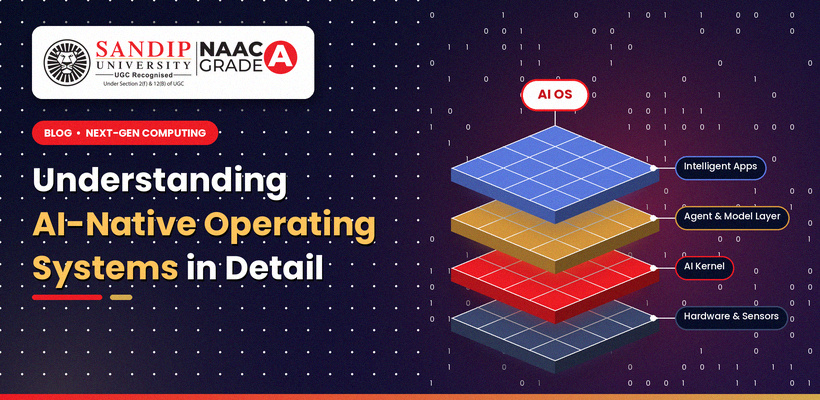
An AI native conceptual operating system could be defined as:
- AI Applications / Agents
- Agent Policy & Security Management
- AI Runtime / Model & Tool Management
- Intelligent Scheduler & Resource Manager
- Containers / VMs / Secure Execution
- Operating System Kernel
- CPU | GPU | NPU | Memory | Storage | Network
This architectural model adds another level of intelligence between applications and standard OS facilities. It is not aimed at replacing standard OS mechanisms, but at making them more adaptive and context-aware.
9. Key Research Challenges
Trust
How can an operating system establish trustworthiness of an AI agent?
Explainability
If an intelligent scheduler makes an allocation decision about resources, is the decision explainable?
Security
How does one prevent malevolent prompts or infected agents from gaining access to the system?
Privacy
How can we process data securely without exposure to risk?
Resource Management
How should the CPU, GPU, NPU, memory, and network be scheduled for use by various AI applications?
Reliability
What will happen if the autonomous agent makes a wrong decision?
Human Control
AI agents should function under definite limits and constraints, especially if their actions can cause an effect on the system’s resources.
10. Future Research Opportunities for Students
- AI-Based CPU Scheduling Algorithm
- Machine-Learning-Based Memory Management
- Energy-Aware AI Workload Scheduler
- Security Sandbox for Self-Sovereign AI Entities
- Kernel-Level Intrusion Detection Using AI Technology
- GPU/NPU Resource Scheduling
- AI Workloads Using Confidential Computing
- Edge-AI Operating-System Architecture
- Multi-Agent Resource Management
- AI-Assisted Container Orchestration
- Disk and Predictive Storage Management
- Intelligent Network Resource Allocation
11. The Future: From Operating System to Intelligent Computing Platform
Traditional operating systems were developed based on resource management ideas. The new AI-based operating systems bring yet another element into the equation, which is resource orchestration.
In the future, the OS could monitor applications all the time, understand their resource needs, implement security rules, optimise energy usage and manage the AI agents.
Yet, intelligence should not negate the deterministic controls. Essential services of the operating system still need predictable performance and reliable security. Therefore, the most realistic path ahead may be a combination approach with elements of conventional OS along with artificial intelligence decision-making.
Conclusion
Operating systems are in the midst of a new era of evolution. With the advent of AI agents, specific accelerators, confidential computing, edge intelligence, and distributed computing, there have been demands that could never be considered before.
The future operating system will have to deal with processes, memory, models, agents, accelerators, data, security policy and intelligence distributed across networks. Modern operating-system platforms, such as Linux, play an important role in facilitating this change, while advances in AI security and confidential computing show that the line between AI and operating systems is becoming very important. Such training is a part of programs like B.Tech in Artificial Intelligence and Machine Learning.
To those involved in teaching, researching, or studying Computer Science from one of the top computer engineering colleges in Maharashtra, AI Native Operating Systems provide an exciting field of study since it involves Operating Systems, Artificial Intelligence, Cybersecurity, Cloud Computing, Edge Computing, and Computer Architecture.