
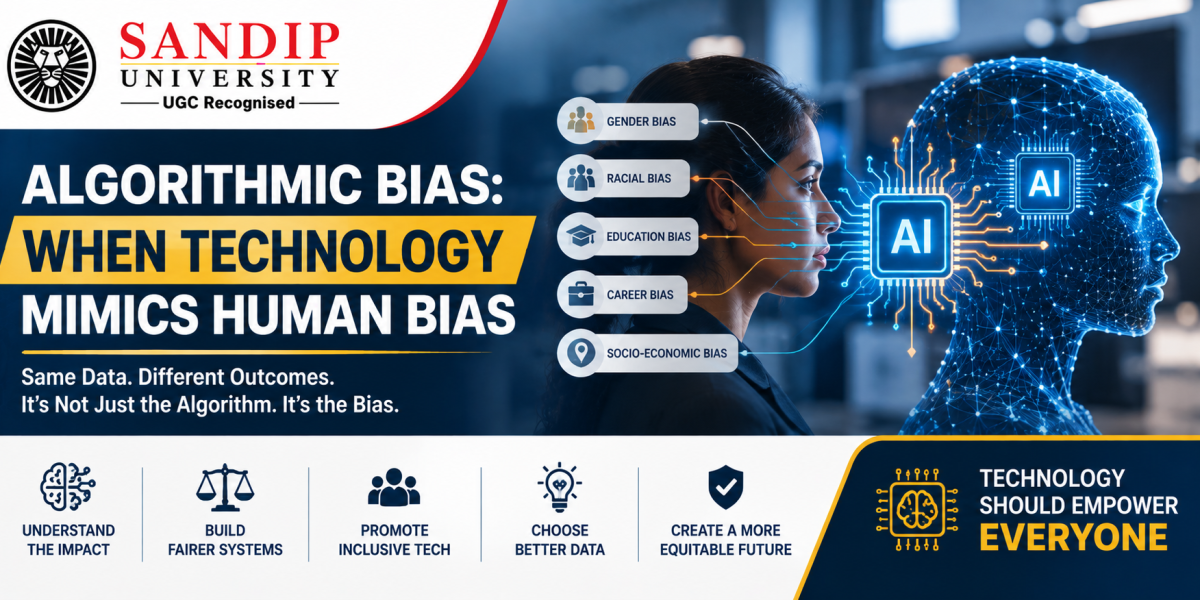
When technology reproduces human bias, this is termed algorithmic bias or algorithmic prejudice which is a topic covered by top law colleges in Nashik.
Artificial Intelligence is typically heralded as fair, effective and unbiased. When the information algorithms are working on is prejudiced or reflects disparate access to opportunity, algorithms can reinforce and even exacerbate social inequality. Algorithmic bias is not only a tech issue. It is also a moral, legal, social and economic dilemma that impairs people’s ability to get jobs, go to school, get loans, seek medical treatment, find housing, use public services and access justice.
What is an Algorithmic Bias?
An algorithm is a set of instructions that informs a computer what to do with input and how to get an answer. Algorithms determine which job applications are read, which internet adverts people see, whether to grant a bank loan and how a platform provides information. For example, an employment program may be taught from records of organisations that have recruited more males than women for top roles in the past.
Even if the system is not trained to bias against women, it might learn that “successful” candidates come from educational backgrounds, careers or hobbies which are male-dominated. Then the system can repeat the original pattern making it look like it is based on science. We identify several types of algorithmic discrimination, such as biased data, proxy discrimination, distinct mistake rates, various impacts, and discriminatory targeting.
How Prejudice Creeps into Algorithms?
Algorithmic bias can occur at nearly every stage of an AI system’s life cycle. Historical records can indicate the inequalities among people in a society in their access to good employment, schools, health care, or residences. A model trained on this kind of data can take prior results as proof of its value. This is a huge problem, because past prejudice can be used to predict future events.
Not Enough Representation
Some groups in the sample may not have sufficient data. Speech-recognition tools, healthcare models and facial-recognition systems may not perform as well when there are less examples from specific ethnic, linguistic, regional, age or handicap groups in the training data. At the system level, a tiny mistake can have very significant implications on a person. If a voice assistant cannot comprehend a regional accent, it could be bothersome, and if an automated healthcare system cannot recognise symptoms in a given set of individuals, it could put lives at danger.
Variation of Proxy
A program is not allowed to use private data directly like caste, religion, gender or race. It might, however, employ identical values and operate as substitutes. That is, the prejudice does not necessarily go away with the removal of a sensitive variable from a data collection.
Various Error Rates
“Just because a system is correct overall doesn’t mean it’s going to work the same for all groups. For example, a risk assessment instrument might produce more false positives for one set of persons compared to another. These disparities can be masked by average accuracy. But fairness isn’t just about how well a system performs overall; it’s about how it performs across different groups.
Feedback Loops
The data that is used to train new systems can be changed by the decisions made by algorithms. Think of a predictive policing system that deploys more police to a neighbourhood with a higher number of historical crime reports. There are probably more logged events with more police officers, which validates the original prediction of the algorithm. This creates a feedback loop that makes it harder and harder to change the first pattern.
Studies on online search have demonstrated that algorithmic results may reinforce social inequality based on gender and may also have a user effect that broadens this imbalance.
Bias and Social Inequality: A Common Denominator
Social inequality is when certain people or groups don’t have the same amount of money, opportunities, rights, respect or resources. Algorithmic systems can amplify injustice in a variety of ways.
Unfair Treatment of Workers
Automated hiring technologies could evaluate applicants based on patterns in hiring choices in the past. This kind of stuff might reward privilege, not true ability.
Economic Inequality Shortage
Credit-scoring and loan-approval systems can influence who receives access to money. There are financial risk factors such as limited experience of institutions, irregular income, informal employment and frequent change of address. Such systems may not directly employ social identity, but the variables they use can reflect the division of the economy.
Disparity in Health Care Access
AI techniques can help doctors figure out what’s wrong with patients and determine who to treat first. But the algorithm may not offer useful ideas if the training data is missing some groups or if it is based on unequal access to healthcare.
Digital Divide
Not everyone has equal access to fast internet, computers, learning how to utilise technology, and reliable online services. People with less access to technology may find it more difficult to use automated basic services.
Why is it Hard to Find Algorithmic Bias?
Algorithmic bias can be hard to detect, as today’s artificial intelligence systems are complex and difficult to explain. It looks like there was a math decision rather than a value decision.
There are a few other difficulties that make it difficult to detect:
- Companies can keep their training data and model designs private.
- People who are affected by a choice made by an algorithm may not know that an algorithm was utilised.
- When models contain hundreds of factors it is challenging to determine the source of discrimination.
- A system may affect people differently based on gender, color, disability, age, financial level, location, etc.
- A model can be theoretically correct but nevertheless bias the outcomes against people.
In contrast, a system may seem statistically fair but be terrible for society in a particular situation.
Ethical and Legal Problems
Algorithms in decision making raise serious problems of responsibility. An algorithm may not explicitly use a protected trait, but could nevertheless end up treating people differently by employing proxies. The European Union Agency for Fundamental Rights states that algorithmic bias can result in both direct discrimination and indirect discrimination via proxy variables.
How can You Reduce Algorithmic Bias?
There’s no one technology fix for algorithmic prejudice. Prevention calls for a collaborative effort on the part of engineers, social scientists, lawyers, policy makers, and organisations and communities impacted by the problem.
Live Review
“Automated tools should not remove accountability, but help people to use their own judgment.” Human evaluation is hugely essential when choices impact people’s freedom, their capacity to earn a living, their health, housing, education or access to fundamental services.
Conclusion
Artificial intelligence can assist in making smarter decisions, improve public services and make administration easier for individuals. The idea is simple: algorithms don’t work in a vacuum, outside of society. They are formed by institutions, and they are learned by social facts. They affect those who are in systems that are not fair. Some of the best law colleges in Maharashtra are examining the implementation of AI in the legal framework.
If inequality is not considered when designing things, technology can exacerbate injustice, faster and less visibly. To be fairer, you need to do more than just get rid of variables that are obviously unjust. This entails questioning what is the objective of an automated option, considering who wins and who loses, including multiple groups in the design process and ensuring there are good mechanisms to remedy problems when they arise.
Ultimately, fairness in algorithms is a political duty. We shouldn’t merely utilise technology to apply patterns from the past to predict what’s going to happen to people in the future. It should make society fairer – so that people all have the same opportunities, and may challenge the decisions that influence their lives.