
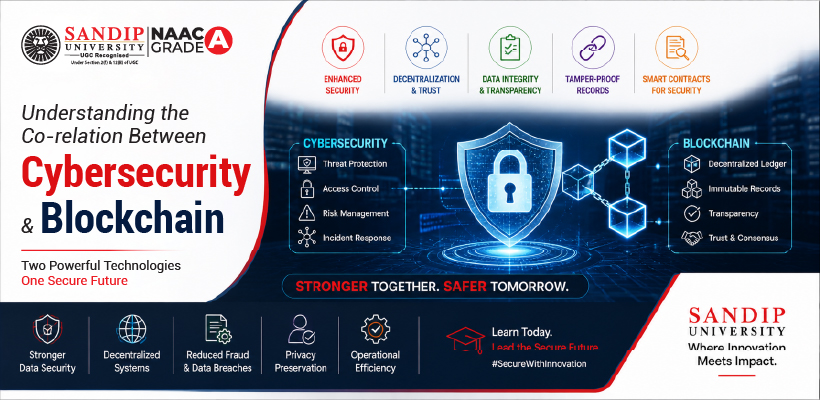
As we are all aware, it is only when we read another headline about a mega breach, a ransomware attack that shut down a hospital, or millions of passwords leaked onto the dark web that it occurs to us again. We have created a virtual reality of centralised network devices, trusted third parties and verified later attitudes. And hackers? They have made such a presupposition anointed with a shopping spree.
Enter blockchain. You no doubt have heard it being blown out of proportion as the savior of finance, supply chains and even the provenance of your morning coffee. However, what does this decentralised, immutable ledger do when you direct it at the fire of bedlam chaos that is cybersecurity? It is both bright, vexing, and immensely intriguing. Some of the best computer science colleges in Nashik are conducting path-breaking research in this field to answer these questions.
The Immutable Bouncer
To begin with, we should remove crypto-bro jargon. A blockchain is a common, append-only register of transactions. As soon as a block of data is sealed and chained to the last one using cryptographic hashes, it becomes difficult to change, since rewriting the entire history would require rewriting the entire chain, not to mention the need to get a majority of the network’s computing power to accept the lie. It can never be the case in practice.
What is it now that you think like a security defender? Provided that I commit system logs, system configuration files, or software hashes to a blockchain, an attacker who manages to compromise my server is unable to silently wipe their tracks. They are not able to backdoor a binary and use the Forged audit trail. The blockchain states: failed to do so. Nice try. I got receipts. It is already deployed in projects such as the Linux Foundation Hyperledger for supply chain security and in the blockchain KSI published by Guardtime, which has already proven billions of system states to the Estonian government. Immutability makes the cleanup tool a favorite among attackers: deleting logs is non-functional.
Cheryl, bye, One Big Honeypot
The silent facilitator of most cyber catastrophes is centralisation. One cloud storage bucket, or one DNS server, A single identity provider -hackers have funnels. The blockchain and its distributed trust turn this (distribute trust on thousands of nodes). There was no single point of failure; there is no single point to own.
The Curious Twist: Blockchain is not (Silver) Secure
This is where it particularly becomes kooky–and where most Hype Trains go off the track. The blockchain is a mathematical stronghold by itself. Nevertheless, applications constructed on it can tend to be as weak as a splashing cracker.
Personal secrets: To have lost thyself, is to have lost thy kingdom. Neither does it include password reset, nor customer support. Phishing scams that lead you to disclose a personal key are still devastating.
Bugs in smart contracts: One of the biggest hacks of 2016 resulted in the loss of $60 million in an Ethereum contract due to a reentrancy bug, which is not a defect in the blockchain, but is instead in the code implementing the functionality on the blockchain. Solidity has become a specialist area for hackers.
51% attacks: Smaller blockchains can be overpowered if a hacker acquires sufficient hash power. As soon as they own a majority, they can undo transactions and counterfeit. It is difficult and has occurred (see Ethereum Classic on various instances).
The off-chain problem: A blockchain can attest that a patient’s medical record in a hospital has not been changed, but it cannot prevent an attacker from stealing the medical record history and then hashing it before raiding the chain. Endpoint security, network encryption, and human error remain important.
Or, more to the point, blockchain mitigates some trust and integrity problems, but it is not a magic bullet and will not fix SQL injection, servers not being patched, or your colleague clicking Free Bitcoin links.
Where it Gets Really Interesting
The most curious synthesis is yet to come about. Decentralised storage is an option: initiatives such as Filecoin and Storj take your files, split them into encrypted pieces, and distribute them across a vast peer-to-peer network worldwide. Although one node is compromised, the assailant will only receive gibberish. Likewise, the blockchain-based PKI (public key infrastructure) replaces the weak certificate authorities we depend on to use HTTPS. Rather than relying on 150+ organisations not to get hacked or become rogue and issue a certificate, you consult a public key in an unchangeable ledger.
Zero-knowledge proofs go even beyond that. Consider demonstrating that you are over 18 or that your company is not in violation of the GDPR, without revealing your birth date or customer base. That magic can be achieved using ZK SNARKs (zero-knowledge succinct non-interactive arguments of knowledge). It is not science fiction; it is already being applied in privacy coins such as Zcash and is being experimented with as corporate audit trails.
The Half-Page Verdict
This is why we can call blockchain the cybersecurity messiah we were waiting for. It will not prevent zero-day attacks, backdoors by nation-states or by the human who writes the password on a sticky note. However, as an instrument that fulfills the purpose of maintaining data integrity, decentralised identity and providing tamperless logs, it is truly a revolution. It will not be the organisations that go after the idea of blockchain-for-everything that are victorious. And they will be the first to question: What is missing in our existing system? And then they will sneak a blockchain into that very gap.
Conclusion
With more intelligent hackers, we need additional weapons. Blockchain is not the silver bullet. But it is one of the very curious, very sharp flechettes, one which renders the task of the attacker of history in rewriting it that much more difficult. Pursuing B.Tech in Cybersecurity and Forensics can help you build a dynamic career in this futuristic field. In cybersecurity, it is half the battle to make the other guy’s life miserable.
Apply now for B.Tech in Cybersecurity and start your journey in next-gen digital security.