
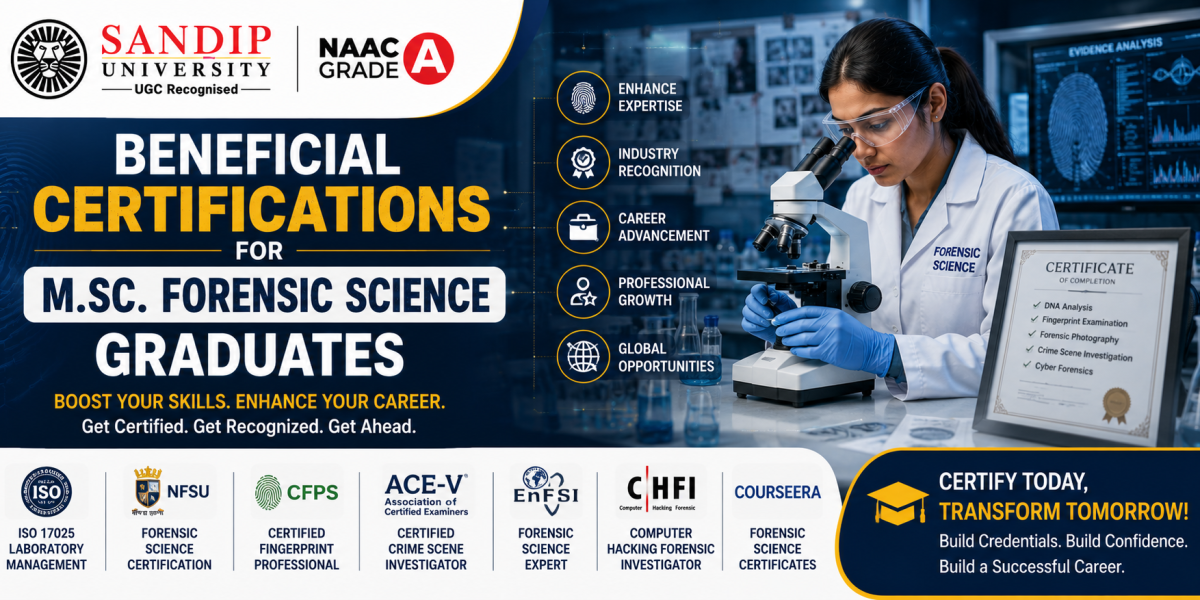
An M.Sc. in Forensic Science offers a good academic background to students in terms of scientific investigation, evidence, laboratory work, and criminal justice. But there are always new things that keep coming in this fast-changing world, and postgraduate education in such an advanced field could be just the starting point of the career for the candidates. A certification can offer a lot of help to those forensic science graduates wishing to enhance their specialisation in their respective field.
Certifications are not replacements for academic qualifications from some of the best forensic science colleges in Nashik or experience. Instead, they serve as an addition to the M.Sc., helping in acquiring specialised knowledge in the respective field.
Why Should M.Sc. Forensic Science Students Get Certifications?
Forensic science is a multi-disciplinary discipline. While a student could have some vague knowledge of forensic biology, forensic chemistry, toxicology, document examination, fingerprinting, crime scene investigation or digital forensics, the person would have to know about a much more complicated and extensive field of study depending on the requirements of the job.
By obtaining proper certifications, one could:
- Have certain specific technical skills
- Show his/her dedication to professional development
- Improve his/her professional profile when searching for a job
- Be aware of the latest equipment and techniques used in the field
- Learn many different facets of forensic science
- Feel comfortable using theoretical knowledge in practice
-
Digital Forensic and Cybersecurity Certifications
With the prevalence of smartphones, computers, cloud computing, and Internet of Things (IoT) devices, investigation in the modern era has been revolutionised. Digital evidence plays a significant role in the investigation of cases related to financial crimes, cybercrimes, identity theft, harassment, violation of Intellectual Property laws, and other crimes. Based on career goals, certifications such as Certified Computer Examiner (CCE), GIAC certifications, or any other digital forensic certifications that hold an international reputation can be taken into account.
-
Crime Scene Investigation Certification
There is more to crime-scene investigation than simply collecting and recognising pieces of evidence. Documentation, photography, evidence preservation, packaging, contamination control and chain of custody processes are basic elements of an investigation.
In that respect, a certificate or a course in crime scene investigation can be very beneficial for those graduates who wish to enter the field of forensic work.
-
Forensic Toxicology and Analytical Methods
The field of forensic toxicology is an interesting one for those seeking employment in the field of analysis of drugs, alcohol, toxins, and other chemicals from biological samples.
Obtaining certifications or short-term training in analytical methods including chromatography, mass spectrometry, method validation, quality control, and laboratory safety would definitely add to one’s value as a holder of the M.Sc. degree.
-
Forensic Biology and DNA Analysis
DNA is now probably one of the most recognised forms of evidence used in forensics. For those graduates looking forward to careers in forensic biology, courses in DNA extraction, quantitation, amplification, interpretation, population genetics, and biological evidence processing would be a good choice.
Furthermore, graduates might also want to obtain certification in molecular biology, genetic testing, and quality assurance in the lab. The above certifications may be especially useful for those graduates aspiring to build a career in forensic biology labs or any other molecular laboratories. Having a certificate means you have pursued further studies, but laboratory experience is essential.
-
Fingerprint and Biometrics Certification
Fingerprint examinations continue to play an integral part in forensics, even as modern-day investigations rely on highly advanced biometric tools. Certifications or special training in fingerprint examinations, latent prints, biometric identification, and others could enable graduates to become experts in identification practices. Such knowledge could be useful for forensic labs, investigation units, security firms, and companies using identity verification technology.
-
Forensic Document Examination
Forensic document examination includes the forensic analysis of the authenticity and provenance of documents and investigation of handwriting, signatures, modifications, printing methods, and writing instruments.
Students with a special interest in this particular field can join professional or certification courses on questioned document examination. This field requires patience, keen observation, and knowledge about scientific methods of investigation.
-
Laboratory Quality Management Certifications
Although technical proficiency is an important aspect of being successful in a forensic lab, the skills of quality management, documentation, validation, SOPs, and certification are just as essential. Certifications or training on laboratory quality management, laboratory auditing, quality assurance, and ISO/IEC 17025 will help graduates learn about the procedures that are followed in a professional laboratory to ensure reliability.
-
Forensic Photography and Imaging
Forensic photography and imaging have always been significant in the documentation of crime scenes and evidence. Sometimes, a well-documented photograph may contain information that might be crucial for investigation purposes.
Training in forensic photography and imaging could help graduates learn about various techniques such as lighting, scale photography, image documentation, evidence photography, and proper handling of digital images. Due to developments in image enhancement and digital technology, forensic imaging training could go hand-in-hand with crime scene investigation training.
How Should One Select the Suitable Certification?
Popular certification cannot serve as a criterion for the choice of certification for building the career path. First of all, one should decide what forensic specialisation will suit them best.
Below is the list of questions that can help to make the decision:
- What interests me?
- What skills are required?
- Is the certification accredited?
Decide whether the institute/university/organisation that gives the certification is reliable and provides the practical program.
Certification should be a Supplement to Practical Training
It is advisable that students combine certification with internships, laboratory training, research, workshops, case studies and practical training.
Development of communication and writing skills is equally essential. The forensic scientist has to convey complex scientific information to investigators, lawyers and sometimes even courts. At this point, it is only scientific accuracy that counts if it is effectively conveyed.
Developing a Career Ready for the Future in Forensic Science
The discipline of forensic science is constantly changing in line with developments in biotechnology, artificial intelligence, cybersecurity, instrumentation analysis, and digital forensics. In turn, such changes bring many opportunities for those graduates who are ready to extend their horizons of expertise far beyond the classical field of forensic science.
M.Sc. studies provide the educational part, but a thoughtfully chosen certification may give additional specialised expertise and professionalism. The best career portfolio, however, includes all these elements plus experience, competence, ethics, and constant self-development.
However, it is important that M.Sc. Forensic Science students from some of the top forensic science colleges in Maharashtra avoid amassing a lot of certificates but rather work towards choosing the certificates which will suit their careers. Through proper planning of their career path and acquiring more skills through practice and continuous learning, students will have opened doors for themselves in different areas of forensic science like forensic laboratories, law-enforcement agencies, cyber security, private investigations, research, academia and others. This is important because in a field where science becomes evidence and evidence impacts justice, it is necessary for professionals to remain ready professionally.