
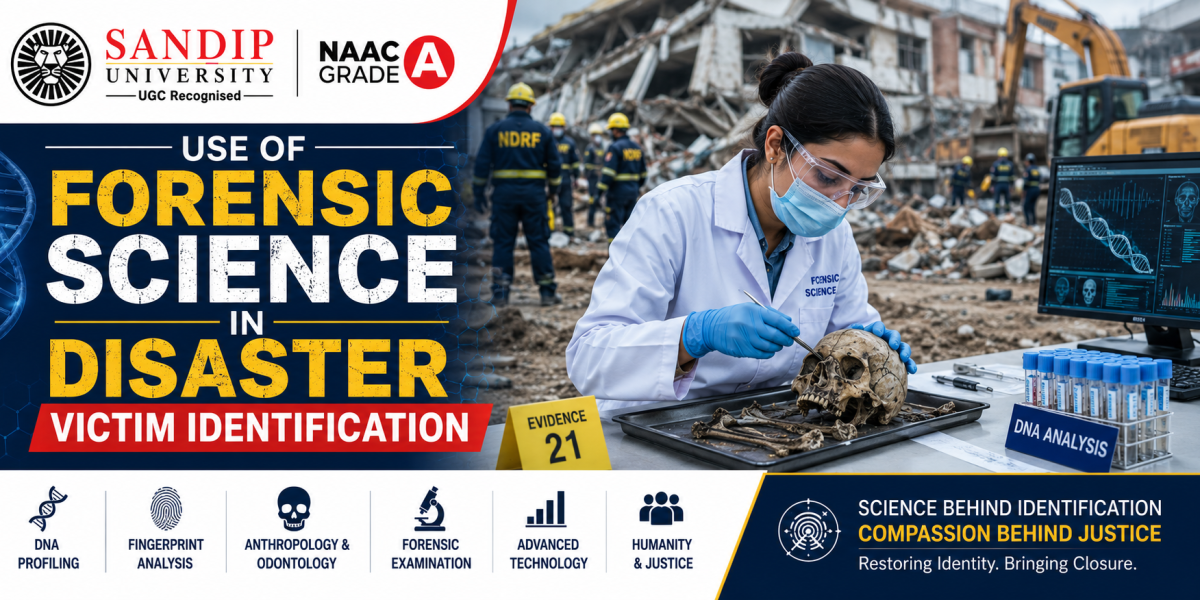
In any disaster, the priority is the rescue of people and immediate help to the survivors. But along with that, the next priority would be to identify the people who died. Disasters like earthquakes, floods, landslides, building collapse, fire, train accidents, plane crash, and explosion among others will leave bodies which cannot be easily identified. In this scenario, forensic scientists from some of the best forensic science colleges in Maharashtra take up the responsibility of Disaster Victim Identification (DVI).
The field uses scientific, technical and investigative methods to determine the identity of the dead in a human manner. Forensics science is much more the scientific application of questions related to legal and investigative issues. This field contributes to criminal investigation, human identification, cybercrime, toxicology, questioned documents, wildlife investigation, disaster management and many other things. DVI is one of the most important applications in forensics because it shows how science can provide solutions to families through it.
Disaster Victim Identification
Disaster Victim Identification is an orderly and interdisciplinary approach applied in the identification of deceased victims of disasters or mass casualty events. Under normal situations, identification of a deceased individual is made through visual identification or documents/relatives of the deceased individual. But in case of a disaster event, there are chances that the body will be badly affected by factors such as fire, trauma, extreme temperatures, decomposition or fragmentation.
Thus, visual identification may not be sufficient. According to INTERPOL, the following systematic processes are involved in DVI; investigation of the disaster scene, post-mortem data collection, ante-mortem data collection and finally comparison/reconciliation of all these to prove the identity of the deceased individual. Scientific tools such as fingerprints, dental identification and DNA identification will play an integral part in identification. INTERPOL – Disaster Victim Identification
Role of Forensic Science in DVI
The DVI procedure starts with the safe recovery and documentation of human remains. The forensics and recovery team notes down the location of the remains, takes photos of the site, makes a note of the associated artifacts, and labels the recovered remains. Documentation is important because evidence can be lost or tampered with unless properly documented.
After recovery, the forensics personnel take post-mortem data, which is the data taken from the dead person. This includes fingerprints, dental, DNA profile, skeletal markers, tattoos, scars, implants, and other identifying factors. On the other hand, investigators gather ante-mortem data, which is the data collected before the death of the person. Such data includes medical records, fingerprints, photos, and other DNA samples of the individual.
Fingerprints, Dental Examination and DNA Profiling
One of the best known and effective forensic identification tools is fingerprints. Fingerprinting is based on distinctive ridge characteristics of human fingers. Sometimes, disaster victims can be obtained and then matched against existing fingerprint records. Biometric technologies can additionally help to match them. Fingerprint identification is especially helpful if there is enough ridge information available.
Another effective method is forensic dentistry, which involves examining teeth. Teeth are able to resist the environment better than other tissues. Information about fillings, crowns, bridges, missing teeth and other dental treatments collected in a dental record can be used for comparison with post-mortem dental data and used for identification.
DNA profiling is probably the best-known modern forensic technique. DNA is genetic material of the human body. In case there is appropriate biological material, a DNA profile of an unidentified person can be compared with a reference DNA of that individual or, if appropriate, DNA of his biological relatives. DNA is especially helpful if fingerprints and dental records are not available.
Role of Forensic Anthropology
In cases where the remains are skeletal, fragmented, or extremely decomposed, forensic anthropology can make considerable contributions to the investigation process. Forensic anthropologists study bones and can even give an estimation regarding some characteristics of the body, such as its age range, biological sex, and height. The forensic anthropologist can also evaluate any injuries or diseases and determine if all the recovered bones belong to the same individual.
Some other specialists can also participate in the process of DVI. These specialists include forensic pathologists who study the bodies and injuries, forensic toxicologists who study such substances as drugs and poisons, forensic photographers who document the evidence, and crime scene specialists who are responsible for the recovery and preservation of evidence. This shows that DVI is not the work of one specialist but the joint effort of several forensic specialists.
DVI will also enable the authorities to keep proper records and even offer useful information regarding a wider scope of the investigation. In some cases, the incident which may look like an accident at first may need to be investigated as a case of technical failure, neglect, crime, or intentional act. Thus, scientific analysis may help understand not only who the victim is but also what happened.
Conclusion
A forensic science degree will involve courses such as crime scene processing, forensic biology, DNA analysis, forensic chemistry, toxicology, fingerprints, questioned documents, forensic physics, ballistics, digital forensics, and forensic anthropology. Pursuing an M.Sc in Forensic Science degree can help you build a career in the disaster victim identification branch of forensics.