
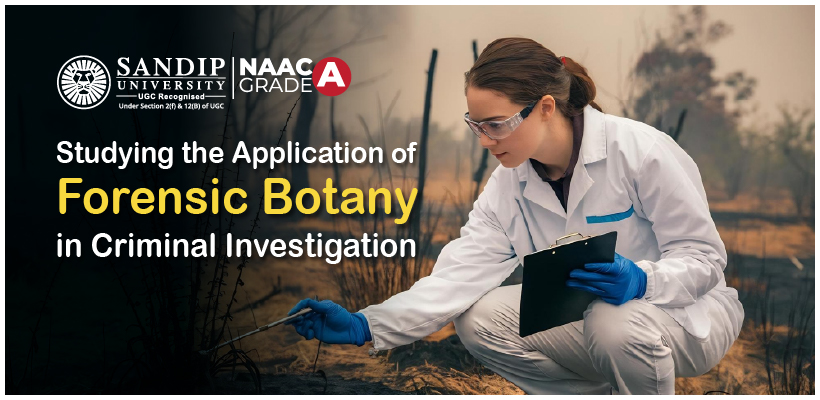
If we imagine any crime scene, chances are that evidence would be linked to items such as fingerprints, DNA or blood. But there are some things at crime scenes that can serve as silent but powerful witnesses—plants. Studying the evidence of plants in criminal investigations is called Forensic Botany and becomes more and more important nowadays. This study is a part of forensic science courses offered by some of the best forensic science colleges in Nashik.
Since plants have an intrinsic nature to be anchored to one position and react to changes in the environment, they are dependable means of detecting time, place, and even human interference. It could be a small piece of the leaf, or pollen particles from clothes, or even soil samples that have traces of plants.
How Plants Help Solve Crimes?
The key usage of forensic botany is the ability to associate a person or an object to a particular location. The pollen grain is very tiny, but it is quite characteristic of a plant from where it comes. Plants have different pollen grains, which adhere to clothing, vehicles, and personal objects. Using these samples, investigators can determine where a person was.
In the same way, seeds, leaves, and wood pieces from a crime scene may be used as trace evidence. When the plant material found on the suspect is similar to the vegetation at a crime scene, it is likely to make the connection more convincing between the suspect and the crime scene.
Estimating Time Through Plant Growth
Another way to use plants for solving crimes involves the estimation of the time of crime using plants. For example, the growth pattern of the vegetation, such as the growth of grass under a body or growth of plants on the bones, will help establish the amount of time that had passed since something happened. The change in the seasons and the growth cycle of plants also helps in determining the time of an incident.
In the case of buried bodies, the roots often wrap around or even penetrate the bones. This helps in establishing the amount of time that the remains have been buried.
Botany in Clandestine Burial Detection
Forensic botany becomes very important in the detection of clandestine burial sites. Disruptions in the soil tend to affect the growth of plants. Thus, an anomaly in plant life might be an indication of a buried body. Some indicators are increased density of the plants, colour, or growth in the plants at a particular site compared to the rest.
The Practical Implications of Forensic Botany
Despite being less known than DNA profiling, forensic botany has helped solve some crimes globally. It has proven to be very efficient when dealing with rural crimes and outdoors since there are many plant samples that are available for collection and analysis.
The most unique feature of forensic botany is the fact that it provides corroborative evidence. Because of this, the information obtained from plants can support other types of evidence collected.
Certain Challenges and Limitations
Even with its vast possibilities, there are certain difficulties that come with forensic botany. Its proper interpretation would require extensive knowledge of botany, ecology, and environmental conditions. Furthermore, plant evidence can be affected by certain external factors like weather, human and even animal activities.
However, with new technological developments and cooperation between various fields, the field of forensic botany only continues to expand.
Conclusion
The vegetation in crime scenes is nothing less than the silent witness to all that is happening around it, recording everything on its own terms. It is possible through scientific analysis that information can be extracted from the silent witnesses of nature.
Professionals with an M.Sc in Forensic Science understand the importance of botany in the field. Forensic botany is a reminder that sometimes evidence is much more difficult to find. Sometimes it hides right under our noses, in the ground.