
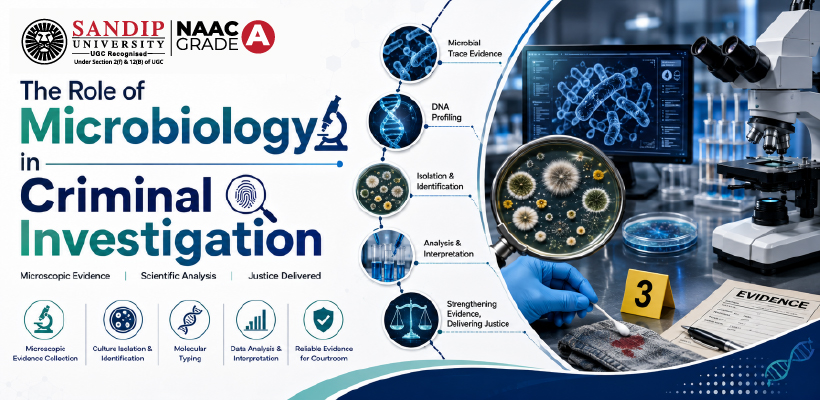
Forensic Science is not only about fingerprint powders, DNA, and ballistics evaluations. The word “bacteria” or “fungi” is rarely associated with forensic science. However, the microorganisms may be one of the best methods of investigation in forensic science. Forensic Microbiology is the use of microbiology for forensic purposes and is a new and fast-growing area of science used for solving crimes, determining victims, time-of-death, identifying sources of biological agents in terrorist attacks, etc. This topic is taught in detail at some of the top forensic science colleges in Nashik. With the help of bacteria that can be found everywhere and that mutate much faster than other types of evidence, it is possible to get more accurate data than getting evidence through other means.
Forensic microbiology refers to the study of microorganisms and their genetic material in crime and civil investigations. This science employs the techniques of microbiology, molecular biology, and ecology to analyse bacteria, fungi, viruses, and all microorganisms present at the crime scene, on the corpse, or on a suspect. Every environment and every human being has its own specific microbiological fingerprint, which allows scientists to answer many questions.
Determining the Time of Death
One of the most recognised applications of microbiology in the field of forensic science is the determination of the death time, i.e. finding out how long the person has been dead. It has been found that as the whole process of decomposition takes place, the overall composition of the microbial community changes in a relatively consistent manner. It has also been documented that a certain phenomenon called “microbial clock” is at work. This implies that certain bacterial and fungal species vary in abundance as decomposition advances to different stages.using the microbial profile of a corpse, with the specifics from its gut, skin (or surrounding soil) even forensics experts can pinpoint time of death much more precisely than with the help of such techniques as body temperature and insect activity, especially for older corpses.
Soil and Environmental Forensics
Soil microorganism communities show significant variations depending on the climate, vegetation, and land use in a particular area. Different soil characteristics make it one of the geographic indicators. For instance, if the soil is detected on certain physical objects belonging to a suspect, forensic bacteriologists would analyse the microorganism genetic material content of this soil and compare it with samples from the crime scene. This technique was successfully applied for linking suspects to graves and for confirming or refuting alibis.
The Human Microbiome as an Identifier
Each individual possesses not only a unique fingerprint but also a specific set of microorganisms. Microorganisms in the body differ from person to person, thus creating a unique microbial signature. Studies reveal that the microbial traces left behind on a given surface, such as a computer keyboard or doorknob, can be used to identify the owner of that surface. This new area of research, also known as microbial fingerprinting, might one day replace the traditional methods of fingerprinting and touch DNA analysis.
Finding out about Cause of Death and Apparent Criminal Activity
Microbiology helps significantly in revealing the issues leading up to death. Forensic pathologists are expected to check for pathology including the ones responsible for sepsis and other microbes causing disease in a weakened immune system victim. That includes cases of possible poisoning, and on top of that, one should remember that microbes can prove if the infection occurred naturally or was maliciously introduced. Investigating wounds can also give evidence as to the time when the injury took place.
Bioterrorism and Biocrime Insight
One of the best-known ways to use forensic microbiology in the field of criminal justice is the area of bioterrorism and biocrime, which is one of the most dangerous fields of investigation. It involves using deadly pathogens like anthrax or ricin to harm people. In this regard, microbial forensics deals with discovering the type of organism used, following its genetic line, determining where it comes from, and the laboratory where it has been made. The technologies involved in microbial forensics include genomic sequencing and epidemiological tracking. As a result, microbial forensics allows one to establish what organism was used in the attack, where it came from, and who had access to it.
Hurdles and Restrictions
But the field of forensic microbiology is not without its hurdles. The environmental variables such as temperature and humidity will impact the microbial community, causing problems when comparing offenses occurring under different conditions. Contamination is also an issue since crime scenes are usually not sterile; microorganisms either from the investigational team, first responders, or the surrounding areas can easily mingle with the original evidence. Finally, while fingerprinting and DNA processes have existed for decades, and the protocols to these techniques have been standardised in court, forensic microbiology is still lacking such court approval of microbial evidence.
The Future of Microbial Forensics
As the cost of DNA sequencing decreases and the technology improves, along with advances in machine learning for the interpretation of complex microbiological data, forensic microbiology is possibly going to become an important part of the investigation process rather than a specialty. Scientists are working towards establishing larger databases of microbiological fingerprints for different environments or populations to make such comparisons possible. Eventually, a simple swab could be of equal importance in an investigation as hair or blood.
Conclusion
Microbiology has evolved over the years to be one of the most important forensic tools, adding a range of possibilities to criminal investigations in addition to fingerprints or DNA. From determining time of death through the change of microbes on a body, to finding out where soil evidence came from, or identifying the origin of a biological attack, microbes are prominent witnesses even if they are silent. As science develops, professionals holding a M.Sc in Forensic Science will use forensic microbiology will pay off in criminal investigations, providing many opportunities to victims and detectives to reveal the truth.