
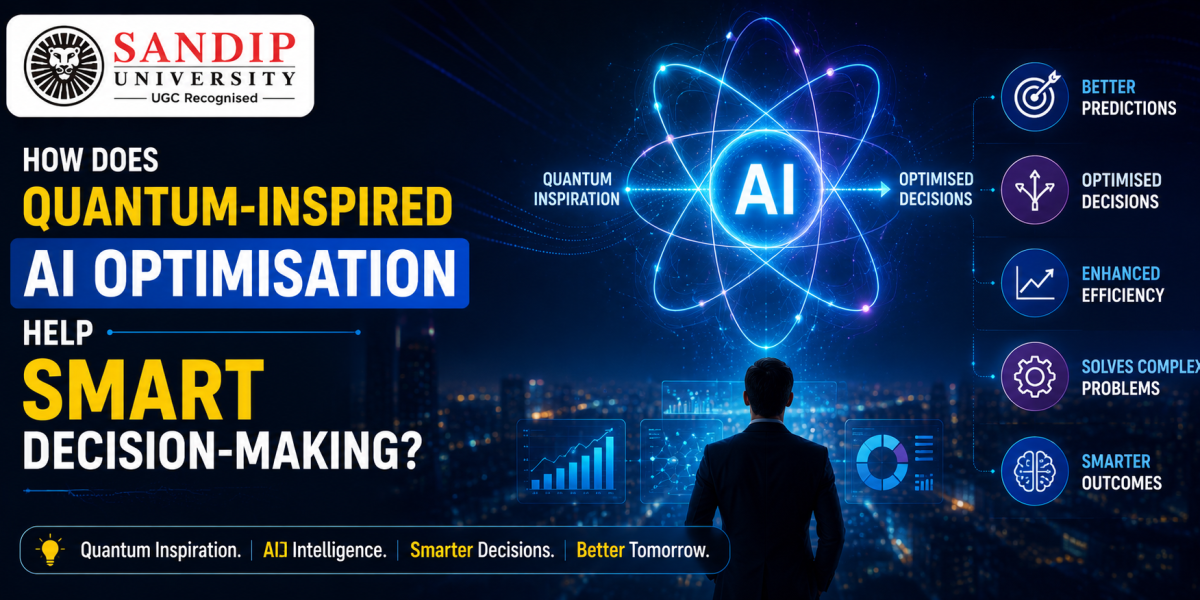
Artificial Intelligence (AI) has transformed the modern computing world by enabling the systems to learn, predict and take decisions using the large volumes of data. However, many optimisation problems are still computationally hard in real-world settings due to complexity, dynamic nature, and large solution spaces. One promising paradigm is called Quantum Inspired AI Optimisation (QIAO), which is an emerging field of study that combines ideas from quantum computing and classical artificial intelligence techniques for solving these problems. Quantum-inspired optimisation algorithms are classical algorithms that do not require special quantum hardware but use quantum principles like superposition, probabilistic state representations and quantum search. Such approaches therefore offer better optimisation capabilities, even without fully matured quantum computers. Recent developments in quantum hardware made by professionals holding qualifications from some of the top engineering colleges in Nashik, AI-assisted quantum chip design, and quantum optimisation research have led to the emergence of the new field.
What is Quantum-Inspired AI Optimisation?
Quantum Inspired AI Optimisation is a family of computational techniques that utilise some properties of quantum systems to reach higher performance in solving optimisation and decision-making problems. The techniques are inspired by quantum mechanics, but can be implemented on classical computer platforms. The objective is to obtain near optimal or optimal solutions in large search spaces with minimum computational complexity and to escape local optimums. Quantum-inspired methods are especially useful in applications where classical optimisation methods do not work because of high dimensionality or non-linearity of the problem.
Research surveys show that quantum inspired machine learning and optimisation are fast growing fields connecting classical AI with potential quantum computational capabilities. Quantum Inspired AI Optimisation is a collection of computational techniques aiming to solve optimisation and decision-making problems more efficiently by mimicking some behaviours of quantum systems. The techniques are rooted in quantum mechanics but can be run on classical computers. The aim is to find good or best solutions in large search spaces with low computational complexity avoiding local optima. Quantum-inspired methods are especially apt for problems with high-dimensional or non-linear problem structures that are hard to solve with classical optimisation techniques. Research surveys indicate that the rapidly expanding fields of quantum-inspired machine learning and optimisation connect current classical AI with future quantum computing capabilities.
Key Quantum-Inspired Optimisation Techniques
-
Quantum Genetic Algorithm (QGA)
Quantum Genetic Algorithms are genetic algorithms that encode candidate solutions as quantum inspired probability states. This representation enables simultaneous exploration of more than one region of solutions which results in faster convergence and better quality of solutions.
2 Quantum Particle Swarm Optimisation (QPSO)
QPSO is an improved version of the classical particle swarm optimisation using quantum probability distribution to guide the movement of particles. The global search ability is improved and premature convergence is avoided.
Engineering design challenges QPSO is an enhanced version of the standard particle swarm optimisation, that uses quantum probability distributions to model the motion of the particles. This enhances the global search ability and reduces the risk of premature convergence.
-
Quantum Annealing Inspired Optimisation
Quantum annealing optimisation techniques exploit the quantum tunnelling phenomenon to escape local optima and explore the global optimal solutions in complex search spaces effectively. Traditional optimisers usually get stuck in sub-optimal spaces. The quantum annealing inspired approaches are better at exploring.
They are very well suited to the solution of combinatorial optimisation problems. These techniques have shown promising applications in the fields of vehicle routing, portfolio optimisation, traffic scheduling and manufacturing process optimisation and resource allocation. Their efficacy in searching large scale optimisation landscapes has drawn great attention from both researchers and industrial practitioners for better decision making solutions.
Here are some of the research trends that will dominate the future of quantum-inspired artificial intelligence optimisation in 2026. Quantum Inspired Reinforcement Learning is a combination of the ability of the reinforcement learning and advanced searching mechanisms of the quantum inspired algorithms.
Applications of Quantum-Inspired AI Optimisation
Healthcare
They find applications in medical image analysis, treatment planning, drug discovery and healthcare resource allocation.
Cybersecurity
It uses quantum inspired techniques for anomaly detection, intrusion prevention and optimisation of secure communications.
Intelligent Manufacturing
Factories can schedule production, manage inventories and do predictive maintenance using quantum-inspired optimisation.
Computer Security Systems
Quantum Inspired Techniques for the Optimisation of Intrusion Prevention, Anomaly Detection and Secure Communications
Energy Engineering
Smart grids utilise optimisation algorithms to optimise energy generation, distribution and consumption and minimise energy losses.
Advantages
Advantages of quantum-inspired AI Optimisation:
- Deeper into larger search spaces
- Enhanced global optimisation performance
- Less chance of getting stuck in local optimum
- Faster rates of convergence
- Scalability for complex real-world applications
- Compatibility with existing infrastructure for classical computation
Challenges
- Absence of standardised frameworks
- Computational overhead for large scale issues
- Absence of benchmarking standards
- Complexity of tuning parameters
- Necessity of explainable decisions in optimisation
Future Outlook
As quantum computing technologies mature, quantum-inspired AI optimisation is expected to play an important role in bridging classical AI and future quantum-enabled intelligence systems. “More and more organisations are using quantum-inspired approaches that are providing tangible benefits today and preparing for the quantum computing ecosystem of tomorrow. Researchers expect quantum-inspired optimisation to play a key role in future smart cities, autonomous systems, healthcare diagnostics, scientific discovery, cybersecurity and sustainable infrastructure management. The combination of AI, optimisation and quantum inspired computing is one of the most promising directions for future intelligent systems.
Conclusion
Quantum Inspired AI Optimisation is a new research area which offers a new perspective by combining the benefits of artificial intelligence and quantum-inspired computation. These techniques are very beneficial in solving hard optimisation problems in different domains as they allow better exploration of complex solution spaces. Some of the best engineering colleges in Maharashtra are offering research opportunities in this field to boost innovation. With the increasing research and industry interest in quantum-inspired optimisation, it is going to be one of the key technologies for the future of intelligent decision making and autonomous systems.