
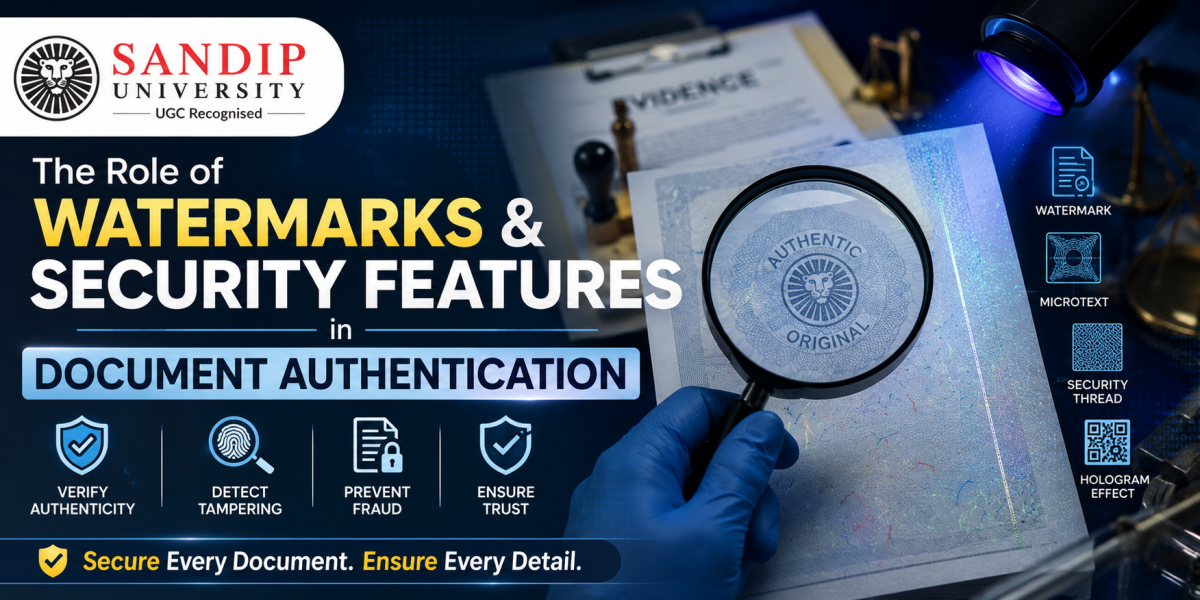
Hold a banknote up to the light sometime. Actually, most people never bother. You’ll see a faint image appear inside the paper itself, not printed on top of it, but somehow in it. That’s a watermark, and it’s one of the oldest tricks in the document security book, dating back centuries, and honestly, it still works remarkably well. Forensic scientists holding qualifications from some of the top forensic science colleges in Nashik are aware of these security features.
I spend a fair amount of time examining questioned documents, and watermarks and security features come up constantly, not just with currency, but with certificates, passports, legal papers, even some brands of premium stationery. People assume forgers just need a good printer these days. They’d be surprised how much a real piece of paper can reveal. People often do not think about how information a simple sheet of paper can hold. For example, a genuine sheet of paper can give away a lot. It is amazing what you can learn from one piece of paper. A genuine sheet of paper alone can tell you a lot about something or someone. They would be surprised at the information a real sheet of paper can provide.
What is a Watermark?
A real watermark is not something printed on the paper. It is made while making the paper. The paper maker uses a roller or mould to make some parts of the paper thicker and some thinner. When light shines through you can see the image or pattern because of the thickness. You can see it when you hold the paper up to a light. Watermarks are created during the papermaking process, with a roller or mould and paper pulp. The thickness of the fibres varies to form the image or pattern.
Why Watermarks Matter in Document Authentication
This matters enormously for authentication, because a real watermark is baked into the structure of the paper. You can’t recreate it by printing something that merely looks like a watermark on the surface. Under transmitted light, a printed fake will usually look flat, uniform, and obviously different from the subtle, almost ghostly translucency of a genuine one.
Key Security Features Used in Official Documents
Watermarks get most of the attention, but they’re really just one layer in a much bigger system. Depending on the document, examiners go through,
Security threads are like strips inside the paper. They are sometimes visible. Sometimes you can only see them under UV light. Some of these threads even have printed text on them. This text is really hard to copy.
Micro printing is a technique where the text’s so small that it looks like a solid line, to our eyes. If you use a magnifying glass, you can read the letters. Most consumer printers and copiers simply can’t reproduce it cleanly, which makes it a great giveaway.
UV-Reactive Fibres and Inks are invisible under normal light, but glow under ultraviolet illumination. A lot of official documents scatter these fibres randomly through the paper during manufacturing, and no two batches look quite the same.
Holograms and optically variable devices are the shifting, shimmering images you see on cards and passports, which change appearance depending on the viewing angle. These are genuinely difficult and expensive to reproduce outside of specialised equipment.
Guilloché Patterns are those intricate, mathematically generated line patterns you see on currency and certificates. They look almost decorative, but they’re deliberately hard to redraw or scan accurately without visible distortion.
Why Forgers Struggle with All of This?
Here’s the thing that trips up most forgery attempts: it’s rarely just one feature that needs matching. A genuine security document layers several of these techniques together, and getting all of them right simultaneously, the paper composition, the watermark, the microprinting, the UV response, requires resources most forgers simply don’t have access to. Even a very good forgery often nails two or three features convincingly and completely misses the rest.
This is exactly where document examiners come in. Using magnification, alternate light sources, and sometimes specialised imaging equipment, we compare the questioned document’s features against known genuine examples, feature by feature. One inconsistency might be explainable. Several inconsistencies in the same direction usually aren’t.
Why Does This Still Matter?
With so much shifting toward digital verification, it’s tempting to think physical security features are becoming irrelevant. They’re not. Passports, land deeds, academic certificates, cheques, currency, an enormous volume of high-value documents still exist in physical form, and probably will for a long time yet. As long as that’s true, forgers will keep trying, and these layered physical defences will keep being the first and often most reliable line of authentication.
Conclusion
When you get a certificate or a brand-new banknote next time take a moment and hold the banknote up to the light. The things you see on the banknote are not just, for show. It’s a quiet, deliberate defence system built right into the fabric of the page, and it’s usually the first thing that gives a fake away. Students pursuing M.Sc Forensic Science are able to further understand the role of watermarks in forensics. These features can sometimes play a vital role in solving crime at the forensics level.