
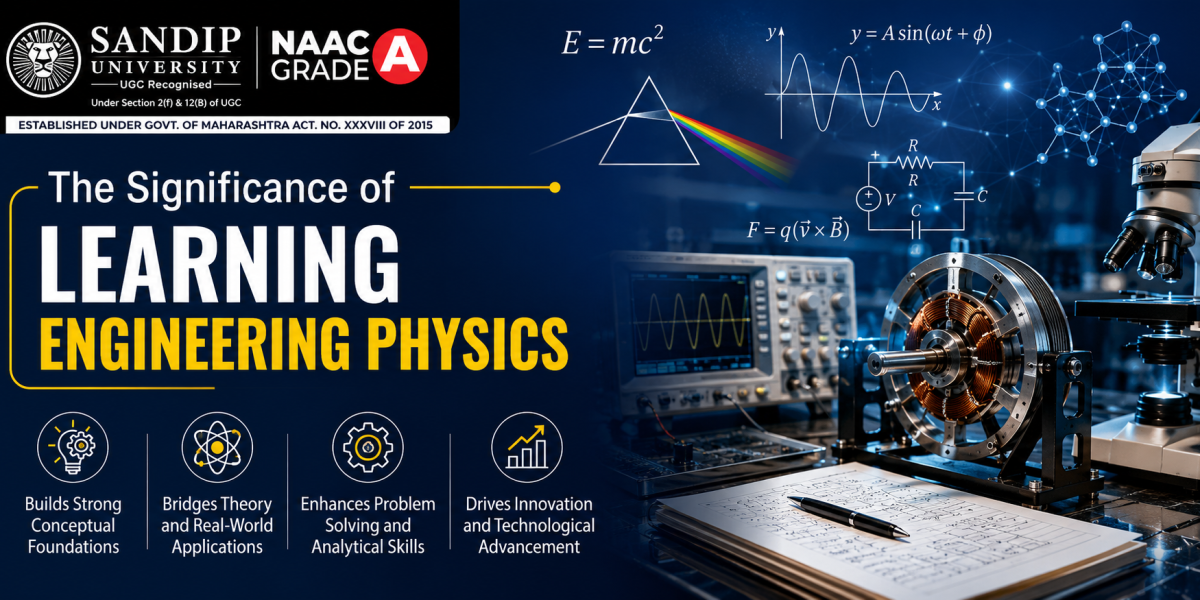
The word ‘physics’ is derived from the Greek language which means the study of nature which as law of motion, force, energy, state of matters and particle behaviour in space and time. It is a fundamental concept which is related to force and energy which give the main objective to study the behaviour of the universe for future growth of human life. Some of the top engineering colleges in Maharashtra are training students to understand the importance of engineering physics to drive innovations in this field.
In the realm of engineering, physics is the most important branch which helps us to study the laws or understand the concept of technology, laws of nature, applications, also to design new machines for future growth and solve daily based problems. Physics helps us to invent a new technology which improves human life for better growth. The computers, satellites, EV vehicles, solar panels, laser, medical instruments are all based on the concepts of Engineering Physics. It also teaches about semiconductors devices, quantum mechanics, fiber optics, nanotechnology, superconductors, etc. This blog will show how much Physics is important in Engineering which explains principles, applications and future scope.
What is Engineering Physics?
Engineering physics is an important field that fills the gaps between fundamental physics theory and practical engineering physics. A single branch is focusing on the full breadth of classical and modern physics which includes the concepts and methods in different ways which are useful for industries, research development, building advanced technology for society, etc. This explains how force is applied, motion, electricity, concepts of light, heat, energy and atomic structure to produce products and systems.
How Physics powers every Engineering Discipline
Each branch of engineering uses a specific principle of physics to enable progress for building new technologies to build a new future.
1. Electrical Engineering
It helps us to study the principles of electricity, magnetism and electromagnetism. The concepts such as voltage, current, resistance, capacitance and electromagnetic induction are studied from fundamental laws of physics. By applying this principle, it helps us to design power generation systems, transformers, motors, electrical circuits, transmission networks and communication systems. The society relies on electrical energy for industrial operations, healthcare, domestic use and transportation. Physics enables the efficiency of energy for products, also reduces transmission losses which help to develop safer and more reliable electrical systems.
2. Mechanical Engineering
One of the important branches where physics plays an important role is to design machines, mechanical systems, manufacturing parts which are based on principles of mechanics which include laws of motion, force, momentum, energy that are directly derived from physics. Engineers use this to design automobiles, turbines, industrial machines and robotic systems. The study of dynamics and statics helps to understand the behaviour of moving objects and stationary objects in thermodynamics for the energy conversion process. It depends heavily on physics to ensure the machines operate efficiently, reliably and safely for different working conditions.
3. Civil Engineering
It is foundational physics which provides a structural design to build constructive infrastructure projects such as bridges, buildings, roads, tunnels, dams with safety, stability and mange to flow the pressure equality for long life of structure. The concepts of material science, fluid, elasticity and mechanics give stability and safety by understanding the force, pressure, stress, strain and load distribution which is essential for constructing long life structures even if any environmental factors such as floods, earthquake or heavy rains can’t affect it. Physics study shows behaviour of soil, water flow and construction materials to create sustainable and life-long infrastructure systems.
4. Electronic Engineering
It provides a core principle of material deals with such as semiconductors devices, communication systems, microprocessors and embedded technologies. The development of transistors, circuits and electronic components is based on the principle of quantum physics, magnetism and electromagnetism theory in communication technologies such as television, radio, mobile networks and satellite communication depends on wave propagation which is a major topic in physics. The rapid growth of digital technology and modern communications systems cannot be possible without studying quantum computing in electronic devices with applications like semiconductor development, circuit analysis and wireless communication which shows how modern physics is important for this field.
5. Computer Engineering
Computer engineering sits at the intersection of electrical and computer science in physics to design hardware, robotics systems, developing computer models and building intelligent systems. The physical principles governing semiconductor behaviour determine the performance limits of processors, memory chips and storage devices. The sensors, actuators, superconducting qubits, photonic logic gates, magnetic storage and solid-state drivers are all governed by the physics principles to interact with real world problems. The computing systems grow more powerful and complex making physics an indispensable guide for hardware engineers.
6. Chemical Engineering
It applies physical principles to design and operating processes like transfer of heat, fluid flow, change in chemical energy and equilibrium state. The understanding of energy and mass transfers that during chemical reactions, separation process and material synthesis. It describes the flow of reactors, phase transition, efficiency, distillation, absorption process, by using statistical mechanics and mechanical physics to control the rates of chemical reactions. The petroleum refining and pharmaceutical to polymer production and environmental remediation, chemical relies on a sound physical understanding to deliver safe, efficient and scalable industrial processes.
Future scope of Engineering Physics
In the future, physics plays an important role in Nanotechnology, Quantum technologies, Renewable energy, and Superconductivity to meet the needs of human life. As humanity confronts complex challenges in health, energy, communication and sustainability, physics-based innovation will be at the forefront of solutions. Several emerging fields highlight the expanding scope of engineering physics.
Students from some of the best engineering colleges in Nashik will build a strong foundation in engineering physics and position themselves at the cutting edges of technological development will prepare to contribute ideas of innovations that will define the growth of human life.
Conclusion
Engineering physics is not an academic subject based on textbooks and laboratories. It is the intellectual engine that drives technological progress across every engineering discipline. Its design structures that endure for centuries, developing semiconductors that power the devices, quantum systems that challenge understanding computation depends on physics at every age.