
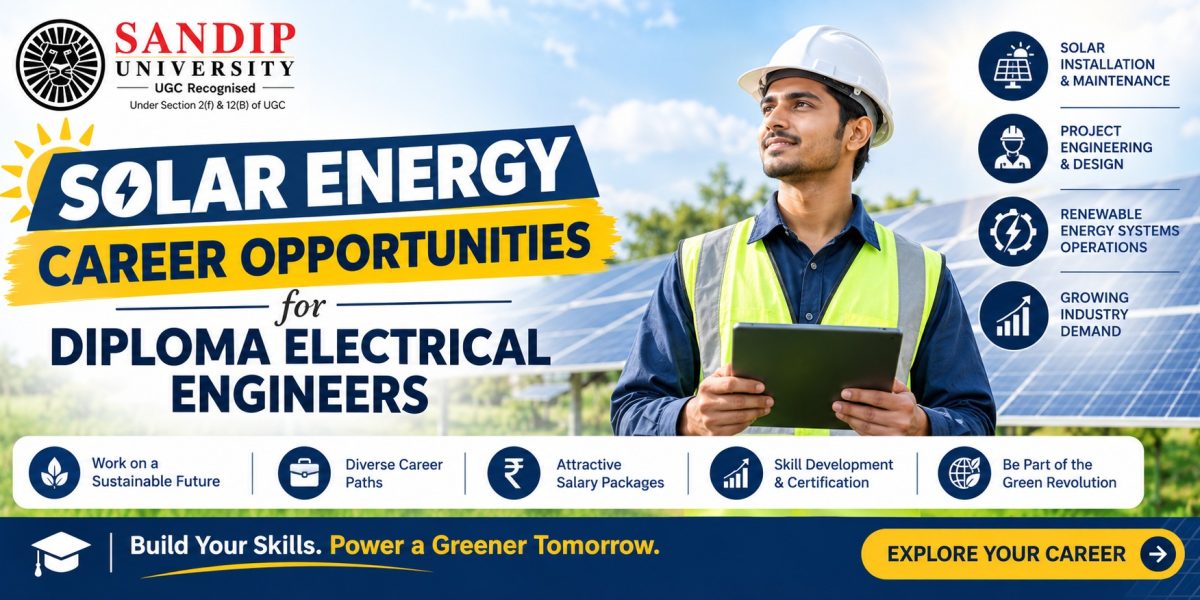
Solar energy is growing more vital every day as people throughout the world require power. Using sunlight to make electricity is a choice, for the long run. For India solar power is very important because of the country’s plenty of sunlight, increasing need for electricity and promise to use energy. The solar industry is no longer about making solar panels. It now includes designing plants, installing them, testing them, getting them ready for use, running them, maintaining them, keeping an eye on them, storing energy connecting to smart grids and managing solar projects.
For students pursuing an engineering diploma from one of the top engineering colleges in Nashik, this rapidly growing industry provides valuable opportunities to gain practical skills and develop a career in the renewable energy sector.
-
The Growing Solar Energy Sector in India
India’s solar energy industry has grown significantly over the past ten years. According to the Ministry of New and Renewable Energy (MNRE), the country’s total solar power capacity had reached around 164.59 GW by 2026. This includes power made on the ground solar panels connected to the grid on rooftops, hybrid projects and solar systems that work without the grid.
This growth is making demand for workers who have technical skills. Solar power plants need engineers and technicians at every step—from looking at a site and planning the work to installing, testing, getting the plant ready and maintaining it.
The building of solar parks is being helped by solar panels on rooftops, solar pumps for farming solar panels on water and projects that use more than one type of energy. These changes are making job chances not in big companies but also in companies that build projects, electrical contractors places that check work companies that run and fix things and in starting new businesses.
Recent Developments in Solar Energy Technology
-
Advanced Solar PV Modules
Solar photovoltaic technology keeps getting better. New projects are using efficiency modules and better ways to make the cells to create more electricity from the same space. Modules need to have better designs and better ways to track the sun are helping to make electricity.
India is also making efforts to increase the domestic production of solar panels. According to the Ministry of New and Renewable Energy, the country’s approved solar PV module manufacturing capacity crossed 100 GW in 2025. The Approved List of Models and Manufacturers (ALMM) has also continued to expand, showing the steady growth of India’s solar manufacturing sector. This means chances in making panels, checking the quality, doing electrical tests and managing projects.
-
Rooftop Solar
Rooftop solar is one of the growing uses of PV technology. The PM Surya Ghar: Muft Bijli Yojana helps one crore households use power with help from the government. The goal is to let homes make their electricity.
For diploma engineers, rooftop solar gives chances to do site checks to figure out how much electricity is needed, decide how big the system should be, connect wires, put in inverters, make sure everything is grounded, protect things and test and get the system ready.
-
Solar Energy Storage
Solar power changes depending on the sun. Battery systems can keep solar energy and use it when needed. Solar with storage is becoming more important for a supply of energy from renewable sources.
Future solar workers should know about batteries Battery Management Systems (BMS) devices that control how the battery charges, inverters, systems that manage energy and basic safety for batteries.
-
Floating Solar and Hybrid Plants
Solar plants are also being built on lakes and other water areas. India has started a government plan for floating solar with the Union Cabinet approving the PM-Surya Sarovar Yojana with a budget of ₹5,070 crore.
Projects that mix solar with wind and energy storage are another area. These systems need engineers who understand how to make energy, how to handle power electronics, how to connect to the grid and how to manage energy.
-
Smart Monitoring and Digitalisation
Modern solar plants are becoming smart with things like SCADA, IoT sensors, remote checks, data analysis and automatic problem finding. Engineers can check things like voltage, current power, how much energy is made, the status of inverters, the temperature of panels and any problems with equipment from a distance. This means future solar engineers need more than regular electrical engineering knowledge. Basic coding, data analysis, IoT and digital monitoring skills can help them get jobs.
Government’s Approach to Solar Energy Development
The government of India is helping energy through many programs and rules.
PM Surya Ghar: Muft Bijli Yojana
The program focuses on panels on homes and aims to help one crore homes. It is expected to speed up installations and create jobs for trained workers in solar and electrical jobs.
PM-KUSUM
Solar energy is more and more important every day as people all over the world need power. It gives us a way to reduce fuels, and helps build a cleaner, better future for the planet. This gives chances for diploma engineers to work on installing pumps, setting up electrical systems, connecting motors, fixing things and running solar plants.
Domestic Manufacturing
The government is also helping make panels and cells at home with the ALMM framework and other rules. The first list of PV cells was made in 2025 and is still being updated. For students this means there will be jobs not in installing but also in making, checking quality, testing and making things.
Skills Required for Solar Plant Design, Installation, Testing and Commissioning
A diploma engineering student who wants to work in solar energy should carefully build up the following skills.
-
Solar Plant Design
Students should learn:
- How solar PV systems work and the parts they use
- Checking a site and looking at how sun there is
- Calculating how much energy is needed
- Choosing the solar panels
- Setting up the panels and how they connect
- Choosing the inverter
- Choosing the cables for DC and AC
- Protecting the system with DC and AC
- Grounding and protection from lightning
- Making a line diagram
- Planning the layout of the system
- Checking for shadows
- Estimating how much energy will be made
- Basic tools for designing and simulating systems
Knowing how to make drawings and use AutoCAD can be very helpful for making layouts and single line diagrams.
-
Solar Installation Skills
Students should get hands-on experience in:
- Putting panels on structures
- Installing the structures
- Connecting DC cables
- Putting in MC4 connectors
- Laying cables
- Installing inverters
- Setting up the AC distribution board
- Grounding the system
- Protecting from lightning
- Installing junction boxes
- Putting in batteries
- Knowing about safety and using protective equipment
Training is very important because solar installation involves both electrical and mechanical tasks.
-
Testing Skills
Before a solar plant is ready tests are done on the electricity. How well it works. Students should learn to use tools like:
- Digital multi-meter
- Clamp meter
- Insulation resistance tester
- Earth resistance tester
- Solar light meter
- Tools to measure DC voltage and
- Thermal camera
- Solar testing equipment
They should know how to check if wires are working, check insulation, check the way things are connected, measure voltage when nothing is connected, check current when it is shorted, check grounding and basic performance checks.
-
Commissioning Skills
Commissioning is the time when the installed solar plant is checked and ready to start working. Students should know:
Check → Test → Check protection → Set up inverter → Connect to the grid → Match the power → Check performance → Write reports → Hand over
They should also know how to make reports, test sheets, checklists, drawings and records for maintenance.
Suryamitra and Skill Development Opportunities
The government knows that having workers is important for the solar industry. The Suryamitra Solar PV Technician Program by MNRE started to make a trained team for the growing sector. MNRE says the program is being used across India in places with a lot of solar power and projects already in place.
The Skill India Digital platform also talks about Solar PV Installer/Suryamitra training that includes installing, checking, testing and getting solar parts ready. Diploma students from some of the best polytechnic colleges in Nashik should look for training that is certified, go on visits to companies, get internships and work on solar projects.
Career Opportunities for Diploma Electrical Engineers
After learning the skills diploma students in electrical engineering can find jobs like:
- Solar PV Design Technician
- Solar Site Engineer
- Solar Installation Engineer
- Solar Testing Technician
- Commissioning Technician
- Solar O&M Engineer
- Solar Project Supervisor
- Solar Electrical Technician
- Solar Quality Inspector
- Rooftop Solar Designer
- Solar Pump Technician
- Solar SCADA/Monitoring Technician
- EV and Solar Charging-System Technician
- Solar EPC Project Coordinator
- Renewable Energy Entrepreneur
With experience and extra training diploma engineers can move into roles like leading projects, managing work, designing systems and doing specialist jobs.
Conclusion
The fast growth of energy is making a new and better job world for students with a diploma in electrical engineering. India’s growing solar power, solar programs for homes farming with solar, solar on water making solar at home and using monitoring are making more need for trained workers.
The main thing for students is to move from what they learn in class to being able to do work. A good solar worker should be able to check a site to figure out how much power is needed, design a system, pick the right parts, install the system safely, check the electrical parts, get the system ready and watch how it works.
So, the education for Polytechnic Diploma in Electrical Engineering should include more about designing, installing, testing and getting ready for solar storing energy, SCADA, IoT, electrical safety and real projects.
The future is for engineers who keep learning skills. By mixing knowledge in electrical engineering with real solar skills and new digital tools, today’s diploma students can be the workers needed to build India’s clean, safe and long-lasting energy future.