
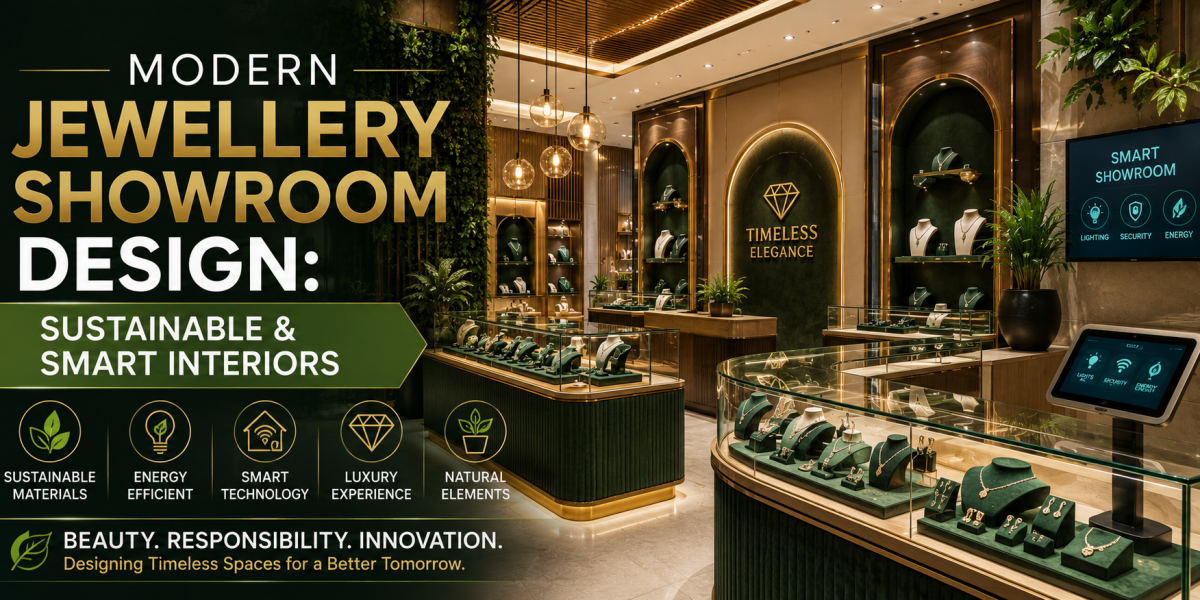
Jewellery retail showrooms in the contemporary world, specifically in 2026, are significantly influenced by the fusion of sustainability, minimalism, and technological incorporation to improve spatial experience and business performance. The purpose is to create an integrated design framework that incorporates all three key elements to improve the planning and execution of jewellery retail showrooms. Some of the top interior design colleges in Nashik highlight the importance of integrating sustainable design, such as recycled materials, green lighting systems, and modular display systems, to improve spatial experience and business performance.
The importance of integrating minimalistic design principles to create an uncluttered spatial experience is also discussed. Additionally, the incorporation of modern technologies, such as digital interfaces, smart security systems, and interactive display systems, is discussed to improve spatial experience and business performance. These strategies create an optimised spatial experience, improve sustainability, and enhance business performance. An eco-minimalistic approach to designing jewellery retail showrooms, with the incorporation of modern technologies, can improve spatial experience, sustainability, and business performance. Let us understand interior design and retail design by providing an approach to create future-ready Jewellery retail showrooms.
Technologies Used in Retail Jewellery Stores
Examples of technology found in jewellery showrooms include:
- Augmented reality (AR) virtual try on
- Smart mirrors
- Interactive digital catalogues
- Artificial intelligence (AI) based customer data analysis
- Biometric security systems
The use of these technologies connects the physical retail experience to the digital retail experience through increased customer engagement and personalised shopping experiences.
Sustainability in Retail Interiors
The design of interiors with consideration to the environment is increasingly becoming a critical element in the way that a contractor constructs (builds out) a space, and in how that space is maintained throughout the useful life of the product. All materials used to construct a space must comply with sustainability requirements, including but not limited to the following: minimising the amount of waste produced during the construction process and the amount of energy consumed during the construction process; providing materials to be reusable or recyclable; and using renewable resources when possible. Some examples of sustainable materials include: sustainably harvested wood, reclaimed glass, modular furniture, and low VOC building products, which are all proven to reduce the amount of chemicals that are released into the environment. Research assessing the impacts of sustainable design on the environment, using Lifecycle Assessment (LCA) methodology, has demonstrated that the choice of raw material used to construct a retail space is one of the most significant contributors to the degree of success achieved by sustainable design with respect to protecting the environment.
Interior Design for Jewellery Stores Today
In the present day, the Jewellery companies are having issues with eco-friendly consumers. And digital transformation trends are generating showrooms that are not only luxurious but also environment friendly. In the Indian tradition there is the blend of art forms and similarly current fashion trends like chains and natural gems. This research aims to provide a guideline for the 2025 trends in Jewellery showrooms that are based on minimalism, eco-friendliness, and immersive technologies to improve the retail experience while reducing environmental impacts. The research objectives are to identify the trends using literature and attachments, design modular showrooms for high-footfall areas such as Nashik shopping malls, and assess the ROI using predictive models based on ANN for environmental impacts. The research methodology is based on qualitative research and quantitative sustainability aspects, targeting multidisciplinary journals such as Sustainability or Design Studies.
However, existing literature in the domain of Jewellery design and retail environments mostly focuses on sustainable materials used in the making of Jewellery, branding strategies for a retail environment, and integrating digital commerce with physical stores. Though these research works are significant in understanding the sustainable nature of products, they are mostly lacking in understanding the spatial and environmental nature of the retail environment for a Jewellery showroom. For instance, there is a lack of research on the integration of sustainable materials in the interiors of a showroom, the use of a minimalist approach in the design of a luxury environment, and the use of smart technologies in the design of a showroom environment for a Jewellery store. Moreover, little emphasis has been given in the existing literature on the integration of environmental lifecycle analysis in the design of a showroom environment, especially in the context of the growing markets in India.
Hence, this research attempts to address this research gap in understanding the comprehensive nature of sustainable and technologically advanced showroom environments for a Jewellery store, especially in the context of contemporary trends in retail environments. This research focuses on problems that can be helped to resolve by creating a complete design plan for jewellery showrooms that are both naturally eco-friendly along with modern technology.