
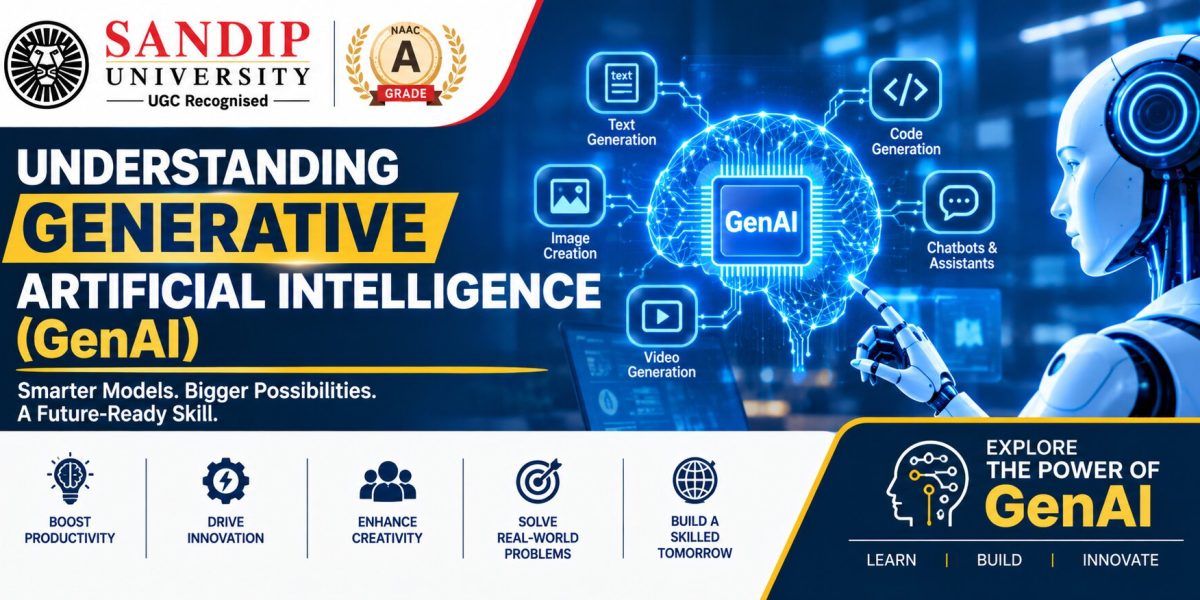
Imagine a tool that can write a poem, debug your code, design a logo and compose a song—all in a few seconds. This is not something you’d see in a science fiction movie. This is the world of Generative Artificial Intelligence or GenAI. It is one of the powerful and transformational technologies we have seen in recent years developed by computer engineers from some of the best computer science colleges in Nashik.
Generative AI is a type of intelligence that creates new content. It can produce text, images, music, videos and even computer code. Unlike AI, which analyses data and makes decisions—like recognising a cat in a photo—Generative AI builds things from scratch. It studies amounts of data to understand patterns. Then it uses those patterns to generate outputs.
This technology is changing industries. It is reshaping how people create. It is raising important questions about what lies ahead for work, education and daily life.
At the core of GenAI are deep learning models. These models are trained on datasets. They learn how language flows, how images are formed and how code operates. Then when someone gives them a prompt, they begin creating something
The main technologies behind GenAI include:
Transformers – A neural network architecture introduced in 2017 that powers GenAI systems
Large Language Models (LLMs) – Such as GPT-4, Claude and Gemini trained on billions of text samples.
Diffusion Models – Used in image generators like Stable Diffusion and Midjourney Multimodal Models – Systems that understand and generate across text, images and audio The process from input to output involves several key steps:
Training – The model sees large amounts of data and learns to predict what comes next—a word, a pixel or a token.
Fine-Tuning – Human feedback helps improve the model’s outputs so they match human expectations better
Prompting – The user provides instructions and the model begins working on a response
Inference – The model produces content in real time usually within seconds
Real-World Applications
Generative AI is already being used in various fields:
Education
- Personalised tutoring systems that adapt to each students’ pace
- Creation of practice questions and study materials
- Translation and simplification of topics into easier language
Healthcare
- Faster drug discovery by generating possible molecular structures
- Better medical imaging and tools for diagnosis
- Automated writing of patient notes and clinical reports
Software Development
- Writing code based on simple descriptions in natural language
- Finding bugs and testing software automatically
- Making documentation and explaining code simply
Creative Industries
- Creating marketing copy, slogans and campaign ideas
- Designing graphics concept art and mock-ups
- Composing music and producing videos
Business & Productivity
- Writing emails and drafting reports quickly
- Running customer support through chatbots
- Analysing data using plain language queries
What are the Drawbacks of Generative AI?
Even though GenAI offers benefits there are serious concerns that must be addressed.
Academic Integrity – Students may use AI to write essays or projects and submit them as their work. This blurs the line between learning and copying.
Accuracy and Hallucinations – Sometimes GenAI gives answers that sound correct but are completely wrong. It may invent sources. Cite articles that do not exist.
Bias and Fairness – The models reflect the biases in the data they were trained on. This can lead to outcomes especially in sensitive areas like hiring or law enforcement.
Privacy – The data used to train these models might include details. If not handled carefully private information could be exposed.
Job Reduction – As GenAI improves many cognitive jobs could become automated. Roles in writing, coding, design and analysis might shrink, leading to job losses.
Environmental Issues – Training AI models requires amounts of energy. This leads to carbon emissions. Contributes to climate change.
These challenges show that while GenAI brings power it also demands careful thinking. We need to consider ethics, safety and long-term impact.
Conclusion
GenAI acts as a powerful teaching assistant. It helps students from some of the best computer engineering colleges in Maharashtra with explanations, supports brainstorming sessions and even assists with coding tasks. For teachers it reduces busywork, creates types of teaching tools and allows fast evaluation of assignments. It can be said that this innovative tool opens up possibilities. It pushes boundaries. It lets people explore ideas in ways they never could before.