
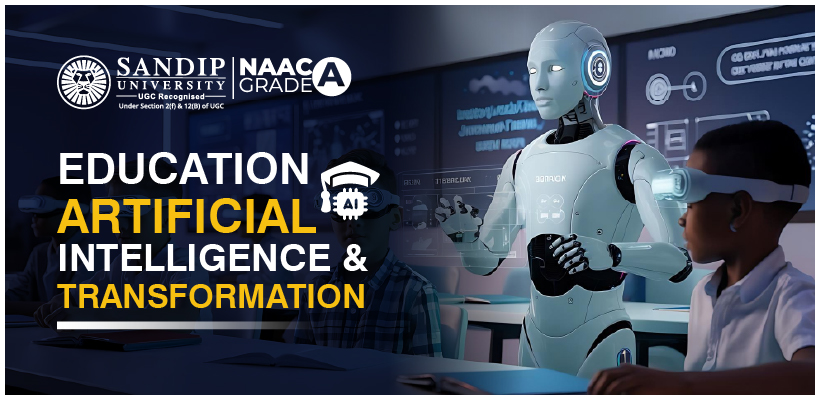
Technology has always shaped human life right from the beginning. It has changed human life in all its aspects. Today the advent of Artificial Intelligence has not remained an imaginary story but a reality. It is reshaping the entire world and the field of education is an exception for this. In fact, it is one of the most affected fields by Artificial Intelligence. This revolution has both positive and negative effects. As it is in its initial phase there is much chaos and confusion about it. Some of the top law colleges in Nashik are implementing the use of AI in training students to become more futuristic lawyers. Let us further explore the impact of AI in the education system:
What is Artificial Intelligence in the Education Sector?
AI is technology which empowers computers and machines to mimic human intelligence, thereby allowing them to learn, reason, solve problems, and make decisions just like a human. Education which traditionally meant classroom teaching where 50-60 odd students are taught by a single teacher, where it is impossible for him to attend every student. This led to the gaps in learning. Artificial intelligence can bridge these gaps and make learning personalized. Artificial Intelligence is basically the use of such tools where learning becomes more accessible.
Government Policy
As we all know that India is currently going through a large-scale digital transformation, and education is the central pillar of this transformation. This move is to integrate AI into teaching. This aligns with the following things:
- National Education Policy (NEP) 2020
- India’s push for Digital Public Infrastructure (DPI)
- The broader National AI Strategy
- The goal of making India a global AI leader
The government believes that AI can do following things
- Personalise education at large scale
- Reduce learning gaps
- Support teachers instead of replacing them
- Enable multilingual and inclusive education
- Improve governance through data-driven policy
How will AI be Used in Classrooms
The AI tools are expected to assist at three levels
a) For Students
1) Personalise learning
- AI tracks student strengths and weaknesses
- Custom exercises are generated
- Adaptive difficulty level
2) AI Tutoring
- Question Answer support
- Concept explanation in local language
- Instant doubt resolution
b) For Teachers
- Learning Analytics
- Dashboard showing student progress
- Early identification of weak students
- Performance heat maps
c) For Policymakers
- District level performance comparison
- Dropout Pattern detection
- Infrastructure gap mapping
- Resource allocation optimization
Conclusion
Artificial Intelligence is set to revolutionise the education sector by making learning more personalized, more accessible, and more efficient. It enhances the skills of teachers, backs students, and improves institutional decision-making.
However, there is fear in some sections of the teachers that whether the technology shall complement or replace them. The end goal is not to create robotic classrooms but to create a smarter, and a more inclusive learning environment. In this light AI in education has remained not just a trend but the foundation of the future of learning.