
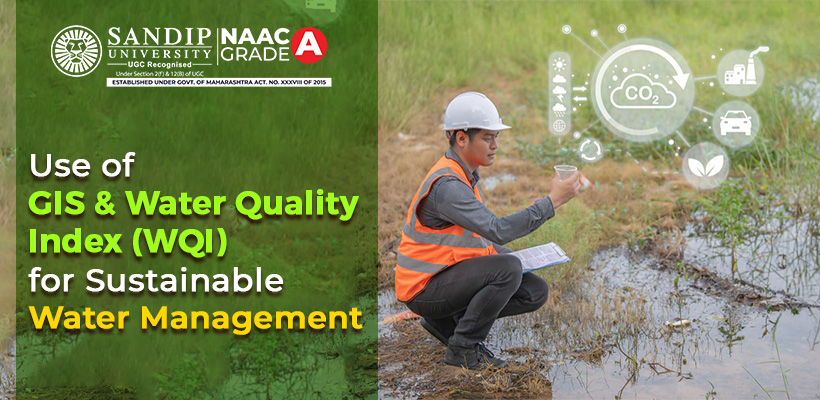
Water is quietly emerging as one of the best-valued inputs of the 21st century. In numerous Indian cities, the actual strain is not only on rivers and lakes but also below our feet — groundwater. It feeds drinking water supply, agriculture and industry. But too much urbanisation, over-extraction and rising pollution loads is stressing the same groundwater each year. Groundwater management must move beyond its broad assumptions to be data-driven and location-specific if we want long-term water security. Here are two tools of great use— GIS (Geographic Information Systems) and Water Quality Index (WQI)—that can have a real impact. Collectively, they assist engineers, planners and authorities in understanding “where the problem is” and “how serious it is” in scientific and practical ways. Many top engineering colleges in Nashik are focusing on sustainable water management through in-depth research and innovation.
How GIS/WQI are supporting sustainable water management, for better decision making at the city and community level. The case for a more intelligent way to manage our groundwater The reality is that water often feels “invisible” — because we don’t see it here. But its challenges are very real: Heavy pumping for domestic and commercial consumption lowers water tables.
Unplanned borewells unthinkingly extract water without assessing recharge capacity. Over time, contamination from raw sewage leaks, solid waste dumping, and industrial discharge infiltrates aquifers. Climate variability changes rainfall patterns and decreases recharge in some seasons. The result is a terrible imbalance: More regions are sucking up groundwater than it can naturally recharge, and quality in other areas is quietly degrading in some pockets. The risk is that quality issues often go unrecognised until health and supply problems start to surface.
Two things mean sustainability here: Protecting groundwater quality, and Balancing extraction with recharge.
1) GIS for Recharge and Discharge Zones:
Geographic Information systems “Making maps” is not enough, it is a platform to collect, store, analyse & show location-based information. In groundwater investigations, GIS is relevant since water issues are almost never consistent from one city or site to another. Even within a few km, water level and quality can deteriorate at groundwater depth changes due to land use, different soil types, geology, drainage schemes, and human activities. With GIS, civil engineers identify recharge or discharge zones (the entry and exits of groundwater systems) Map hot spots for contamination and sources of potential pollution Study land-use influences such as buildings on the building, industrial development or farming land Use multi-collected datasets (geology, slope, rainfall, drainage and soil) to make sense of rainfall and also cover it In simple terms: GIS tells the “where” and helps explain why.
2) WQI Parameters: pH, TDS, EC, and More:
Water Quality Index Water quality testing often produces many parameters—pH, TDS, Electrical Conductivity and several chemical indicators. These numbers are easy for those who can’t read and for many decision-makers to understand. That is why WQI is useful. WQI combines several water-quality parameters into an index value that accounts for the overall quality of water at a location. It broadly categorises water into good, poor, or unfit to drink (depending on selected standards and a method to do so). A WQI calculation usually includes factors such as pH (acidity/alkalinity) Total Dissolved Solids (TDS) Electrical Conductivity (EC), and often other parameters that reflect the research purpose are contained. One of the benefits of WQI is that it provides a clear “summary” so that we can quickly compare different sampling settings.
Identifying Hotspots with GIS + WQI
To Boil it Down: WQI indicates the “how good” (or risky) the water. GIS + WQI jointly offers Power Alone however GIS plus WQI is important So what are your two strong points together, though? But together, they provide a powerful decision support process: WQI gives us the quality status of groundwater at each sampling point. GIS helps plot these points on a map and identify clusters, patterns and affected areas across it. Plotting WQI values on a GIS map allows one to immediately detect: Which areas have consistently poor water quality, do poor water quality align with specific land uses? Where do you prioritise interventions?
So what that makes for — picking the areas where it should be carefully monitored through different methods, picking which sources of pipes for further expansion, what kind of recharging plans are best undertaken, establishing a monitoring program of pollution controls in sensitive areas. Real Example: A case from the Allahabad Smart City The following material introduces an example through a demonstration from the Allahabad Smart City for GIS – WQI combination. GIS mapping in these studies helps to determine hydrological zones and pollution sources, whereas WQI is more useful for flagging unsafe water areas. Combined output helps authorities prioritise the right efforts — such as where cleanup can be located in certain areas, how pollution can be controlled at the source or as a recharge measure where the maximum upside can be extracted.
The key takeaway from such applications is distilled, data-based prioritisation helps prevent wasted efforts and, in case of scarce resources, maximises the overall results. Going to the Next Level: Remote Sensing & Machine Learning Today’s groundwater management integrates GIS and WQI with sophisticated technologies: With remote sensing, Satellite data can track huge areas and offer indicators, for example: Land use changes, vegetation changes, and soil moisture as well as proxies for recharge levels. Remote sensing enables wide-scale, repeat analytics, which is helpful in rapid urban sprawl. Machine learning Machine learning allows one to model data in relation to water trends and pattern recognition or forecasting for such things as future drops in groundwater flow, possible water contamination, or the connection between land use and flow quality. This can be addressed early, without any problem escalation, as the attachment explains.
Sustainability Requires People, Not Technology The best tech solutions won’t address groundwater problems on their own. Sustainable water management requires a partnership among Civil engineers and hydrologists Geologists and environmental scientists Analysts and urban planners Policy makers and local groups Communities and water user groups Local awareness as well as training is needed. Communities are going to realise the impact of protecting recharge zones, not dumping waste and building recharge structures in the long run.
Conclusion
Groundwater offers a lifeline — but fragile too. There is no other choice, with population growth, climate stress and rising pollution, we need to address them sustainably. GIS gives location information. WQI gives quality clarity. Together, they drive us toward smarter groundwater planning, better monitoring and interventions. This strategy is even more powerful with remote sensing, data analytics, and community engagement. Some of the best engineering colleges in Nashik are driving tech development in the field of water management to find sustainable practices to save water. The time to embrace water management science backed by technology is now if we want to have reliable groundwater for the future generations.