
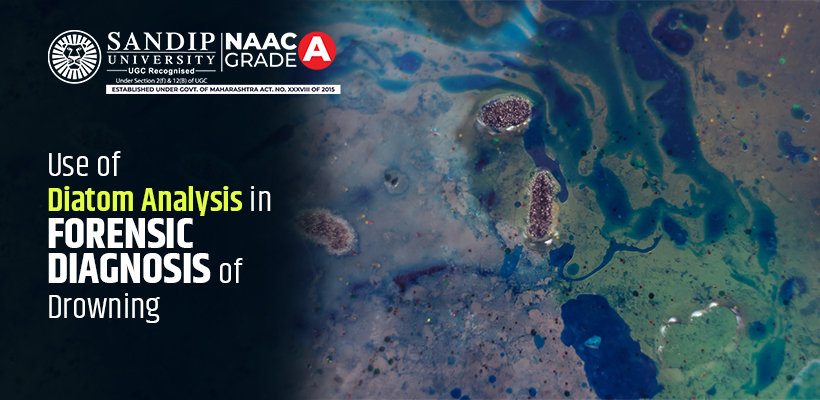
Diatoms are single-celled photosynthetic algae that are found worldwide in all aquatic habitats. Their significance in forensic sciences is attributed to their silica cell wall, termed ‘frustule’, which is extremely stable to chemicals and decay. This means that even after severe decomposition of a biological tissue, diatoms will remain in it and serve as good evidence of a suspected drowning. Some of the top forensic science colleges in Nashik train students about diatoms in high-tech laboratories to help them use this tool for forensic diagnosis.
Distribution of Diatoms in the Human Body
In antemortem drowning, there is an active inhalation of water. The air passages are filled with water, which in turn enters the alveoli. As circulation is still taking place, the diatoms present in the aspirated water are transported across the alveolar-capillary barrier into the bloodstream and distributed throughout the organs.
Diatoms will always be found in the lungs since they are the portal of entry, but their forensic relevance increases significantly once they are discovered in locations such as the distant organs; the liver, kidneys, brain and the spleen, as blood supply to these areas is quite considerable. The most important location for the finding of diatoms is the bone marrow, typically of the long bones such as the femur. The marrow is relatively safe from the effects of contamination and post-mortem diffusion, and hence, one of the most suitable locations for demonstrating the systemic spread.
However, in instances of postmortem immersion, in which the body is placed into water after the death has occurred, the inability for an active circulation to distribute diatoms systemically, the diatoms only appear on the body’s external surfaces and perhaps in the upper respiratory system.
Diagnostic Approach to Drowning Using Diatoms
The presence of diatoms in internal organs provides a vital test in forensic drowning cases. This test relies on the diatom having an impenetrable shell of silica which is difficult to destroy and may survive the harsh treatments to which tissues are subjected.
The simplest method and the one commonly used is acid digestion. In this method, samples of tissue (bone marrow, lung, or liver) are placed in concentrated acids (nitric acid is ideal). Organic material is digested away by the acid, leaving the silica structures of diatoms intact. The residue is centrifuged; the pellet is observed under a microscope for the presence and morphology of diatoms.
Another technique used is hydrogen peroxide digestion; this technique is gentler than the aforementioned method and provides greater preservation of the diatom structure. Another way to digest the tissues is using enzymatic digestion; this technique uses proteolytic enzymes to digest the tissues without affecting the morphology of the diatoms; it is used where a precise morphological identification is necessary. The identification of diatoms is made based on their morphological characteristics, such as their size, shape and the features on the surface, under either light microscopy or (in higher scale environments) scanning electron microscopy, following the extraction process.
An interesting further application of the diatom test is to compare diatoms found on the body to those present in the water samples taken from suspected drowning locations. Species matching strengthens the conclusion that death occurred in that location, and may provide evidence for the body being moved post-mortem.
Conclusion
Diatoms, a well-documented and lasting method for confirming drowning in forensic casework, demonstrate that internal organs possess active metabolic functions during drowning, and that antemortem drowning can be differentiated from postmortem immersion. When performed rigorously and analysed in the context of the medicolegal issue by professionals holding a B.Sc in Forensic Science, the diatom test is an invaluable tool in the forensic investigation of drowning.