
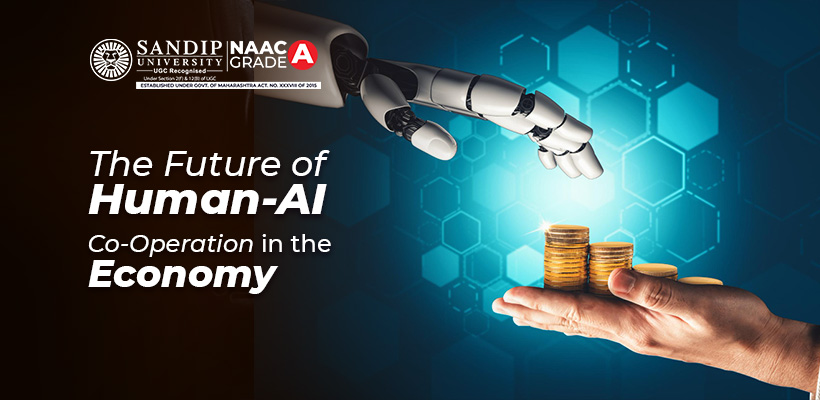
Automation of industries has changed the appearances of industries, switching the manual labour to the use of machines and software operated systems over the decades. To the offices and to the digital work processes, automation has created productivity, lowered the cost efficiency in the assembly line production. The additional growth of technology is, however, not simply the automation. We have just seen the beginning of the cooperation between humans and artificial intelligence (AI) where a human is not overwhelmed by artificial intelligence, but they engage with each other. Some of the top computer science colleges in Nashik offer path-breaking courses in artificial intelligence to train future engineers and boost innovation in this field.
It is not the ones, which are based primarily on automation, but the ones, which can unite the human capacity to be creative, critical and emotional in thinking with the artificial intelligence analysis, which have proven successful in the new digital economy. The combination of such a partnership generates a strong synergy, and it can deal with complicated issues, promote innovation and transform the future of work.
Human and AI cooperation is not depriving people of being machine-dependent, but it improves human beings and organisations performance, which in its turn, could be able to achieve these results that were not previously achievable.
Automation to Collaboration Evolution
The automation in the past was to be used to remove manual labor and repetitive work. The efficiency of the industrial robots has contributed much in the factories; automated finances and software scripts. Nevertheless, the old-fashioned automation systems are based on the rules, and can barely be adapted to the unpredictable circumstances.
It is a new dimension of artificial intelligence. Artificial intelligence is able to predict and identify trends as well as learn. Intelligent systems can help a person in the process of decision making, problem solving and strategy planning instead of these systems being reliant on instructions.
This kind of transformation is among three important epochs of technology:
- Mechanisation -Machines will help in the physical work
- Automation involves use of machines and software
- Smart Cooperation – The AI and human beings collaborate to address complex tasks
This new paradigm will turn AI into an assistant of productiveness and not an assistant of efficiency.
The significance of human and AI relationship
There are essential differences in the strength of human intelligence and artificial intelligence. Together with one another they are implemented.
Artificial Intelligence Strengths
AI systems excel at:
- Fast analytics of big data
- Anomalies detection and patterns
- Performing tedious analytical work
- It should be capable of working 24/7
This is created by conducting predictions using past data.
Human intelligence Strengths
Humans excel at:
- Creativity and innovation
- Sensuality and emotional intelligence
- Ethical judgment, ethical reasoning
The thinking and awareness, which accompany the other two skills, include strategic thinking, and the awareness of the context. Human and AI collaboration makes the organisations the beneficiaries of the synergised world of analytical accuracy and innovative intelligence.
The Continuous Areas of Work that is Changing as Human and AI Conspire
The partnership between human beings and AI is already transforming other areas and fields.
Healthcare
The sphere of healthcare is among the fields where AI-based diagnostic systems can be adopted and used to analyse the medical information and images the patient provides and help the doctor make more accurate diagnoses. Last, but not the least, are left to the medical personnel that rely on the history of the patient, ethical issues and clinical suitability.
Compared to a physician who offers empathy and human touch that are required to treat a patient, AI can find out the patterns of medical imaging with great precision.
Finance
Fraud prevention, risk management, and algorithm trading are some of the areas in which banks are becoming more dependent on AI. Millions of transactions are processed by AI systems, and an aspect of suspicion can be determined.
But even then, financial experts interpret and make insights, develop strategies and investments decision making in the overall economic scenarios as well.
Education
Student performance is analysed and the learning style to establish learning algorithms based on AI and personalising the learning experience. The teachers then utilise such insights in transforming their instructional approaches and offer certain support.
The human mentorship will be expanded to the future classroom by incorporating the smart tutoring systems.
Creative Industries
The other argument which must be given is that AI is not killing creativity but it is improving it and hence people were afraid of it in the first place. Artists, writers, makers, and designers have begun to utilise AI tools to brainstorm, generate creative variants and create content quicker.
To give the example, AI-based design systems can produce a great number of variants of prototypes, which may then be elaborated and contextualised by a human designer.
Research and Engineering (Scientific)
The field of research is also being transformed through AI because complex data is being processed, experiments are being modelled and the findings that may be obtained are mentioned. AI is used to facilitate the work of researchers in creating materials science, pharmaceuticals, and climate modelling at an accelerated rate.
Human intuition is the process that determines the way the research will be done and AI helps in discovering quicker.
The Changing Nature of Jobs
Human-AI collaboration will not cause the removal of the working positions but will redefine the working qualification requirements and positions.
Monotonous work issues are being automated and human labor is being shifted to the higher value work and entail:
- Strategic thinking
- Innovation and design
- Relationship management
- Ethical decision-making
- Cross-functional problem solving
Creating an Efficient Human-AI Cooperation
Designing Human-Centred AI
AI systems are not expected to substitute human choices. Fair algorithms, explainable AI models, and simplified interfaces also facilitate the promotion of usability and trust.
Training the Workforce
The competencies the employees will need to learn are the competencies of the cooperation with AI technologies. The training modules will consist of information literacy (teamwork and analytical training in an online environment).
Ethical AI Governance
The fair use of AI requires responsible AI practices that will result in fairness, accountability and openness. The algorithmic bias, morally right use of AI and data privacy are the policies that ought to be there in the organisations.
Encouraging Innovation
An organisation must develop a culture whereby its employees can be in a position to test AI devices and learn how they can be utilised. Technical and domain experts can come up with the most effective innovations when they are working together.
Human-AI Collaboration Issues
Regardless of these enormous potential benefits there are some obstacles that should be overcome.
Trust in AI Systems
The employees may also be reluctant to use the insights produced by AI due to the fact that the systems are not well understood. Explainable artificial intelligence models have the ability of enhancing trust and transparency.
Skill Gaps
The technical and analytical skills needed to handle the AI systems are not available in some of the companies. Reskilling and continuous learning programs are required.
Ethical Concerns
Inherent prejudice of the algorithms, fear regarding the loss of jobs, as well as, abuse of information are just some of the issues that must be dealt with with the assistance of the powerful government apparatus.
Integration Complexity
When AI is introduced to the current organisational systems and processes, it may be quite technologically complicated and demand considerable investments.
The Future Economy: The Humans and Machines Partners
This will make the future economy be that of team intelligence in which both humans and machines will interrelate in the solution of the problems that are facing the world.
The human-AI co-operation will also be brought by the new technologies:
- Generative artificial intelligence in artistic problem-solving
- Augmented reality was human machine interaction
- Brain-to-computer interfaces machines
- Quantum computing to solve complicated optimisation problems
The partnership of intelligent technologies and human beings will depend on the success of the latter to succeed in the new landscape. Companies that focus on collaborating and not replacing will unleash untapped potentials of productivity, creativity and sustainability.
Conclusion
The future of the workplace is not with robots taking over the human beings but with a man and a machine. The example of the human-AI partnership where technology supports human abilities is one of the powerful changes in the automation of the intelligence to augmented intelligence. Pursuing a B.Tech in Artificial Intelligence and Machine Learning program can help you design a competitive future for yourself in this industry.
The opportunities of AI to analyse human creativity, empathy, and strategic thinking can give organisations new opportunities and overcome complex issues of the global economy. The new era is the era when human-AI cooperation will be introduced, the era when the technology may be of service to the people, not take them up, the era when the interaction between the people and intelligent machines can be the source of the innovations and developments.