
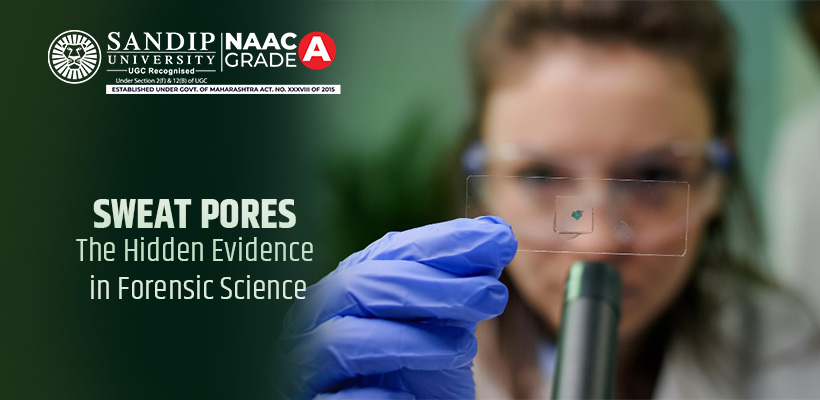
Fingerprints, DNA, bloodstains and hair are examples of evidence that forensic science has always used. However, as criminal methods get more complex the field of science needs to look into new areas of evidence. One such area is sweat pores, which hasn’t gotten attention. Sweat pores are openings of sweat glands found on the skin’s friction ridges. They are a part of forensic identification that people often overlook. Many top forensic science colleges in Nashik train students in high-tech labs to help them gain hands-on skills on how to efficiently gather evidence.
Fingerprint analysis usually looks at patterns like loops, whorls and arches. Studying sweat pores, called Poros copy gives more details to identify someone. Sweat pores are unique. Do not change much over time. This makes them very helpful in identifying people especially when fingerprints are partial or damaged. As a result, looking at sweat pores is becoming more important in science. It is an advanced way to identify people. Sweat pores help make identification more accurate. They are a tool for forensic scientists.
Understanding Sweat Pores
* Sweat pores are openings on the skin that are connected to sweat glands
* They have patterns on each person especially on areas like fingers, palms and soles
Sweat pores are important for making fingerprints. When someone touches a surface sweat and oils from their pores are left behind. This can be used to make impressions that can be developed using methods. Forensic experts can now look at the position, shape and frequency of pores in fingerprint ridges using imaging methods.
Pore patterns do not change during a person’s lifetime. This makes them a steady and trustworthy method of identifying a person. Sweat pores are really beneficial in cases that need an accurate result and it will provide information about the suspects or victim that what they were feeling when the crime happened.
Chemical Information from Sweat
Sweat can show what someone eats, drinks or does on a basis. It can also show signs of drugs, alcohol or poisons. This chemical information can help investigators. There are challenges in using sweat pores as evidence. General forensic labs may not have high-resolution imaging equipment. Sweat residue can be broken down by conditions. Pore-based evidence is still a new area of forensics.
Future Scope and Significance
Evaluating sweat pores should become simpler and more precise as forensic technology advances. Standardised protocols may develop as research advances. Sweat pores are a resource that links chemical and physical analysis. Forensic experts can improve the accuracy of investigations by evaluating this kind of hidden evidence. Sweat pores play a role in forensic relevance. They represent a field of forensic science. As technology improves and research grows, sweat pores may prove to be a powerful source of forensic evidence.
The future of sweat pore analysis looks really good because of imaging and analytical technologies. We can use resolution digital microscopy and automated fingerprint identification systems to get a better look at the details of sweat pores. This can help us figure out who someone is and keep places secure. We can also use sweat pore analysis with sciences like forensic science and molecular biology to learn more about how sweat pores develop and what they are made of,
* Resolution digital microscopy can help us see the small details of sweat pores
* Automated fingerprint identification systems can help us compare the details of sweat pores
* Artificial intelligence can help us analyse the details of sweat pores
But there are some problems with sweat analysis. Sometimes the results can be different because of the environment or the condition of the skin. We need to keep doing research and make sure everyone is doing the analysis in this way. This will help us use sweat pore analysis all the time in science.
Conclusion
In the end sweat pores are a powerful way to identify people. With technology and more research, sweat pore analysis is going to be a very important tool in forensic investigations. Pursuing a B.Sc in Forensic Science can boost your career scope in the field of forensic science. Sweat pore analysis is definitely going to help us solve crimes and keep people safe.