
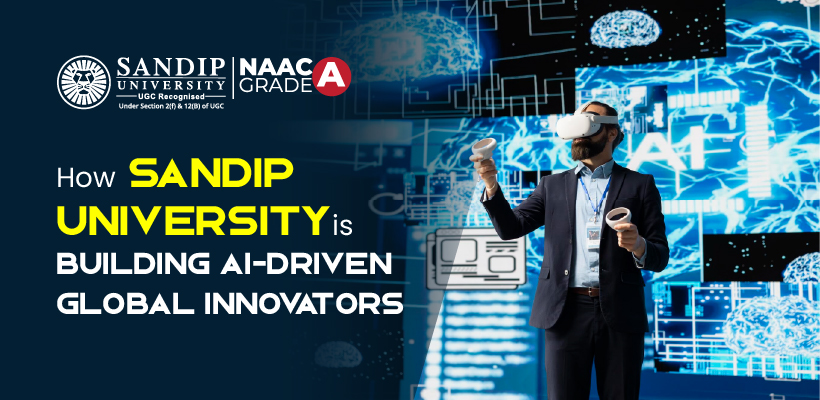
Technology has been changing faster than ever before. In the year 2030 AI, smart automation, sophisticated computing and data-driven ecosystem will characterise the way industries work, the way governments will work and the way world economies will be developed. It will not be just engineers demanded but people who are able to think strategically, create intelligent systems, and solve global complex problems.
The ideals of tech education cannot be recalibrated with changes in the curriculum. It requires a total overhaul of the approach to learning, experimenting, and applying knowledge among the students. As one of the best engineering colleges in Nashik, Sandip University is already undergoing this change by developing an academic ecosystem that would be in line with the AI-enabled world of the future.
From Traditional Learning to Intelligent Education
The old fashioned model of engineering gave focus to theory-based teaching. The decade that follows however needs application first thinkers. Students should learn algorithms, data structures, and computational models in addition to knowing how to apply AI solutions into practice.
This shift includes:
- Experiential learning methodologies
- Problem-based assignments
- Industry-simulated lab environments
- Collaborative innovation projects
This can reduce students into inactive learners and make them technology innovators.
AI as the Core Academic Pillar
AI is no longer a specialised field but is becoming a pillar topic in all areas of life. AI is transforming the world of healthcare, financial analysis, autonomous systems, and smart cities among others.
Students gain exposure to:
- Machine learning algorithms and model training
- Deep learning frameworks and neural networks
- Computer vision and natural language processing
- Predictive modeling and big data analytics
- Ethical AI and responsible innovation
This is organised learning so that the graduates can develop scalable, efficient and socially responsible AI systems.
Integration with Emerging Technologies
AI is not an autonomous activity. Technology has a better future in terms of integration. Smart systems communicate with e-cloud systems, cybersecurity systems, blockchain systems, IoT devices, and automation systems.
In Sandip University, interdisciplinary exposure helps students to understand that:
- AI enhances automation and robotics
- Cloud computing scales AI applications
- Cybersecurity protects intelligent systems
- Blockchain secures data-driven ecosystems
- IoT enables real-time AI decision-making
It is this holistic knowledge that equips students to work within complicated multi-technology settings.
Hands-On Innovation and Research Culture
The next-generation innovators of the world are constructed through the experiment. Development based on projects is major in enhancing realistic capacity.
Students engage in:
- AI-powered application development
- Smart automation system design
- Data analytics case studies
- Emerging technology research exploration
- Prototype development and testing
Learning based on research has the effect of developing profound analytical thought and independence in problem solving.
Building Global Competence and Leadership
The online economy has no boundaries. The current and future AI engineers and tech specialists need to be capable of thinking on the global level and coming up with solutions that would impact the world.
Sandip University helps students to acquire international level competencies by aligning academic programs to the emerging trends in technology and the ever changing global standards.
The development of leadership is directed towards:
- Strategic thinking
- Ethical decision-making
- Innovation mindset
- Entrepreneurial orientation
- Adaptability to technological disruption
Such qualities define global innovators of 2030.
Preparing for the Digital Economy 2030
The employees of 2030 will need hybrid skills, i.e., a combination of AI skills, knowledge of automation, a command of data, and intelligence of solving problems. The professionals should be in a position to develop intelligent systems that are secure, elastic and enduring.
With high-order curriculum design, applied technical training, and a culture of innovation in academics Sandip University is training students to become industry leaders as opposed to being industry adapters.
Conclusion
The redefinition of tech education is staying ahead of the future and not responding to it. AI will only continue to permeate every major industry in the coming decade and organisations willing to leverage AI to the fullest in their academic systems will make the leaders of tomorrow.
However, by integrating the pillars of a solid AI, interdisciplinary integration, research-based innovation, and global preparedness, top engineering colleges in Maharashtra like Sandip University are developing a generation of AI-driven global innovators ready to drive the Digital Economy 2030 and beyond.