
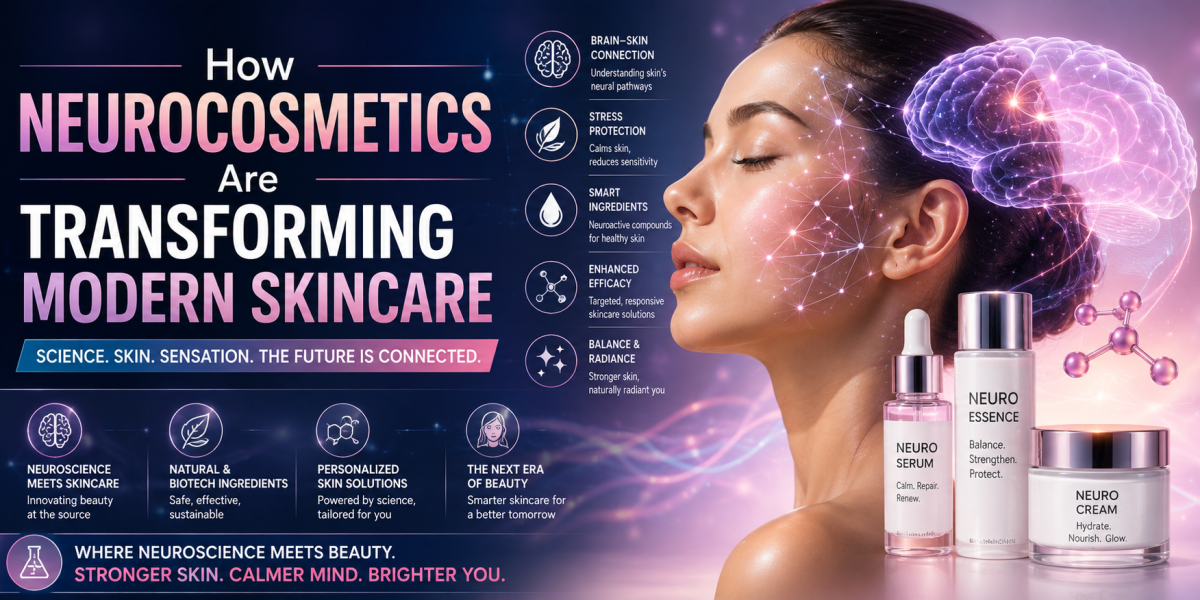
Neurocosmetics is an emerging concept in the cosmetics field that studies the connection between the skin and the nervous system at the level of perception and sensation. Products in this category are designed to make a difference beyond the surface: while conventional cosmetics ask the question “does it make the skin look better?” neurocosmetics pose a more complex query: “how does it influence the skin?”
The concept is gaining traction due to the skin’s recognised role as a sensory, immunological, and endocrine organ. The skin’s nerve endings, receptors, and neurotransmitters make it possible for irritation and other stimuli to modify the feeling of comfort and trigger emotional responses. Therefore, the topic of neurocosmetics is increasingly associated with cosmetology, dermatology, and psychodermatology, offering an innovative approach to skincare and the development of cosmetics at some of the best cosmetology colleges in Nashik.
Meaning of Neurocosmetics
Neurocosmetics, refers to cosmetics, which work through the skin-brain connection. Scientists believe that neurocosmetics are the intersection of dermatology, neuroscience, psychodermatology, and cosmetics. The main idea is that cosmetics can improve the skin’s condition and reduce irritation via the influence on the nervous system. However, neurocosmetics are not intended to cure diseases, but only to help in reducing the symptoms.
It is important to note that the innovation in cosmetics is crucial, as for many customers, the visual appeal is not the only criterion. The feel of the product, its fragrance, coolness, irritation, softness, comfort – all these characteristics matter and affect the perception of cosmetics. Thus, neurocosmetics affect the connection between the ingredients and nerve endings, and the perception of these ingredients.
Communication between the Skin and the Brain
The connection between the skin and the nervous system is achieved through reflexes, neuropeptides, and neuro-immune interactions. The skin has nerve endings that respond to temperature and pressure and react to irritation. At the same time, the brain can affect the state of the skin through the stress response cascade and the action of stress hormones.
The skin’s response to irritation is often mediated by the hypothalamic-pituitary-adrenal axis, which regulates the stress response; therefore, stress influences the state of the skin and its protective barrier. This connection is explained by the fact that the skin possesses a local stress response system, which allows it to independently resist the action of stress hormones. In turn, this ability is limited, and stress often manifests itself on the skin in the form of rashes and dryness.
Key Ingredients Used in Neurocosmetics
The products of this group of cosmetics have a large set of ingredients that affect various receptors on the skin and reduce irritation. Neurocosmetics includes many active substances that block the transient receptor potential (TRP) channels and thus reduce the level of irritation and pricking. For example, the activation of TRPV1 channels is responsible for the burning sensation, dryness, tightness, and stinging. The reduced activation of these channels allows normalising the skin’s response to pricking.
Moreover, neurocosmetics contain ingredients that improve the skin barrier function and reduce inflammation, meaning that it will be less irritating for the skin than traditional cosmetics. Researchers explain that neurocosmetics interfere with the release of neurotransmitters and neuropeptides and affect the skin’s microbiome, which explains their impact on the signal molecules and receptors responsible for the skin’s response to irritation and stress.
Importance of Sensory Experiences in Neurocosmetics
Sensory experiences associated with the use of cosmetics are of great importance in neurocosmetics. The texture of the product, its consistency, skin adherence, cooling, and scent significantly affect the perception of the product and its effects. This is particularly important for the development of preparations since a favourable qualitative composition ensures constant use of the product, which in turn has a positive impact on the results.
Therefore, in the study of cosmetics, sensory evaluation methods are being developed to determine the specific influence of individual ingredients on the human receptor. In this regard, it is becoming increasingly clear that cosmetics, due to their formulation and specific effects on the skin, are no longer just topical treatments. Thus, in psychodermatology, the concepts of cutaneous sensation are intertwined with the science of cosmetics, influencing both the quality of life and the state of the skin.
Science and Marketing of Neurocosmetics
It is important to note that the concept of neurocosmetics is often used in marketing to highlight the benefits of the product. However, not all preparations that position themselves as neuromodulators affect the skin in a significant way. Neuromodulator cosmetics usually target the sensory receptors of the skin, thus eliminating its irritation and inflammation. At the same time, such a technique is not always beneficial for the skin, especially if the cosmetic has only a short-term effect.
Therefore, it is important to consider the ingredients and mechanism of action of neurocosmetics. In case a cosmetic product only soothes the skin without targeting the active irritant, it should be used with caution. In addition, when interpreting the effects of neuromodulators, it is necessary to consider the current state of research on this topic, since there are varying opinions about the real influence of these substances on the skin-brain connection. Researchers note that neuromodulator cosmetics often have a placebo effect due to the psychological perception of their effects.
Future Potential of Neurocosmetics
Neurocosmetics will develop in the direction of individualising the effects of cosmetics, taking into account the specifics of each person’s skin. The role of sensory perception will also be important in the future, since it has a psychological effect on the human being, which translates into a change in the state of the skin. In addition, the mechanisms of interaction between the microbiome and the nervous system open new opportunities for neurocosmetics, allowing them to affect both the skin and the state of the whole body. Thus, the prospects of this concept are vast, as neurocosmetics can form a comprehensive approach to skincare while taking into account the individual characteristics of the skin.
In addition, the use of artificial intelligence will allow neurocosmetics to take a step into the future, making it possible to select cosmetics individually for each person. Therefore, neuromodulator cosmetics, which can affect a wide range of indicators of the human body, will be one of the most promising areas of the cosmetics industry.
Conclusion
In conclusion, neurocosmetics demonstrates that skincare is not only about the visual effects of a product. The concept combines science and art, attracting scientists holding a B.Sc in Cosmetic Science and ordinary consumers with its innovative technology. The neurocosmetics concept is beneficial to both dermatologists and the beauty industry as it focuses on the mechanisms that ensure the well-being of the skin. Thus, neuromodulator cosmetics are a priority in the study of skincare, and their popularity is justified as they offer attention to indicators that are important for the body’s well-being beyond the face.